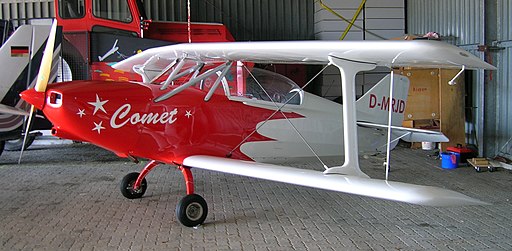
The B&F Fk12 Comet is a German-designed single-engine, two-seat ultralight biplane that stands out in the light aircraft sector for combining classic biplane aesthetics with modern engineering and materials. Conceived by Peter Funk in the mid-1990s and first flown in March 1997, the Fk12 has been offered both as a fully factory-built aircraft and as a kit for amateur construction. Its configuration adheres to the traditional tandem-seat biplane layout with equal-span wings and significant stagger, yet it incorporates advanced structural components and aerodynamic features that distinguish it from many other ultralight designs. The aircraft was produced in meaningful numbers through the early 2000s, with over eighty units recorded by the late 2000s, and it has found registrations not only in Europe but also under special light sport aircraft certificates in the United States.
Airframe and Structural Specifications
At the heart of the Fk12’s appeal is its thoughtfully engineered airframe. The fuselage is built around a combination of welded steel tubing at the forward section for strength and aluminum tubing aft for weight savings, all skinned with a mix of composite and glass-fiber laminate panels. The wings make extensive use of modern materials as well, featuring carbon fiber main spars and leading edges paired with aluminum secondary spars and fabric-covered rear sections. The biplane’s single-bay wing arrangement is supported by streamlined I-shaped interplane struts and braced with lift and drag wires, while the upper wing centre section is reinforced with inverted V-cabane struts. Full-span flaperons on both upper and lower wings provide responsive roll control and improved low-speed handling. A notable convenience feature is the folding wing mechanism that allows the aircraft to be reduced to a compact footprint for hangar storage or transport.
The tail assembly follows a conventional layout with trapezoidal vertical and horizontal surfaces, and the rudder’s deep profile caters to effective yaw control. The undercarriage is a fixed tailwheel design with spring cantilever main gear legs mounted to the lower longerons; wheels can be fitted with aerodynamic fairings. Across its structural elements, the Fk12 marries traditional biplane charm with a contemporary mix of composites, carbon fiber, and tubular metal construction.
Dimensions and Weight Characteristics
The Fk12’s physical dimensions reflect its compact ultralight categorization while providing adequate space for two occupants seated in tandem. The aircraft typically measures just over 5.5 meters in length, with a wingspan of approximately 6.7 meters and a height close to 2 meters. Wing area across both planes totals roughly 13.4 square meters, contributing to effective lift generation and low-speed performance. Empty weights for standard configurations are in the mid-200 kilogram range, depending on equipment and options, while maximum takeoff weights vary regionally due to ultralight regulatory limits, generally around 450 kilograms with allowances up to 520 kilograms where permissible. These specifications enable a respectable useful load for fuel, occupants, and modest baggage, and the structural design supports robust load factors suitable for spirited flying within the ultralight class.
Powerplant and Propulsion Systems
The Fk12 has been offered with a range of Rotax four-cylinder horizontally opposed engines, the most common being the 74 kW (99 hp) Rotax 912 ULS. Lower and higher power options include the base Rotax 912 UL of around 60 kW (80 hp) and the turbocharged Rotax 914 producing approximately 87 kW (113 hp). Various propeller choices have been available, from two-blade wooden designs to composite constant-speed units, depending on performance goals and customer preferences. Some experimental installations have explored larger engines such as Lycoming variants for enhanced aerobatic capability or higher power output. Fuel capacity in the standard configuration is about 58 liters, housed centrally in the fuselage, though some owners opt for supplementary wing tanks to extend range. The recommended fuel type for Rotax engines is automotive gasoline (MoGas) for regular use, with certain limitations and recommendations against prolonged use of aviation gasoline (AvGas) depending on engine.
Aerodynamic and Flight Performance
Despite its seemingly vintage appearance, the Fk12 exhibits performance parameters that are competitive within its class. Cruise speeds at roughly 75 % power typically approach 180 km/h, with maximum speeds near 200 km/h under optimal conditions. Stall speeds in clean configuration are low enough to facilitate manageable takeoffs and landings, while never-exceed speeds (V_NE) are placed well above cruise to provide adequate safety margins. The aircraft’s lift-to-drag characteristics deliver an efficient glide profile relative to its ultralight peers, and the rate of climb can exceed 7 m/s (approximately 1,380 ft/min) with appropriate engine selection. Structurally, the aircraft’s design load limits permit load factors in the +9/−3.5 g range at specified weights, underscoring its inherent structural strength when operated within limits. The combination of full-span flaperons, responsive controls, and balanced biplane aerodynamics yields agile handling that appeals to sport flying and recreational pilots alike.
Cockpit Configurations and Systems
The Fk12 cockpit configuration is noteworthy for its adaptability. Pilots and passengers are seated in tandem under a modular fairing system that can be rapidly converted between open and enclosed cockpit layouts. This flexibility allows for open-air flying in favorable weather or more protective enclosures in cooler conditions. The instrument suite in typical configurations includes basic flight instruments such as airspeed indicator, altimeter, compass, engine RPM, and temperature and pressure gauges, with more advanced avionics offered as options by individual builders or buyers of factory-built examples. Standard systems include mechanical elevator trim, hydraulic disc brakes, and streamlined rigging for flight control connections, ensuring both ease of operation and maintenance simplicity. With these features, the Fk12 continues to appeal to sport aviators seeking an engaging and versatile flying experience.
Operational Context and Legacy
Over the years since its introduction, the B&F Fk12 has carved out a niche as one of the few modern biplanes available in serial production, appealing to pilots who appreciate classic design with up-to-date materials and performance. Although production activity has fluctuated over time, the aircraft remains recognized in historical and regulatory records, including acceptance as a light sport aircraft in some jurisdictions. Owners value the aircraft for its combination of agility, aesthetics, and relatively straightforward maintenance, and examples continue to be active in private flying communities across Europe and beyond.
