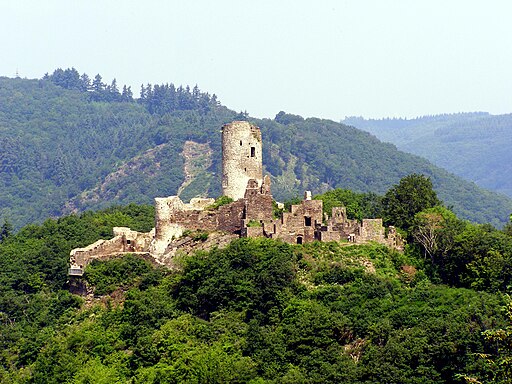
Winneburg rises above the Moselle region in western Germany, overlooking a landscape defined by river valleys, vineyards, and historic trade routes. Its elevated position was of decisive strategic value, allowing those who controlled the castle to monitor movement along the Moselle and the surrounding countryside. The choice of location reflects medieval priorities, where visibility and defensibility were essential for maintaining authority. From its heights, Winneburg dominated not only the physical landscape but also the political and economic life of the region, serving as a clear symbol of power in an area shaped by commerce and territorial rivalry.
Origins and Medieval Development
The origins of Winneburg date back to the High Middle Ages, when castles were established as fortified seats of noble families tasked with securing territories and enforcing feudal rights. Initially constructed as a strong defensive structure, the castle was designed to withstand sieges and provide refuge in times of conflict. Thick walls, controlled access points, and compact building arrangements reflected the constant threat of regional warfare. Over time, as the castle’s role became firmly established, Winneburg expanded in both scale and complexity, adapting to the changing needs of its occupants while remaining a central instrument of regional control.
Architectural Structure and Defensive Design
Architecturally, Winneburg exemplifies the functional clarity of medieval military construction. Its layout was shaped by the terrain, with fortifications integrated into the natural rock formations of the hill. Towers, curtain walls, and inner courtyards were arranged to maximize defense while maintaining a workable residential environment. Although later modifications introduced more comfortable living spaces, the castle never lost its fundamentally martial character. The enduring prominence of defensive features underscores the persistent instability of the region during much of the castle’s active life and highlights the importance of military preparedness in medieval noble residences.
Decline, Destruction, and Ruin
Winneburg’s decline was closely tied to broader political changes and the diminishing military relevance of hilltop castles. During periods of intensified conflict, particularly in the early modern era, the castle suffered damage and eventual destruction. Once its strategic value was lost, reconstruction was deemed unnecessary, and the site gradually fell into ruin. This process of abandonment transformed Winneburg from a symbol of authority into a historical relic. The remaining walls and structures convey a powerful sense of the past, illustrating how once-dominant fortresses could quickly lose their purpose in the face of changing warfare and political organization.
Cultural Legacy and Present-Day Significance
Today, Winneburg stands as a striking ruin that continues to shape the cultural identity of the Moselle region. Rather than being viewed solely as a remnant of destruction, the castle is valued as a historical monument that offers insight into medieval life, architecture, and regional power structures. Its preservation as a ruin allows visitors to engage directly with the past, experiencing the scale and atmosphere of a medieval stronghold. Winneburg’s enduring presence in the landscape serves as a reminder of the transitory nature of political power and the lasting impact of history on place and memory.
