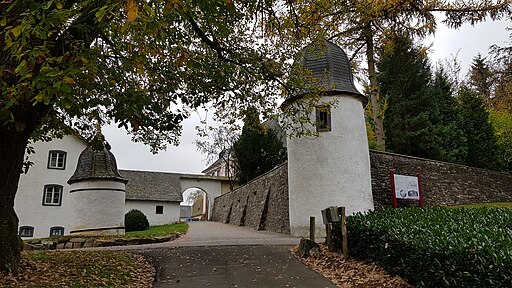
Schloss Wallerode is located in the eastern part of Belgium, within a region shaped by shifting borders, linguistic diversity, and centuries of political change. The surrounding landscape, marked by open fields and gently rising terrain, reflects the agricultural foundation upon which many noble estates in this area were built. The castle’s position within this environment was strategically chosen to oversee land and local routes while also providing a dignified residential setting. Its presence contributed to the historical identity of the surrounding settlement, reinforcing the role of noble residences as focal points of authority and continuity in a region frequently influenced by larger European conflicts.
Foundations and Early History
The origins of Schloss Wallerode reach back to the medieval period, when fortified residences were established to secure landholdings and assert noble power. Early structures on the site were likely functional in nature, combining defensive elements with basic residential spaces. Over time, as feudal tensions eased and the political landscape evolved, the castle underwent a gradual transformation. Defensive requirements diminished, allowing the residence to expand and become more comfortable and representative. This development reflects a broader historical pattern in which castles shifted from military strongholds to symbols of status and governance, adapting to changing social and political realities.
Architectural Evolution and Style
Architecturally, Schloss Wallerode embodies a layered development shaped by multiple building phases. Medieval foundations and compact forms were gradually enhanced with later additions that emphasized symmetry, larger openings, and refined proportions. The castle’s architectural language illustrates the transition from a fortified structure to a stately residence designed for comfort and display. Each phase of construction responded to contemporary tastes and technological advances, resulting in a building that cannot be confined to a single stylistic category. Instead, Schloss Wallerode presents a coherent yet complex architectural narrative, where historical continuity is visible in the careful integration of old and new elements.
Role in Local Society and Economy
Schloss Wallerode played an essential role in the social and economic life of its surrounding area. As the center of an estate, it functioned as an administrative hub where agricultural management, legal authority, and local governance converged. The castle’s owners exercised significant influence over daily life, shaping land use and maintaining social order. At the same time, the estate provided employment and stability for the local population, creating a reciprocal relationship between the castle and its community. This interaction illustrates the broader function of noble residences in rural Europe, where estates were both centers of power and integral components of local economic networks.
Modern Significance and Preservation
In the modern period, Schloss Wallerode has faced the challenges common to many historic estates, including changing ownership structures and the need for ongoing maintenance. Despite these pressures, the castle remains an important cultural landmark. Preservation efforts have sought to protect its architectural character while acknowledging the realities of contemporary use. Today, Schloss Wallerode stands as a testament to the region’s complex history, offering insight into the evolution of noble life, architecture, and land management. Its continued existence highlights the value of conserving historic structures, as they provide tangible links to the past and enrich the cultural landscape for future generations.
.jpg)