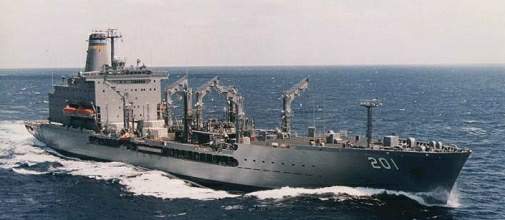
USNS Patuxent (T-AO-201) is a fleet replenishment oiler of the Kaiser-class, operated by the United States Navy under Military Sealift Command. The class was developed during the late Cold War period to provide a highly capable, globally deployable logistics platform able to sustain naval task forces at sea for extended periods. Patuxent’s primary mission is underway replenishment, delivering fuel to aircraft carriers, cruisers, destroyers, and auxiliary vessels without requiring them to return to port. As a non-combatant auxiliary ship, its operational value lies in endurance, cargo capacity, and reliability rather than speed or firepower, making it a critical enabler of sustained naval operations across all theaters.
Hull Design and Principal Dimensions
USNS Patuxent is built with a steel monohull optimized for heavy liquid cargo carriage and stability during replenishment operations. The hull form emphasizes predictable handling and structural strength, allowing the ship to safely conduct connected replenishment alongside combatants in open ocean conditions. The vessel has an overall length of approximately 206 meters, a beam of about 29.7 meters, and a full-load draft approaching 11 meters. Full-load displacement is in the range of 41,000 to 42,000 tons, reflecting the substantial volume of fuel carried. Internal tank arrangements are subdivided to improve damage control, cargo segregation, and trim management as fuel is transferred at sea.
Propulsion System and Performance Characteristics
The propulsion plant of USNS Patuxent consists of two steam turbines driving a single shaft, powered by oil-fired boilers designed for long-duration, steady-state operation. Total output is approximately 24,500 shaft horsepower, providing a maximum speed of around 20 knots, which is sufficient to operate with carrier strike groups during transit and replenishment evolutions. The propulsion system prioritizes reliability and endurance over rapid acceleration, with fuel efficiency optimized for sustained cruising speeds. Electrical power is generated by multiple ship service turbine generators, ensuring redundancy for cargo handling systems, navigation equipment, and hotel services during high-demand replenishment operations.
Fuel Cargo Capacity and Transfer Systems
The defining technical feature of USNS Patuxent is its fuel cargo capacity and transfer capability. The ship can carry approximately 180,000 barrels of petroleum products, including marine diesel fuel, aviation fuel, and other specialized naval fuels. Cargo is distributed among multiple segregated tanks, allowing simultaneous carriage of different fuel types without cross-contamination. The replenishment system includes multiple fueling stations on both port and starboard sides, enabling the ship to refuel two vessels at once while also supporting astern refueling operations. High-capacity pumps and stabilized hoses allow rapid fuel transfer rates, minimizing the time required for connected replenishment and reducing operational risk during alongside maneuvers.
Dry Cargo and Aviation Support Capabilities
In addition to liquid fuel, USNS Patuxent is capable of carrying limited quantities of dry cargo, including packaged supplies, spare parts, and provisions, supporting more comprehensive logistics missions. The ship is equipped with cargo handling gear such as cranes and transfer rigs to move palletized goods during replenishment at sea. A flight deck and hangar facilities support the operation of a single helicopter, typically used for vertical replenishment, personnel transfer, and medical evacuation. The aviation capability enhances flexibility by allowing resupply operations when sea conditions or tactical considerations limit alongside transfers.
Command, Control, and Crew Composition
USNS Patuxent is operated by a civilian mariner crew under Military Sealift Command, typically numbering around 80 to 90 personnel, with an embarked Navy detachment responsible for communications, aviation operations, and mission coordination. The bridge and cargo control spaces are designed to manage complex replenishment evolutions, integrating navigation, propulsion control, and fuel transfer monitoring. Habitability standards are consistent with long-duration deployments, providing adequate berthing, messing, and support facilities for extended operations far from home ports. Communications systems allow coordination with fleet units and shore commands, ensuring precise timing and execution of logistics tasks.
Survivability and Operational Limitations
As a non-combatant auxiliary vessel, USNS Patuxent is lightly protected and not intended to operate independently in high-threat environments. It carries no offensive weapon systems and relies on fleet escorts and operational planning for protection in contested areas. Survivability features focus on redundancy, fire suppression, and damage control rather than armor or combat resilience. The large fuel cargo requires rigorous safety protocols, including inert gas systems, monitoring sensors, and strict procedural controls during transfer operations. These measures reduce the risk of fire or explosion while maintaining a high tempo of replenishment activity.
Strategic Importance and Service Value
USNS Patuxent (T-AO-201) plays a vital strategic role by enabling U.S. naval forces to remain forward-deployed and operational for extended periods without reliance on shore-based fuel infrastructure. The ability to refuel combatants at sea directly supports power projection, deterrence, and global maritime presence. While often operating out of public view, Patuxent’s technical capabilities and endurance make it an indispensable component of naval logistics architecture. Its continued service underscores the enduring importance of replenishment oilers as force multipliers that sustain the operational reach and effectiveness of modern naval fleets.
