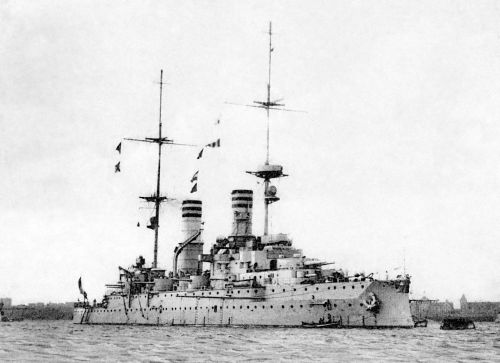
SMS Kaiser Barbarossa: The German Pre-Dreadnought Named for an Emperor
SMS Kaiser Barbarossa was a German pre-dreadnought battleship of the Kaiser Friedrich III class and the final ship of that five-vessel group to be constructed. Named after Frederick I, Holy Roman Emperor—better known as Frederick Barbarossa—the battleship embodied the mixture of historical symbolism, industrial ambition, and naval expansion that characterized Imperial Germany at the end of the nineteenth century. Built by Schichau-Werke at Danzig, she was laid down in 1898, launched on 21 April 1900, and commissioned on 10 June 1901. Her arrival completed a class that introduced several features that would influence subsequent German battleship designs, most notably three propeller shafts and a heavy secondary battery supporting a comparatively modest main armament.
When Kaiser Barbarossa entered service, she was a formidable capital ship. At roughly 125.3 meters long and more than 11,000 tonnes in displacement, she combined heavy armor with four 24 cm guns in two twin turrets, eighteen 15 cm secondary guns, twelve 8.8 cm quick-firing weapons, machine cannon, and six 45 cm torpedo tubes. Three triple-expansion engines gave her a designed output of about 13,000 horsepower and a top speed of approximately 17.5 knots. Her main armor belt could reach 300 mm, while her turrets and forward conning tower received protection up to about 250 mm.
Yet Kaiser Barbarossa also belonged to a generation of warships whose period of technological superiority was exceptionally brief. She was designed before the turn of the century and entered service in 1901, but the arrival of new German pre-dreadnoughts and, above all, the British HMS Dreadnought in 1906 quickly transformed the standards by which battleships were judged. During the First World War she was briefly returned to active service, but her role was largely defensive and secondary. After being withdrawn from frontline duties in 1915, she became a prison ship at Wilhelmshaven. She survived the war only to be struck from the naval register in 1919 and broken up in 1920.
The Kaiser Friedrich III Class
A New German Battleship Philosophy
The five ships of the Kaiser Friedrich III class represented a major step in the standardization of German battleship design. Earlier German capital ships, particularly the Brandenburg class, had experimented with unusual arrangements and carried six 28 cm guns. The Kaiser Friedrich III class adopted a more conventional layout with four heavy guns arranged in two twin turrets, one forward and one aft. The main battery was smaller in number and caliber than that of the Brandenburgs, but German designers compensated by giving the new ships an exceptionally powerful secondary battery of eighteen 15 cm guns.
This arrangement reflected contemporary thinking about how a battleship engagement might develop. Naval planners were still uncertain about the ideal balance between heavy guns and rapid-firing artillery. The expectation was that battleships might engage at relatively short distances, where a large number of medium-caliber shells could damage an opponent’s superstructure, gun positions, communications equipment, and exposed crew while the heavy guns attacked the main armored areas. The Kaiser Friedrich III class therefore represented a distinctly pre-dreadnought interpretation of the battleship: a heavily protected platform combining a small number of large guns with an enormous volume of medium-caliber fire.
The class was also important mechanically. These were the first German battleships to use three propeller shafts, a feature that would become characteristic of later German capital ships. Their designers also concentrated on seaworthiness, and contemporary assessments regarded them as good sea boats that did not take excessive amounts of water in heavy conditions. In this respect, Kaiser Barbarossa was not merely a weapons platform but part of an attempt to create a reliable ocean-going battle fleet.
The Meaning Behind the Name
The name Kaiser Barbarossa carried considerable historical weight. Frederick I, Holy Roman Emperor, had ruled in the twelfth century and became famous as “Barbarossa,” or “Red Beard.” In the German Empire of the nineteenth century, Frederick Barbarossa had become an important historical and cultural figure, associated with imperial authority and the medieval German past.
Naming a modern battleship after such a figure was therefore more than a simple choice of identification. The Imperial German Navy frequently connected its ships with the history and prestige of the German states, monarchs, and imperial tradition. Kaiser Barbarossa became a steel representation of that historical symbolism, linking the industrial and military ambitions of the newly unified German Empire with a ruler who had occupied the imperial throne centuries earlier.
The choice was particularly appropriate during a period when Germany was seeking a more prominent international role. A battleship was one of the most visible demonstrations of industrial power available to a modern state. The vessel required enormous quantities of steel, complex machinery, advanced armor production, precision artillery, and a highly trained crew. Kaiser Barbarossa thus represented both historical memory and modern technological capability.
Construction of SMS Kaiser Barbarossa
Built at Schichau-Werke
Kaiser Barbarossa was constructed by Schichau-Werke at Danzig, one of the major shipbuilding centers of the German Empire. Her keel was laid in 1898 under the 1897 naval construction program, and the completed hull was launched on 21 April 1900. She entered commissioned service on 10 June 1901. Her construction cost was reported at approximately 20.3 million marks, a considerable investment that reflected the enormous resources required to build a modern battleship.
The ship measured 125.3 meters overall and had a beam of 20.4 meters. Her draft was approximately 7.89 meters forward and 8.25 meters aft. Depending on the loading condition and source, her displacement was approximately 11,100 tonnes in normal condition and up to around 11,785 tonnes at full load. She carried a crew of roughly 650–690 officers and sailors, with figures varying according to period and source.
Her hull was broad in proportion to its length, providing the stability required to carry a substantial armored battery. The design was not intended to produce a fast cruiser-like capital ship. Instead, the emphasis was on maintaining a stable firing platform, carrying enough armor to survive heavy shellfire, and remaining seaworthy during extended fleet operations.
Triple-Expansion Power
The propulsion system consisted of three vertical three-cylinder triple-expansion steam engines, each driving its own propeller shaft. Steam was produced by a combination of four Thornycroft-type boilers and eight cylindrical boilers, all fired by coal. The machinery was rated at approximately 13,000 horsepower and was designed to propel the ship at about 17.5 knots. Trials demonstrated that she could reach around 18 knots under favorable conditions.
The three-shaft arrangement was a notable feature of the class. Redundancy was valuable in a battleship because damage to one machinery unit did not necessarily mean complete loss of propulsion. More importantly, the arrangement represented an evolutionary step in German capital-ship engineering. Later German battleships would continue to use multiple shafts, although the triple-expansion engines themselves would eventually give way to more advanced turbine machinery.
Her coal supply allowed a cruising range of approximately 3,420 nautical miles at 10 knots. This was sufficient for the North Sea and Baltic operations for which the German fleet was principally preparing, while also giving the ship reasonable endurance for training cruises and movements between German naval bases.
Armament of the German Pre-Dreadnought
Four 24 cm Main Guns
The main battery of Kaiser Barbarossa consisted of four 24 cm SK L/40 guns mounted in two twin turrets. One turret was positioned forward and the other aft of the central superstructure, creating a conventional centerline arrangement that allowed both turrets to fire effectively on either broadside.
The 24 cm guns were smaller than the 28 cm weapons carried by the preceding Brandenburg class, but they were intended to provide a useful balance between shell weight and rate of fire. German naval designers believed that rapid heavy-gun fire could be highly effective, especially when combined with the immense secondary battery.
This philosophy made sense within the tactical assumptions of the 1890s. Naval battles were expected to occur at comparatively short distances, and commanders believed that repeated hits from medium-caliber weapons could rapidly destroy the fighting efficiency of an opposing ship. The Kaiser Barbarossa design therefore did not treat the main battery as the only source of offensive power.
Eighteen 15 cm Guns
The secondary battery was arguably the defining characteristic of Kaiser Barbarossa. She carried eighteen 15 cm SK L/40 guns, distributed among protected positions in the hull and superstructure. This was an unusually large secondary battery and provided an enormous amount of rapid-firing artillery.
Twelve 8.8 cm SK L/30 quick-firing guns were intended primarily for defense against torpedo boats. Twelve small machine cannon added another layer of close-range protection, while six 45 cm torpedo tubes gave the battleship the ability to launch torpedo attacks against enemy capital ships at short range.
The resulting weapons suite reflected the complicated tactical environment of the pre-dreadnought era. A battleship had to fight enemy battleships, defend itself from cruisers, and protect against increasingly dangerous torpedo boats. There was no single weapon capable of dealing with all these threats, so designers provided several layers of artillery.
From a later perspective, this arrangement would appear excessively complicated. The dreadnought concept would eventually concentrate battleship firepower in a much larger number of heavy guns while retaining a more standardized secondary battery. But when Kaiser Barbarossa was designed, the large collection of different weapons represented a serious attempt to make one ship capable of handling a wide variety of tactical situations.
Armor and Survivability
Protection for the Battle Line
Armor was central to Kaiser Barbarossa‘s design. Her main belt reached approximately 300 mm in thickness, while the armored deck was about 65 mm thick. The main gun turrets were protected by armor up to approximately 250 mm, as was the forward conning tower. The secondary battery casemates received around 150 mm of protection.
The thick central belt protected the machinery spaces and other vital portions of the ship. The philosophy was straightforward: a battleship operating in the line had to remain afloat and capable of fighting after absorbing enemy fire. Protection of the ammunition supply, engines, command positions, and main artillery was therefore given priority.
The heavy conning tower armor was equally important. Before the widespread use of sophisticated remote fire-control systems, commanders and navigating officers depended on positions that were physically located within the ship’s superstructure. Protecting those spaces helped preserve command capability during a battle.
The armor also contributed significantly to displacement. A battleship could not simply be made immune to enemy fire. Every additional layer of protection added weight, which affected draft, speed, machinery requirements, and fuel consumption. Kaiser Barbarossa represented one solution to this balancing problem: relatively moderate speed combined with substantial armor and a heavy artillery battery.
Career With the Imperial German Navy
Peacetime Training
After entering service in 1901, Kaiser Barbarossa joined the German fleet and participated in the exercises and training routines that dominated the peacetime careers of Imperial German battleships. The fleet’s ships regularly practiced maneuvering, gunnery, signaling, formation work, navigation, and coordinated operations.
These exercises were particularly important because Germany was still developing the institutional knowledge required to operate a large battle fleet. A battleship could possess excellent guns and armor, but its combat effectiveness ultimately depended on the ability of hundreds of sailors and officers to work together. Fleet maneuvers allowed commanders to test tactics while crews developed the skills needed to maintain a battleship under demanding conditions.
The broader political context was also significant. The Imperial Navy was expanding rapidly under Admiral Alfred von Tirpitz, especially after the Naval Law of 1898. Kaiser Barbarossa belonged to the generation of ships that helped establish the infrastructure, doctrine, and experience from which the later High Seas Fleet emerged.
The Limits of the Pre-Dreadnought
By the first decade of the twentieth century, however, Kaiser Barbarossa was already being overtaken by newer German battleships. The Kaiser Friedrich III class had been designed in the 1890s, and naval technology was changing with extraordinary speed.
The most dramatic development was the arrival of HMS Dreadnought in 1906. Her all-big-gun armament and turbine propulsion effectively created a new standard for battleship construction. Older pre-dreadnoughts did not become physically weaker overnight, but their relative combat value fell sharply because they could no longer match the range and concentrated heavy-gun fire of the new generation.
Germany responded by constructing its own dreadnoughts, while ships such as Kaiser Barbarossa increasingly moved toward reserve and training roles. The transformation demonstrated one of the defining characteristics of naval history in this period: a battleship could require years to design and build, yet be overtaken by technological developments only a few years after commissioning.
The First World War
Return to Active Service
When war broke out in August 1914, Kaiser Barbarossa was reactivated along with her sister ships. The class formed the V Battle Squadron of the High Seas Fleet, but its role was primarily defensive rather than offensive. The ships were assigned to security duties in German coastal waters, where their armor and artillery could still provide useful protection.
Their presence reflected a practical calculation. Germany possessed a number of old pre-dreadnoughts that were still expensive and potentially useful, but placing them against modern enemy capital ships would have been unnecessarily dangerous. The older vessels could instead defend naval bases, coastal waters, and important approaches while the newest dreadnoughts and battlecruisers formed the principal striking force.
Kaiser Barbarossa therefore spent the war performing duties that were far removed from the dramatic battleship engagements for which the Imperial German Navy is best remembered.
Withdrawal in 1915
The V Battle Squadron was withdrawn from frontline service in February 1915 as newer ships became available and the limitations of the old pre-dreadnoughts became increasingly obvious. The ships were no longer worth maintaining as fully active battle-line units.
This did not make Kaiser Barbarossa useless. Large battleships were valuable sources of accommodation, training space, workshops, and engineering equipment. Instead of risking the ship in combat, the German Navy could obtain more practical value by using her as a stationary naval asset.
Kaiser Barbarossa and her sister Kaiser Karl der Grosse were eventually used as prison ships at Wilhelmshaven. Their large hulls and internal spaces made them suitable for this purpose. It was a remarkable transformation for a ship that had originally been designed to fight in the battle line.
The Final Years
From Battleship to Prison Ship
The conversion to prison accommodation reflected the final stage in Kaiser Barbarossa‘s operational life. Her original purpose had been to serve as a heavily armed capital ship, but by the later years of the war her greatest value lay in her size and infrastructure rather than her weapons.
The fate of the ship also reflected the wider decline of the pre-dreadnought battleship. All five Kaiser Friedrich III-class vessels had been important fleet units during the early years of the twentieth century. By the First World War, however, they had been displaced by dreadnoughts and battlecruisers.
After Germany’s defeat, there was little possibility that an obsolete battleship such as Kaiser Barbarossa would return to active service. She was struck from the naval register in 1919 and sold for demolition. In 1920 she was broken up at Rüstringen, ending a career that had lasted less than two decades.
Historical Importance of SMS Kaiser Barbarossa
A Bridge Between Two Naval Eras
The greatest significance of Kaiser Barbarossa lies in her position between two eras of battleship development. She was a sophisticated example of the pre-dreadnought concept, yet her service life overlapped with the arrival of the radically different dreadnought.
Her three-shaft propulsion system, four-gun main battery, eighteen-gun secondary battery, and heavy armor represented the dominant assumptions of German naval design at the end of the nineteenth century. These features would soon be replaced or transformed as larger guns, better fire control, turbines, and improved armor arrangements became standard.
The ship is therefore useful for understanding why the dreadnought revolution was so important. The change was not simply about building a bigger battleship. It altered the relative value of an entire generation of existing ships.
A Symbol of Imperial Germany
Kaiser Barbarossa also carried an unmistakable political and cultural message. Her name connected the modern German Empire to the medieval Holy Roman Emperor Frederick Barbarossa, while her construction demonstrated the industrial capabilities of the late nineteenth-century German state.
The ship’s career followed the broader rise of the Imperial Navy. She was created during a period of naval expansion, trained alongside the vessels of the growing fleet, and eventually became part of the High Seas Fleet during the First World War. Her decline mirrored the decline of the naval assumptions under which she had been designed.
In that sense, Kaiser Barbarossa was more than a warship. She was a product of the political ambitions, industrial resources, technological experimentation, and historical imagination of Imperial Germany.
Technical Specifications of SMS Kaiser Barbarossa
The following figures describe Kaiser Barbarossa primarily in her original configuration. Published figures can vary slightly depending on whether normal or full-load displacement is being used and whether the ship’s original or later wartime configuration is being described.
| Specification | SMS Kaiser Barbarossa |
|---|---|
| Class | Kaiser Friedrich III class |
| Type | Pre-dreadnought battleship |
| Builder | Schichau-Werke, Danzig |
| Laid down | 1898 |
| Launched | 21 April 1900 |
| Commissioned | 10 June 1901 |
| Length overall | 125.3 m |
| Beam | 20.4 m |
| Draft | Approx. 7.89 m forward / 8.25 m aft |
| Normal displacement | Approx. 11,100 tonnes |
| Full-load displacement | Approx. 11,785 tonnes |
| Propulsion | 3 vertical triple-expansion steam engines |
| Shafts | 3 |
| Boilers | 4 Thornycroft + 8 cylindrical boilers |
| Power | Approx. 13,000 PS |
| Maximum speed | Approx. 17.5–18 knots |
| Range | Approx. 3,420 nautical miles at 10 knots |
| Crew | Approx. 622–687 |
| Main armament | 4 × 24 cm SK L/40 guns |
| Main-gun arrangement | 2 × twin turrets |
| Secondary armament | 18 × 15 cm SK L/40 guns |
| Anti-torpedo-boat armament | 12 × 8.8 cm SK L/30 guns |
| Small-caliber weapons | 12 × machine cannon |
| Torpedo armament | 6 × 45 cm torpedo tubes |
| Main belt armor | Up to 300 mm |
| Armored deck | Approx. 65 mm |
| Main turret armor | Up to 250 mm |
| Conning tower armor | Up to 250 mm |
| Secondary casemate armor | Approx. 150 mm |
| First World War role | Coastal and security duties |
| Later role | Prison ship |
| Struck from naval register | 1919 |
| Final fate | Scrapped at Rüstringen in 1920 |
Conclusion
SMS Kaiser Barbarossa was one of the last representatives of an important stage in the evolution of the German battleship. Designed in the 1890s and commissioned in 1901, she combined heavy armor, four 24 cm main guns, eighteen 15 cm secondary weapons, three-shaft propulsion, and a respectable speed into a powerful pre-dreadnought package. Her design reflected the belief that a battleship’s effectiveness depended not solely on the size of its largest guns, but on the combination of armor, rapid-firing artillery, speed, and seaworthiness.
Her career also reveals how quickly those assumptions were overturned. The arrival of the dreadnought transformed the naval balance and made the Kaiser Friedrich III class increasingly obsolete. Kaiser Barbarossa was still capable of useful defensive work during the First World War, but she was never again the modern capital ship envisioned by her designers. Instead, she moved from fleet service to coastal defense and finally to the very different role of prison ship.
Her ultimate fate in 1920 was shared by many pre-dreadnought battleships across Europe. They had been extraordinarily expensive and technically sophisticated when built, but their usefulness was shortened by one of the fastest periods of innovation in naval history. Kaiser Barbarossa consequently stands as an excellent example of both the ambition and the vulnerability of pre-dreadnought battleship design.
The ship’s historical importance therefore extends beyond her individual service record. She represented the industrial strength of Imperial Germany, the naval expansion of the Kaiser era, and a distinctive German interpretation of battleship warfare. At the same time, her rapid decline demonstrated that even heavily armored and powerfully armed capital ships could become obsolete almost overnight. Named for one of the most famous emperors of medieval Europe, Kaiser Barbarossa ultimately became a symbol of another empire’s technological transition—from the traditional pre-dreadnought battle fleet toward the modern dreadnought age.