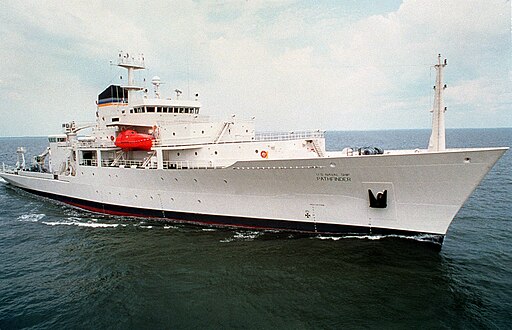
USNS Pathfinder (T-AGS 60) is the lead ship of the Pathfinder-class oceanographic survey vessels operated by the United States Navy through Military Sealift Command. The class was developed to replace older survey ships and to provide a modern, highly capable platform dedicated to hydrographic, geophysical, and oceanographic data collection. Pathfinder’s primary mission is to support naval operations by mapping the seafloor, analyzing oceanographic conditions, and gathering data essential for submarine navigation, mine warfare planning, undersea cable routing, and amphibious operations. Unlike combatants, Pathfinder is a specialized auxiliary vessel whose value lies in precision, endurance, and scientific capability rather than speed or armament. It operates globally, often independently, in both coastal and deep-ocean environments.
Hull Design and General Dimensions
USNS Pathfinder is built with a steel monohull optimized for stability, low acoustic interference, and sustained operations at sea. The hull form emphasizes predictable motion characteristics, which are critical for accurate survey work and the deployment of sensitive sensors. The ship has an overall length of approximately 100 meters, a beam of about 17 meters, and a draft of roughly 6 meters, allowing it to operate effectively in open ocean while still accessing many coastal areas. Full-load displacement is in the range of 4,600 to 5,000 tons, providing the mass and stability required to support heavy survey equipment, winches, and sensor arrays. Hull design also incorporates features to reduce self-noise, which is essential for high-quality acoustic data collection.
Propulsion Plant and Performance Characteristics
The propulsion system of USNS Pathfinder is configured for endurance and precision rather than high speed. The ship is powered by diesel engines driving a single controllable-pitch propeller, supplemented by bow and stern thrusters that provide excellent low-speed maneuverability and dynamic positioning capability. Maximum speed is approximately 16 knots, while economical cruising speeds are significantly lower to optimize fuel efficiency and minimize acoustic disturbance during survey operations. The propulsion and auxiliary systems are engineered to support extended deployments, with an operational endurance measured in weeks rather than days. Dynamic positioning allows Pathfinder to maintain a fixed position or follow extremely precise track lines, which is critical for high-resolution mapping and sensor deployment.
Survey Systems and Scientific Capabilities
The defining feature of USNS Pathfinder is its extensive suite of oceanographic and hydrographic survey systems. The ship is equipped with advanced multibeam and single-beam echo sounders capable of producing detailed bathymetric maps of the seafloor across a wide range of depths. Side-scan sonar systems are used to detect and classify objects on or near the seabed, while sub-bottom profilers allow analysis of sediment layers beneath the seafloor surface. Pathfinder also supports the deployment of towed sonar arrays, remotely operated vehicles, and autonomous underwater vehicles, expanding its data collection capability beyond hull-mounted sensors. Onboard laboratories and data processing spaces enable real-time analysis and preliminary interpretation of collected data, reducing turnaround time for operational use.
Deck Equipment and Over-the-Side Operations
USNS Pathfinder is designed to support complex over-the-side operations required for oceanographic research and naval survey missions. The ship is fitted with multiple heavy-duty cranes, A-frames, and winches capable of handling large sensor packages, towed bodies, and deep-water instrumentation. Specialized handling systems allow the safe launch and recovery of equipment in varying sea states, while reinforced working decks provide ample space for containerized mission modules and support equipment. The stern working area is particularly important for towing operations, with fairleads and cable management systems engineered to minimize vibration and mechanical stress on long sonar arrays and umbilicals.
Command, Control, and Crew Facilities
The ship is operated by a civilian mariner crew under Military Sealift Command, typically numbering around 40 personnel, with additional accommodations for embarked Navy hydrographic teams, scientists, and technical specialists. Total embarked complement can exceed 60 personnel depending on mission requirements. The bridge and operations spaces are designed to integrate navigation, propulsion control, and survey system management, allowing close coordination between ship handlers and scientific operators. Habitability standards are relatively high compared to older survey ships, supporting long-duration missions with improved berthing, mess, and recreation facilities. Secure communications systems enable Pathfinder to transmit collected data to shore-based commands and research centers for further analysis.
Survivability, Limitations, and Operational Profile
As a non-combatant auxiliary vessel, USNS Pathfinder is not designed for operations in high-threat environments. It carries no offensive weapon systems and relies on situational awareness, operational planning, and, when necessary, naval escorts for protection. Structural survivability and damage control systems are designed to commercial standards with naval enhancements, prioritizing safety and redundancy rather than combat resilience. Operationally, the ship excels in low- to moderate-threat regions where sustained, precise data collection is required. Weather and sea state can influence survey quality, but the hull and stabilization characteristics allow Pathfinder to operate effectively in a wide range of conditions compared to smaller research vessels.
Strategic Importance and Long-Term Utility
USNS Pathfinder (T-AGS 60) plays a critical role in enabling undersea dominance and maritime awareness for the United States Navy. Accurate knowledge of the ocean environment directly supports submarine operations, mine countermeasures, and the safe navigation of naval and commercial vessels. The data collected by Pathfinder also has long-term strategic value, contributing to nautical charting, environmental understanding, and future operational planning. While its mission is largely invisible compared to front-line combatants, the technical capabilities and endurance of Pathfinder make it an indispensable asset within the naval auxiliary fleet, providing foundational knowledge that underpins modern naval operations across the globe.
_underway_in_the_Gulf_Of_Mexico_on_19_September_1994_(6490546).jpg)