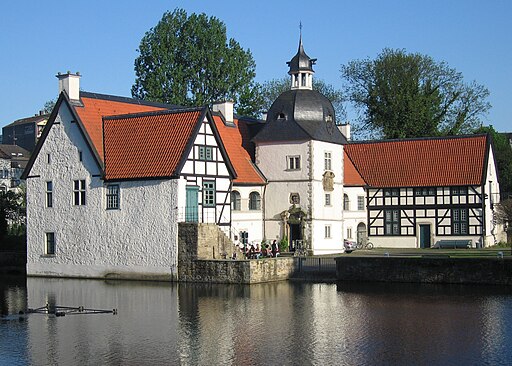
Wasserschloss Haus Rodenberg is situated in the western part of North Rhine-Westphalia, near the town of Alsdorf, in a landscape historically shaped by agriculture, small waterways, and regional trade routes. The castle occupies a low-lying site that made ideal use of surrounding watercourses, which were redirected to form a broad moat encircling the complex. This setting reflects the typical characteristics of a Rhineland water castle, where natural terrain and hydrology were as important for defense as stone walls. The surrounding land supported farming and settlement, ensuring that the castle functioned not only as a defensive structure but also as the center of a productive estate.
Medieval Origins and Early Development
The origins of Haus Rodenberg date back to the Middle Ages, when fortified manor houses became common among the regional nobility. Early structures on the site were likely modest in scale, built to secure land ownership and protect agricultural resources rather than to withstand prolonged military sieges. Over time, as the importance of the estate increased, the buildings were expanded and reinforced with stone, and the moat system was further developed. These changes marked the transformation of Haus Rodenberg into a recognizable water castle, reflecting both growing wealth and the need for greater security during a period of frequent regional conflict.
Architectural Structure and Water Defenses
Architecturally, Wasserschloss Haus Rodenberg was defined by its compact layout and strong emphasis on water-based defenses. The main residential buildings were arranged around an inner courtyard, enclosed by thick masonry walls that provided protection while maintaining a practical living environment. The moat served as the primary defensive element, creating a physical barrier that limited access and enhanced the sense of seclusion and authority. Bridges and controlled entry points regulated movement into the castle, reinforcing its role as a secure noble residence. The overall design favored durability and functionality, with limited exterior ornamentation and a clear focus on defensive efficiency.
Noble Ownership and Estate Administration
For centuries, Haus Rodenberg was associated with noble families who used it as a residence and administrative center for their lands. The castle functioned as the heart of estate management, overseeing agricultural production, collecting rents, and exercising local jurisdiction. Its owners played an important role in regional networks of power, often maintaining ties to neighboring noble houses and ecclesiastical institutions. The daily life of the castle was shaped by this administrative role, with servants, farmers, and officials regularly passing through its gates, making it a focal point of social and economic activity in the surrounding countryside.
Transformation in the Early Modern Period
As military technology and political structures evolved, the defensive importance of water castles like Haus Rodenberg gradually declined. During the early modern period, the castle underwent changes that reflected new priorities centered on comfort and representation. Interior spaces were adapted to suit contemporary living standards, and some defensive features lost their original function. While the moat and walls remained defining elements of the complex, their role became increasingly symbolic, emphasizing tradition and status rather than active defense. These adaptations allowed the castle to remain relevant as a noble residence in a changing world.
Decline and Loss of the Original Structure
In later centuries, economic shifts and changing patterns of land ownership led to the decline of Wasserschloss Haus Rodenberg. Maintaining such a complex structure became increasingly difficult, and parts of the castle fell into disrepair. Over time, much of the original building fabric was lost, either through neglect, deliberate dismantling, or redevelopment of the site. What remained was the outline of the former castle, preserved in the landscape through remnants of the moat and foundations that hint at its former scale and importance.
Modern Use and Cultural Memory
Today, the site of Haus Rodenberg is valued as a historical and cultural landmark rather than as a complete architectural monument. The preserved earthworks and water features provide insight into the structure and function of medieval water castles in the Rhineland. Local efforts to commemorate and interpret the site have helped keep its history alive, integrating it into the cultural memory of the region. Although the original buildings no longer dominate the landscape, Wasserschloss Haus Rodenberg continues to represent the historical relationship between nobility, land, and water, offering a tangible connection to the medieval past of North Rhine-Westphalia.
