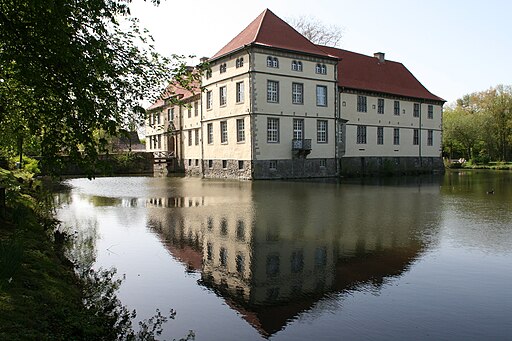
Schloss Strünkede originated as a medieval water castle whose primary purpose was to secure territory and assert control over surrounding lands in the Emscher region. Its early development was shaped by the political fragmentation of the area, where small noble houses competed for influence and resources. The presence of water defenses was not only a practical response to military threats but also a visual statement of authority. Over time, the castle became firmly embedded in regional power structures, serving as a residence, administrative center, and symbol of continuity for its ruling families.
Architectural Transformation Through the Centuries
The architectural form of Schloss Strünkede reflects a gradual transition from fortress to noble residence. While the original defensive layout remained legible in the moat and compact massing, later renovations introduced elements aimed at comfort and representation. Larger windows, more regular facades, and refined interior spaces altered the character of the building without erasing its medieval core. These changes reveal how architecture adapted to evolving social expectations, as noble status became increasingly expressed through cultivated living environments rather than purely defensive strength. The result is a structure that balances solidity with refinement.
Life Within the Castle Estate
Daily life at Schloss Strünkede extended well beyond the walls of the main building. The estate functioned as a complex economic and social system, encompassing agricultural land, outbuildings, and housing for servants and workers. The castle’s residents oversaw production, collected rents, and administered justice, making the site a center of local governance. Seasonal rhythms dictated much of the activity, from harvest cycles to maintenance of the water systems that protected the castle. This integration of residence and administration illustrates how noble estates operated as self-contained worlds tied closely to the surrounding population.
Relationship to the Park and Landscape
The landscape surrounding Schloss Strünkede evolved alongside the building itself, gradually shifting from a purely functional defensive environment to a designed parkland. Water features remained central, but their role expanded to include aesthetic and recreational functions. Tree-lined paths, open lawns, and carefully framed views created a setting that emphasized leisure and contemplation. This transformation reflected changing attitudes toward nature, where controlled landscapes became expressions of order and cultural refinement. The park thus reinforced the castle’s identity as both a historic stronghold and a place of cultivated residence.
Decline, Damage, and Renewal
The later history of Schloss Strünkede was marked by periods of decline, as economic pressures and political changes reduced the relevance of aristocratic estates. Industrialization in the surrounding region altered the social fabric, and the castle faced challenges related to maintenance and use. Episodes of damage and neglect threatened its survival, yet these difficulties also prompted renewed appreciation of its historical value. Restoration efforts focused on stabilizing the structure and reinterpreting its spaces, allowing the castle to transition from private residence to a site of public interest.
Cultural Role in the Present Day
Today, Schloss Strünkede functions as a cultural landmark that connects the region’s medieval past with its modern identity. Its preserved architecture and landscaped grounds provide a setting for exhibitions, educational programs, and community events. Rather than existing as a static monument, the castle serves as a space for engagement and reflection, demonstrating how historic buildings can remain relevant through adaptive use. Schloss Strünkede stands as an example of how heritage, when thoughtfully maintained, can continue to shape cultural memory and regional identity well into the present.
