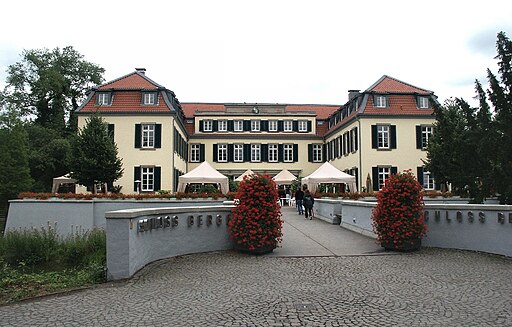
Schloss Berge developed from an early aristocratic estate whose origins can be traced to medieval landownership in the region that is now part of Gelsenkirchen. Initially, the site functioned less as a military stronghold and more as a representative residence connected to agricultural management and regional administration. Its location near important routes and fertile land made it well suited for estate life, and over time it became a visible symbol of noble presence in a largely rural landscape. The continuity of ownership across generations helped establish Schloss Berge as a stable center of influence long before major architectural transformations took place.
Architectural Form and Interior Character
The architectural identity of Schloss Berge is shaped by a series of rebuilding phases that gradually refined its appearance into that of a stately manor. Rather than emphasizing fortification, the design focused on symmetry, proportion, and clarity of form. The exterior presents a calm and ordered impression, while the interior spaces were organized to support both representative functions and private living. Large rooms for gatherings coexisted with more intimate chambers, reflecting the dual role of the building as a social venue and family residence. This architectural restraint gives Schloss Berge a dignified presence rooted in function rather than excessive ornamentation.
Estate Economy and Daily Life
Life at Schloss Berge revolved around the management of land and resources, making the estate an important economic unit within the region. Agricultural production, tenant relationships, and local administration were coordinated from the manor, tying the surrounding population closely to the rhythms of estate life. The household included not only the noble family but also servants, craftsmen, and laborers whose daily work sustained the operation of the property. This interconnected structure illustrates how estates like Schloss Berge functioned as microcosms of social order, where hierarchy and cooperation were both essential to stability.
Transformation of the Surrounding Landscape
The landscape around Schloss Berge evolved from purely productive farmland into a more consciously designed environment. Gardens, tree-lined avenues, and open green spaces were introduced to frame the building and enhance its visual impact. These changes reflected broader cultural trends that valued landscape design as an expression of refinement and control over nature. At the same time, the estate retained its practical orientation, ensuring that aesthetic improvements did not disrupt agricultural use. The resulting balance between utility and beauty remains one of the defining qualities of the site.
Industrialization and Changing Functions
The onset of industrialization in the Ruhr region brought profound changes to the context of Schloss Berge. Rapid urban growth and shifting economic structures diminished the traditional role of noble estates, prompting a reassessment of how such properties could be used. Schloss Berge gradually lost its function as a private aristocratic residence and began to assume new roles aligned with public and cultural life. This transition marked a significant shift in identity, as the building adapted to serve a broader community rather than a single family lineage.
Contemporary Significance and Preservation
Today, Schloss Berge stands as a prominent cultural and architectural landmark that reflects the layered history of its region. Preservation efforts have focused on maintaining the integrity of the building while allowing for contemporary use, ensuring that it remains accessible and relevant. The manor and its surrounding grounds now provide a setting for events, cultural activities, and public enjoyment. Schloss Berge demonstrates how historic estates can be successfully integrated into modern urban life, offering continuity with the past while contributing to the cultural landscape of the present.
