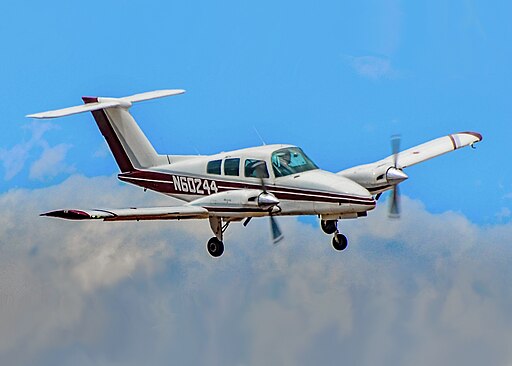
The Beechcraft Duchess is one of the most recognizable light twin-engine trainers ever produced, created specifically to deliver a modern, safe, and standardized multi-engine training platform for flight schools and professional pilot pipelines. Introduced in the late 1970s, the Duchess was designed during a period when multi-engine instruction demand was rising quickly, and Beechcraft’s goal was to offer an aircraft that felt like a serious twin without the operating costs and complexity of larger executive models. The result was an aircraft with a stable airframe, predictable handling, excellent cockpit visibility, and systems that were complex enough to teach real multi-engine procedures while still being manageable for student pilots. While it never aimed to be a high-performance business twin, the Duchess became highly respected for its training value, robust construction, and consistent flight characteristics, and it remains widely used today in multi-engine training and time-building environments.
Airframe Design and Structural Configuration
The Duchess is an all-metal, low-wing cantilever monoplane with retractable tricycle landing gear, built around a clean and practical aerodynamic layout. Its wing design favors stability and training predictability rather than maximum cruise speed, and the aircraft is intentionally engineered to behave in a forgiving, well-mannered way throughout the training envelope. The fuselage provides a relatively wide cabin for its class, with comfortable seating for four occupants in a typical training configuration and generous window area that improves situational awareness for both pilots. Control surfaces are conventional and designed for balanced feel, with the aircraft maintaining good roll response without being twitchy, and a strong sense of directional stability that helps students learn asymmetric thrust management in a controlled way. The landing gear retracts fully, reducing drag in cruise, and the aircraft’s ground handling is stable and easy, which matters greatly for training environments where frequent takeoffs and landings are the norm. Structurally, the Duchess has a reputation for being solid and durable, with an airframe that tolerates repeated training cycles better than many lighter, more delicate twins.
Dimensions and Weight Parameters
In physical size, the Duchess sits squarely in the compact light twin category, but it has proportions that make it feel larger than many competing trainers. Wingspan is approximately 38 feet 1 inch (about 11.6 meters), while overall length is about 30 feet 3 inches (roughly 9.2 meters), and height is near 9 feet 8 inches (around 2.9 meters). Wing area is approximately 200 square feet (about 18.6 square meters), supporting a moderate wing loading that helps maintain stable handling and consistent performance. Maximum takeoff weight is typically around 3,900 pounds (about 1,770 kilograms), with empty weight usually in the 2,500 to 2,650 pound range depending on equipment and avionics. Useful load generally falls between 1,200 and 1,350 pounds, which is strong for a twin trainer and allows the aircraft to carry two pilots, fuel, and training equipment without immediately becoming weight-limited. Fuel capacity is commonly around 100 gallons usable in standard configurations, providing plenty of endurance for long training flights and cross-country requirements.
Engine Installation and Propeller Systems
The Beechcraft Duchess is powered by two Lycoming O-360 series engines, each typically rated at 180 horsepower. These are naturally aspirated, horizontally opposed, carbureted piston engines that are well-known across general aviation for their reliability, simplicity, and relatively predictable operating behavior. The engine choice is a major reason the Duchess became popular with flight schools, since parts availability, maintenance familiarity, and overhaul support are widespread. The engines drive constant-speed propellers, which is a crucial training feature because it introduces student pilots to real-world multi-engine propeller management, including power setting coordination, RPM control, and feathering procedures. The Duchess uses full-feathering propellers, meaning it can properly simulate and train for engine failure procedures in a way that fixed-pitch or non-feathering systems cannot. Because the aircraft is not turbocharged and uses moderate horsepower engines, its high-altitude performance is limited compared with more powerful twins, but the powerplant configuration is extremely well matched to the Duchess mission: safe, repeatable, and cost-conscious multi-engine training.
Performance Characteristics and Training Envelope
The Duchess is not built for speed, but its performance is well balanced for training, IFR work, and realistic twin-engine operations. Typical cruise speeds are around 135 to 150 knots depending on power setting, altitude, and aircraft condition, and this speed range is ideal for instructional flying because it gives students time to manage checklists, navigation, and abnormal procedures without being rushed. Rate of climb on two engines is commonly in the 1,200 feet per minute range when light, but decreases noticeably as weight increases, which is valuable from a training perspective because it teaches realistic performance planning. Service ceiling is generally around 18,000 to 20,000 feet, but most operations occur at lower altitudes where the normally aspirated engines maintain power. Single-engine performance is intentionally modest, and this is one of the Duchess’s defining characteristics as a trainer, since it forces students to respect airspeed control, proper configuration, and correct emergency procedures. Takeoff distance and landing distance are moderate, and the aircraft performs well on paved runways typical of training airports, though it is not a short-field specialist. Stall speeds are relatively low for a twin, and stall behavior is generally stable and predictable, making it well suited to instructional demonstrations.
Fuel, Electrical, and Systems Architecture
The Duchess is designed with systems that are complex enough to teach multi-engine operations but not so complicated that they overwhelm new pilots. Fuel is carried in wing tanks, typically with a left and right system feeding each engine, and the aircraft includes crossfeed capability to teach fuel management and balancing. The electrical system usually includes dual alternators, supporting redundancy and IFR reliability, and the aircraft’s avionics were commonly delivered in training-friendly configurations with dual navigation radios, transponder, and later GPS retrofits. Many Duchess aircraft today have been upgraded with modern glass displays, digital engine monitoring, and more advanced autopilots, but even older panel layouts remain functional for multi-engine instruction. Landing gear operation is electric or hydraulic depending on configuration, and its reliability has been a key factor in the aircraft’s training success. Environmental systems are straightforward, with cabin heat and ventilation designed for frequent stop-and-go operations, and the aircraft’s overall systems layout is intentionally logical, making it an excellent platform for teaching checklist discipline and cockpit flow.
Handling Qualities and Multi-Engine Training Value
The Duchess is especially valued for its stable and forgiving handling, which is not an accident but a deliberate design feature. In normal flight, it is steady and easy to trim, and it tracks well in instrument conditions, which makes it ideal for IFR multi-engine training. In engine-out scenarios, it provides realistic asymmetric thrust handling without being excessively aggressive, and its relatively large vertical tail gives good directional control when properly flown. Because the aircraft is not overpowered, students must learn to manage V-speeds, identify the failed engine correctly, and maintain best single-engine climb speed with precision, which builds strong habits for later transitions into faster, heavier twins. The Duchess also teaches energy management well, since it does not accelerate or decelerate as rapidly as some lighter aircraft, requiring pilots to plan configuration changes and descent profiles thoughtfully. On landing, the aircraft feels stable and planted, and it tolerates training mistakes better than many high-performance twins, which is exactly why it has remained a favorite for flight schools.
Operational Roles, Longevity, and Reputation
Although the Duchess was designed primarily as a trainer, it is fully capable as a personal travel aircraft for owners who value twin-engine redundancy and a comfortable cabin. Its true legacy, however, is in professional pilot training, where it became one of the standard aircraft for multi-engine ratings, commercial training, and airline pathway programs. Its durability, predictable behavior, and relatively straightforward maintenance profile allowed it to remain economically viable long after production ended. In the modern era, the Duchess continues to serve in flight schools, private ownership, and specialized training operations, often with upgraded avionics that keep it compatible with modern airspace requirements. The aircraft’s reputation is built on what it does best: providing a stable, honest, technically complete multi-engine platform that teaches pilots the fundamentals of twin-engine flying without disguising the real-world responsibilities of asymmetric thrust, propeller management, and performance planning.
