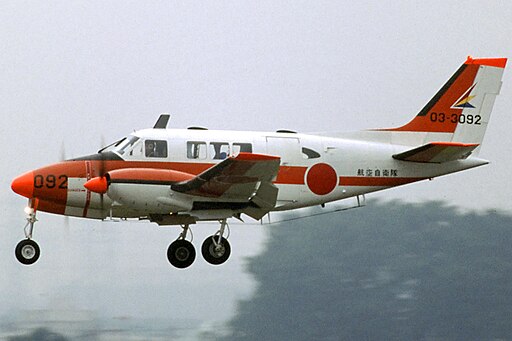
The Beechcraft Queen Air is one of the most important twin-engine piston utility aircraft ever produced by Beechcraft, positioned historically as the practical bridge between the company’s earlier light twins and the later turboprop King Air dynasty. Introduced in the late 1950s, the Queen Air was engineered for operators who needed real payload capability, predictable multi-engine performance, and a cabin that could be configured for executive transport, cargo hauling, medical evacuation, or government service. It is often described as a no-nonsense aircraft because it prioritizes structural strength, useful load, and stable handling over the sleek, speed-first styling of smaller business twins. Across its production life, the Queen Air gained a strong reputation for ruggedness, good single-engine manners for its class, and a cabin volume that made it genuinely useful rather than merely comfortable. Even decades after production ended, the aircraft remains relevant in niche roles, especially where piston twins are preferred for operating cost, parts familiarity, or mission-specific modifications.
Airframe Architecture and Structural Design
The Queen Air is an all-metal, low-wing cantilever monoplane with retractable tricycle landing gear, built around a relatively large fuselage cross-section compared with many piston twins of its era. The design is closely related to the Twin Bonanza lineage but expanded in both cabin volume and gross weight capability, with structural reinforcement to support heavier loads and repeated utility operations. The wing is optimized for stable lift and controllability rather than extreme speed, and the aircraft’s aerodynamic design emphasizes predictable behavior in climb, cruise, and approach profiles. The landing gear retracts into the engine nacelles and fuselage structure, and the overall gear geometry gives the Queen Air a stable stance on the ground, which is particularly valuable for cargo loading and frequent cycles. Many airframes were delivered with large cabin doors and flexible interiors, making the aircraft well suited to mixed passenger and freight missions. The tail design and control surfaces provide solid yaw authority, which is critical for asymmetric thrust handling in engine-out scenarios, especially at higher weights.
Dimensions and Weight Parameters
The Queen Air sits in the medium piston twin category, noticeably larger than aircraft like the Baron but smaller than commuter-class twins. Typical wingspan is approximately 45 feet 10 inches (about 14.0 meters), with an overall length around 35 feet 6 inches (roughly 10.8 meters) and a height near 14 feet (about 4.3 meters). Wing area is in the neighborhood of 280 square feet (around 26 square meters), providing the lift needed for higher payload operations without excessive stall speeds. Maximum takeoff weight varies by model, but common configurations fall around 7,000 to 8,000 pounds (about 3,175 to 3,630 kilograms), depending on structural and engine variants. Empty weights typically range from about 4,700 to 5,300 pounds (2,130 to 2,400 kilograms), leaving useful load figures that can exceed 2,000 pounds in many real-world aircraft. This weight and volume balance is one of the reasons the Queen Air was so widely used as a working airplane, since it could carry multiple passengers plus baggage, or a meaningful cargo load, without immediately sacrificing fuel to stay within limits.
Powerplant Options and Propulsion Systems
The Queen Air was produced with several engine configurations over its lifespan, most commonly using Lycoming horizontally opposed, fuel-injected piston engines in the 340 horsepower class. Many variants were equipped with Lycoming IGSO-540 engines, which are geared and supercharged, allowing the aircraft to maintain power at altitude and improving climb and cruise performance under heavier loads. This engine choice gave the Queen Air a more serious operating envelope than many normally aspirated piston twins, particularly for operators needing consistent performance in hot-and-high conditions or during long climbs with passengers and freight. The propeller system typically uses constant-speed, full-feathering propellers, supporting efficient cruise operation and safe engine-out handling. Because the Queen Air is heavier and more mission-oriented than lighter twins, the engines are working engines rather than simply cruise engines, and the aircraft benefits from disciplined engine management to protect cylinder head temperatures, manage supercharger behavior, and maintain long-term reliability. The geared supercharged Lycoming installations also mean maintenance standards and inspection discipline are a major part of ownership reality, but they are paired with a powerplant system that was designed specifically for sustained high-load operation.
Performance Characteristics and Operational Envelope
Performance for the Queen Air is best understood as utility performance with strong cruise capability rather than pure speed. Typical cruise speeds are often in the 185 to 205 knot range depending on model, power setting, altitude, and airframe condition, which is notably fast for an aircraft with this much cabin volume and payload capability. Maximum speeds can push slightly higher in clean configurations, but the aircraft is usually operated at conservative cruise settings to balance fuel burn, engine temperatures, and range. Service ceiling varies with variant, but supercharged models are capable of operating into the mid-20,000-foot range, giving the aircraft meaningful weather and terrain flexibility. Rate of climb is typically around 1,300 to 1,700 feet per minute when light, decreasing as weight increases, which is expected for a working twin designed to carry real loads. Range depends heavily on fuel capacity and power settings, but typical planning numbers are often around 1,000 nautical miles with reserves under efficient cruise operation. Takeoff and landing distances are moderate, and while the Queen Air is not a dedicated STOL aircraft, it is capable of operating from many regional airports and smaller fields when properly loaded and flown, especially with correct flap technique and engine power management.
Cabin Layout, Payload Flexibility, and Mission Configurations
One of the defining strengths of the Queen Air is its cabin, which is significantly more usable than many piston twins that are nominally six- to eight-seat aircraft but feel cramped in practice. The Queen Air can be configured for executive seating with club arrangements, for utility seating with multiple rows, or for cargo with seats removed and tie-down points used for freight. Many aircraft were equipped with cargo doors that allow bulky items to be loaded without awkward maneuvering through narrow passenger entries. Cabin volume and floor strength make it suitable for medevac conversions, surveillance equipment installations, and government communications fits, which explains why the aircraft was widely adopted by military and state operators. The aircraft’s center of gravity range supports a variety of loading patterns, but as with any twin in this class, careful attention to weight and balance is essential, especially when operating with aft cabin loading or when converting between passenger and cargo roles.
Avionics, Systems, and Reliability Considerations
From a systems standpoint, the Queen Air was built in an era when aircraft were expected to be maintained and operated as serious machines, and its systems reflect that mindset. Fuel systems typically include multiple wing tanks with crossfeed capability, allowing flexibility in balancing and abnormal operations. Electrical architecture generally uses dual alternators or generators, supporting redundancy for IFR operations, while de-icing and anti-icing equipment was available on many airframes, including pneumatic boots, heated props, and windshield anti-ice depending on configuration. Many Queen Airs flying today have been modernized with contemporary GPS navigation, digital autopilots, engine monitoring, and upgraded communications equipment, dramatically improving situational awareness while retaining the aircraft’s proven airframe. Because many models use supercharged and geared engines, engine monitoring and careful maintenance are particularly valuable, and modern engine instruments often extend both reliability and component life.
Handling Qualities and Pilot Technique
The Queen Air is generally known for stable, solid handling, especially in cruise and instrument conditions, which made it a popular platform for corporate and government pilots. It is not as sporty as lighter twins, but it is predictable and confidence-inspiring when flown with correct technique. Approach speeds are higher than smaller twins due to its weight and wing loading, and it rewards pilots who manage energy early and fly stabilized approaches. Engine-out performance is respectable for its class, but like all piston twins carrying heavy loads, the aircraft demands disciplined asymmetric thrust procedures, correct airspeed control, and prompt configuration management. In turbulence, the Queen Air tends to feel heavier and more planted than lighter aircraft, which is an operational advantage on longer legs. Ground handling is straightforward for an aircraft of its size, and the landing gear stance contributes to good directional stability during taxi and rollout.
Legacy and Role in Beechcraft Evolution
The Queen Air occupies a critical place in aviation history because it directly influenced the design philosophy and structural approach that would later define the turboprop King Air family. In many ways, it was the piston-powered proof-of-concept for a pressurized, utility-capable executive aircraft with real cabin space and real payload. While it was eventually eclipsed by turboprops in speed, altitude performance, and operating economics for many missions, the Queen Air remains admired for its toughness, straightforward mission flexibility, and the distinctly Beechcraft build quality that makes these airframes last. For operators who want a classic twin with a large cabin, meaningful useful load, and the ability to serve as a true working aircraft, the Beechcraft Queen Air continues to stand out as one of the most capable piston utility twins ever produced.
_(cropped).jpg)