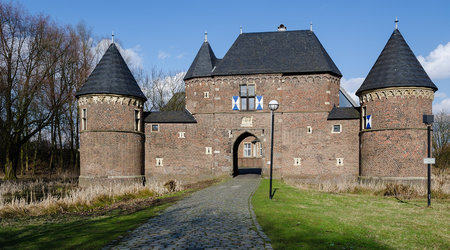
In a part of Germany better known for industry, rail lines, and the fast pulse of the Ruhrgebiet, Burg Vondern feels like a quiet rebellion against modern speed. It sits in Oberhausen as a reminder that this region wasn’t always smokestacks and steel. Long before the Ruhr became a symbol of industrial Europe, it was a landscape of rivers, marshy fields, noble estates, and local power struggles that played out on the edges of towns. Burg Vondern is one of those rare places where you can still sense that earlier world without needing much imagination. The moment you see its solid walls, its defensive structure, and the way it seems to hold its ground, you understand it was built for an era where safety and status had to be physically defended.
A Castle Shaped by the Land Around It
What makes Burg Vondern particularly fascinating is how closely it is tied to its environment. Unlike hilltop castles that dominate valleys from above, Burg Vondern belongs to the lowlands. It has the character of a water castle, the kind designed for flat terrain where moats and wetlands could be turned into natural defense systems. That difference matters because it changes how the building feels. The castle isn’t trying to intimidate from a distance. Instead, it sits like a self-contained world, enclosed and protected, with an atmosphere that suggests endurance rather than spectacle. It is a fortress that grew out of the practical realities of the region, where control over land, waterways, and local routes mattered more than dramatic height.
The landscape of North Rhine-Westphalia has always been a place of transition, and castles here reflect that. They are less romantic in the fairy-tale sense and more grounded in the logic of survival. Burg Vondern fits this perfectly. Its structure communicates the need to protect a residence, store supplies, and establish a permanent presence in contested territory. Even today, when the surroundings have changed dramatically, the castle still carries that original sense of purpose.
From Noble Residence to Regional Landmark
Burg Vondern is not the type of castle that exists purely as a monument. It lived a working life for centuries. It was connected to noble families, local administration, and the everyday economic systems of its time. That kind of long continuity gives the site a different weight than castles that were abandoned early or destroyed and rebuilt as decorative ruins. Burg Vondern survived because it adapted. Over generations, it shifted roles while still keeping its core identity as a fortified residence.
This is one of the most interesting things about the castle: it tells a story of persistence rather than dramatic collapse. Many people think of medieval history as a chain of wars and sudden endings, but most places endured through slow change. Burg Vondern reflects the quieter reality of European history, where power moved gradually, alliances shifted, and buildings were adjusted piece by piece to fit new needs. When you look at the castle’s layout and its architectural details, you can sense that it was shaped over time, not designed all at once.
Architecture That Feels Like a Timeline
Burg Vondern’s architecture is compelling because it is layered. Instead of a single unified style, the castle carries traces of different centuries and different priorities. Defensive features sit alongside elements that suggest comfort and domestic life. That contrast is exactly what you would expect from a residence that had to balance security with status. The medieval world was not purely military; it was also social, political, and deeply concerned with symbols.
The castle’s walls and enclosed courtyard create a feeling of separation from the outside world. Once inside, the space becomes more intimate, almost surprisingly so. That shift is part of the castle’s design logic. It was meant to create a boundary between danger and safety, between public and private. In modern times, when the idea of threat is no longer tied to armed conflict at your doorstep, the same boundary feels almost peaceful. It becomes a space where you can slow down and notice details.
The Ruhrgebiet Contrast: Castles in an Industrial World
One of the most striking things about Burg Vondern is its location. Oberhausen is not a sleepy medieval village. It is part of a metropolitan region shaped by factories, mines, and the 19th and 20th centuries. That contrast gives the castle a special kind of presence. It is not isolated in countryside; it is embedded in a place that reinvented itself through industry.
This makes visiting Burg Vondern feel different from visiting castles in southern Germany, where castles often blend naturally into postcard landscapes. Here, the castle feels like a survivor of a different era, standing in a region that changed its identity dramatically. The Ruhrgebiet has always been a place of transformation, and the castle becomes a symbol of continuity within that transformation. It reminds you that history does not begin with industry. The Ruhr region had its own medieval and early modern worlds, with local rulers, agricultural economies, and fortified estates long before coal reshaped everything.
A Place That Still Hosts Life
Burg Vondern is not only something you look at; it is a place that still hosts activity. That is important, because castles can easily become lifeless museum objects. When a historic building becomes too sanitized, it loses the sense that people once lived there. Burg Vondern avoids that trap by remaining connected to events and cultural life. This helps the castle keep its human dimension.
When a place like this hosts gatherings, festivals, or community events, it becomes more than a preserved shell. It becomes a bridge between centuries. You can stand in the courtyard and imagine the weight of older history, while also hearing modern voices and laughter. That combination is what makes heritage feel real. It is not only about preserving stone; it is about keeping the site meaningful.
The Emotional Pull of a Quiet Fortress
Not every castle inspires awe through scale. Burg Vondern has a different kind of emotional pull. It is modest compared to the grand royal fortresses of Europe, but it feels authentic in a way that can be even more powerful. It offers the sense of a local stronghold, a place that mattered intensely to the people who built it and lived around it.
That local scale is part of its charm. You do not need to imagine kings and legendary battles to feel the significance of the building. Instead, you can imagine the daily reality of medieval and early modern life: the routines of managing land, the constant concern for security, the negotiations between families, the slow rhythm of seasons. Burg Vondern feels like it belongs to that human world, not just to heroic fantasy.
A Castle That Encourages Slow Looking
Burg Vondern rewards patience. It is the kind of place where you notice how thick walls change the temperature of air, how enclosed spaces alter sound, and how small architectural choices reveal social priorities. Even details that might seem ordinary become meaningful when you remember their original context. A narrow passageway, a fortified entrance, or the way windows are placed can tell you how people thought about risk and privacy.
In the modern world, where so much of travel is optimized for quick photos, a castle like this almost asks you to do the opposite. It encourages slow looking. The longer you stay, the more it feels like a space with memory. You begin to notice that it is not just old, but shaped by generations of decisions.
The Story of Regional Identity
Burg Vondern also matters because it contributes to the Ruhr region’s identity in a broader sense. The Ruhrgebiet is often reduced to a single narrative: coal, steel, labor, and post-industrial renewal. That story is real and important, but it is not complete. Castles like Burg Vondern remind people that the region has deeper roots.
This matters culturally because it expands how residents and visitors understand the area. The Ruhr is not just a place that rose in the industrial era; it is a place with medieval structures, aristocratic estates, and centuries of settlement patterns that shaped its towns long before modern factories arrived. Burg Vondern acts as a visible anchor for that longer history. It is proof that the Ruhr region is not one story, but many layers stacked over time.
Why Burg Vondern Still Feels Relevant
It would be easy to treat Burg Vondern as a relic, a leftover from a world that no longer exists. But in reality, it still feels relevant because it represents themes that remain familiar. It speaks about how communities protect themselves, how power is organized, and how architecture reflects social structure. Even if modern life no longer requires moats and fortified walls, people still build boundaries, create private spaces, and design environments to express stability.
The castle also resonates because it offers a rare kind of calm. In a dense metropolitan region, spaces like this are valuable not only historically but emotionally. They provide a sense of distance from modern noise, even if the city is not far away. Burg Vondern gives you the feeling that time can slow down, that the past is not completely erased by development, and that there are still places where history can be experienced physically rather than just read about.
Visiting as an Experience, Not a Checklist
A visit to Burg Vondern is best approached as an experience rather than a checklist. It is not about rushing through a set of highlights. It is about letting the place shape your attention. The castle’s strength lies in atmosphere: the enclosed courtyard, the sense of shelter, the quiet authority of its walls.
For travelers who enjoy hidden gems, Burg Vondern offers something special. It does not feel like a stage set built for tourism. It feels like a genuine survivor of local history. And because it is located in a region many visitors pass through without considering its older layers, the castle can feel like a discovery. It reminds you that the Ruhrgebiet has medieval depth, not just industrial fame.
Burg Vondern as a Living Reminder
Burg Vondern is ultimately a reminder of how places endure. It has seen centuries of change, from feudal life to modern urban reality, and it still stands. It does not demand attention through grandeur, but through presence. It holds its space with the calm confidence of something that has outlasted trends, political shifts, and economic revolutions.
In a region defined by reinvention, Burg Vondern represents continuity. It is a piece of the Ruhr’s older soul, preserved not as nostalgia but as part of the region’s full identity. For anyone interested in German history beyond the usual postcard images, it offers a meaningful encounter. It is not a castle that tries to impress you with fantasy. It impresses you by being real, by being local, and by quietly proving that the Ruhr’s story is far older than its smokestacks.