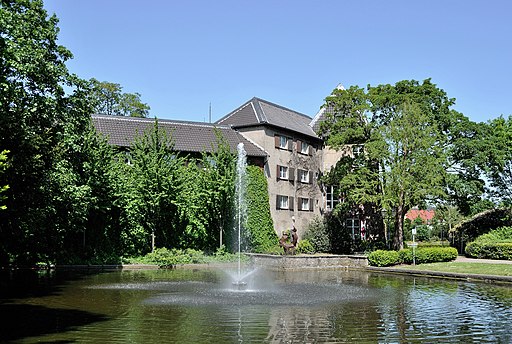
Burg Dinslaken is the kind of place that surprises you, not because it is enormous or theatrical, but because it still exists at all. In a region where wars, urban expansion, and constant rebuilding have erased countless historic structures, this castle remains as a steady fragment of an older world. Dinslaken sits on the edge of the Ruhr and the Lower Rhine, a geographical meeting point where cultures, trade routes, and political influence have always overlapped. Burg Dinslaken reflects that position. It is not a remote fortress built to dominate from a mountain peak, but a grounded stronghold shaped by local needs, local power, and the practical reality of protecting land in a flat, water-rich landscape.
The castle’s presence feels different from the famous landmark castles people associate with Germany. It does not play into fantasy. It feels like something that grew out of necessity, and that is exactly what makes it so compelling. Burg Dinslaken is less about romance and more about endurance. It is the type of building that witnessed centuries of ordinary life, administrative decisions, and regional tensions without needing to become a national symbol. And yet, precisely because it is local, it feels more intimate and more honest.
A Castle Born from the Logic of the Lowlands
To understand Burg Dinslaken, it helps to think about the geography that shaped it. The Lower Rhine region has never been defined by dramatic mountains or natural barriers. Instead, it is a landscape of rivers, wetlands, and wide open terrain. In such places, defensive architecture developed differently. Castles here often relied on water, moats, and controlled access rather than sheer height. Burg Dinslaken fits this tradition. Its form and placement reflect the idea that security comes from enclosure, from limiting entry points, and from using the land itself as a defensive partner.
This creates a different atmosphere for the visitor. Hilltop castles often feel like statements of dominance. Lowland castles feel like statements of survival. Burg Dinslaken gives you the impression of a place designed to hold on, to resist the uncertainties of its time, and to remain functional through long stretches of political change. It reminds you that medieval power was not only expressed through grandeur but also through control of land, roads, and resources.
The Role of Burg Dinslaken in Regional Power
Burg Dinslaken was never meant to be just a residence. It was part of the machinery of authority. In medieval and early modern Germany, castles like this were essential nodes in the system of regional rule. They served as administrative centers, protective shelters, and symbols of legitimacy. The castle’s importance was tied to the surrounding territory, to its economic value, and to the political ambitions of those who controlled it.
This is one of the most interesting aspects of Burg Dinslaken: it represents the everyday reality of governance. It was not a distant royal palace where politics happened behind ceremonial walls. It was closer to the ground. Decisions made here affected local farmers, merchants, and the rhythm of the town itself. The castle’s story is therefore not only architectural but social. It is connected to the way people lived, worked, paid taxes, and navigated the authority structures of their time.
Architecture That Balances Strength and Livability
Burg Dinslaken carries the signature tension of many historic castles: it had to be strong enough to defend, but comfortable enough to live in. Over the centuries, these priorities shifted. What began as a more defensive structure often evolved into something more residential, with improvements reflecting changing tastes, technology, and political stability.
This layered development is what gives the castle its character. Even without focusing on specific decorative details, you can sense that the building is not frozen in one moment. It feels shaped by long use. Its walls and layout reflect adaptation rather than a single architectural vision. That sense of gradual change makes Burg Dinslaken feel more like a living timeline than a static monument.
It also makes the castle easier to connect with. A purely defensive ruin can feel distant, as if it belongs to an era too harsh to imagine. Burg Dinslaken, by contrast, suggests that people lived full lives here. There were routines, domestic spaces, storage rooms, conversations, and quiet nights. The building’s survival allows you to sense those human layers, even if you are visiting centuries later.
The Castle and the Town: A Shared History
One of the most important things about Burg Dinslaken is its relationship with the town. Castles are often described as separate from the settlements around them, but in reality they were deeply intertwined. The castle shaped the town’s development, and the town supported the castle’s existence. This relationship created a shared identity that still echoes today.
Dinslaken’s growth, its local economy, and its strategic significance were influenced by the presence of the castle. The building was not only a defensive structure; it was a focal point of authority that organized the surrounding landscape. Even as centuries passed and the town modernized, the castle remained as a reference point, a reminder that Dinslaken was once part of a broader network of regional power.
This is why Burg Dinslaken feels meaningful even to people who are not passionate about medieval history. It is not just a tourist object. It is a piece of local identity, embedded in the town’s memory. It represents continuity in a region that has experienced enormous change.
Survival Through Centuries of Change
The Lower Rhine and Ruhr borderlands have seen their share of upheaval. Political boundaries shifted repeatedly, wars swept through, and modern development transformed the landscape. Many castles were destroyed, dismantled, or absorbed into new construction. Burg Dinslaken’s survival is therefore not something to take for granted.
What makes its endurance especially impressive is that it remained relevant. Buildings survive best when they are used, and Burg Dinslaken’s story is tied to that practical truth. It adapted to new purposes and new eras. Instead of becoming obsolete, it found ways to remain part of the community’s functioning life.
This adaptability is part of what makes the castle so interesting today. It is not only a reminder of medieval power but also a case study in how historic structures can persist through reinvention. In a region famous for industrial transformation, Burg Dinslaken quietly demonstrates that reinvention is not only a modern theme. It has always been part of the area’s story.
A Different Kind of Beauty
Burg Dinslaken does not overwhelm you with dramatic scenery. Its beauty is more subtle. It is the beauty of proportion, of solid materials, of a structure that looks like it belongs exactly where it stands. There is a grounded dignity to it, a feeling that it was built to last and that it has done exactly that.
This kind of beauty often feels more rewarding than spectacle because it grows on you. At first glance, you may see a historic building. But the longer you stay, the more you notice how it shapes space, how it frames the surrounding town, and how it holds an atmosphere that modern architecture rarely achieves. It feels calm, contained, and quietly authoritative.
In many ways, Burg Dinslaken offers a refreshing alternative to the more famous castles of Germany. It is not packaged as a fantasy destination. It is real, local, and deeply tied to the everyday history of the region. That authenticity makes it memorable.
The Castle as a Cultural Anchor
In modern times, castles often survive by becoming cultural anchors. They host events, exhibitions, community gatherings, and educational programs. Burg Dinslaken fits naturally into this role because it has always been a focal point. The building’s presence draws people in, not only because it is old, but because it offers a space that feels distinct from ordinary urban life.
When a historic castle becomes part of a community’s cultural rhythm, it gains a new kind of importance. It stops being only a reminder of the past and becomes part of the present. Burg Dinslaken’s value is therefore not limited to historians or architecture enthusiasts. It matters to the town because it provides a shared space of identity, a landmark that connects generations.
This is especially meaningful in regions like North Rhine-Westphalia, where many towns had to rebuild after the destruction of the 20th century. Historic buildings that survived or were restored often become symbols of resilience. They offer continuity in places where so much has changed.
Visiting Burg Dinslaken Today
A visit to Burg Dinslaken is best approached with the mindset of discovery. It is not a castle that demands you rush through a list of highlights. Instead, it rewards attention. You notice how it sits in relation to the town, how its walls create an enclosed sense of space, and how its architecture reflects both defense and domestic life.
The experience is also shaped by the fact that the castle feels close to everyday life. You are not isolated in a tourist bubble. You are in a real town, in a real region, where history and modern life coexist. That makes the visit feel more grounded. You can leave the castle and immediately step into the rhythm of Dinslaken, which reinforces the sense that this building was always part of a living community rather than a distant monument.
Burg Dinslaken and the Identity of the Region
Burg Dinslaken holds a special place in the broader identity of the Lower Rhine and Ruhr borderlands. It reminds visitors that this region is not defined by one era. The Ruhr’s industrial legacy is powerful, but it is only one layer. Beneath it lies a much older landscape of castles, estates, trade routes, and local power structures.
The castle also represents the kind of history that is often overlooked: the history of smaller towns, regional authority, and everyday governance. These stories are less dramatic than royal courts and famous battles, but they are closer to how most people actually lived. Burg Dinslaken becomes valuable precisely because it preserves that more grounded narrative.
Why Burg Dinslaken Still Matters
Burg Dinslaken matters because it is a survivor with purpose. It is not only an old building; it is a symbol of continuity in a region shaped by change. It connects Dinslaken to centuries of regional history, and it gives the town a tangible link to the era when castles were not tourist attractions but working centers of power.
At the same time, the castle’s modern role as a cultural and civic landmark shows how heritage can remain alive. Burg Dinslaken does not exist only to be admired from a distance. It continues to serve as a place where people gather, learn, and experience the town’s identity. That balance between past and present is what makes it special.
