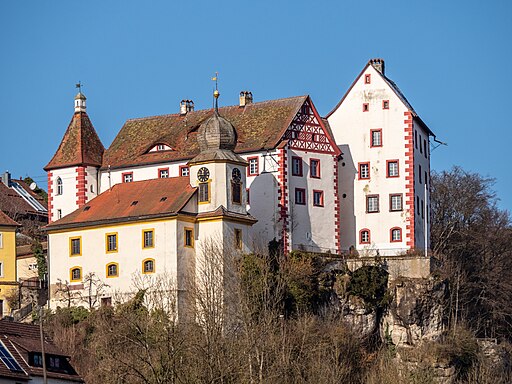
Burg Egloffstein rises from the Franconian Switzerland region like something carved out of the rock itself. In a landscape famous for dramatic limestone cliffs, deep valleys, and winding forest paths, the castle feels perfectly placed, as if the terrain had been waiting for it. This part of Bavaria is often described as romantic, but Burg Egloffstein adds a sharper edge to that romance. It is not a decorative ruin built for scenery. It is a real fortress, rooted in the medieval logic of protection, visibility, and control. Even today, the castle’s position creates a sense of dominance, not in an arrogant way, but in a natural one. It looks like it belongs to the cliff the way a hawk belongs to the wind.
What makes Burg Egloffstein especially fascinating is that it does not feel like a museum piece. It feels like a survivor. It carries the atmosphere of a place that has been lived in, defended, rebuilt, and adapted across centuries. And because the surrounding region still feels intensely rural and wooded, it is unusually easy to imagine the castle in its original context. You do not have to fight modern noise or city skylines to reach the medieval world here. The landscape does half the storytelling for you.
The Setting: Franconian Switzerland at Its Most Dramatic
The region around Burg Egloffstein is one of Germany’s most distinctive landscapes. Franconian Switzerland is not large, but it feels dense with natural character. Its limestone formations, caves, and steep hills create a setting that is unusually theatrical for central Europe. Castles here do not sit politely in open fields. They cling to heights, peer out from cliffs, and emerge from forests like guarded secrets. Burg Egloffstein is one of the most convincing examples of this tradition.
This landscape is not only beautiful; it is historically meaningful. In medieval times, terrain shaped everything. It determined where roads could pass, where settlements could grow, and where power could be enforced. A castle placed above a valley was not just scenic. It was strategic. Burg Egloffstein’s position allowed it to watch movement through the region and to protect the territory associated with the Egloffstein family, whose name became intertwined with the local identity.
Even now, when the valley is peaceful and visitors arrive for hiking rather than trade, the castle’s location still communicates its original function. It feels like a place built to see first and to be reached last.
A Castle with the Personality of a Fortress
Burg Egloffstein has a different energy from the refined palaces and baroque residences found elsewhere in Bavaria. This is not architecture designed for salons, music, and social display. It is architecture shaped by the reality of conflict. The castle’s core identity is defensive. It has the compact, rugged feel of a stronghold meant to endure.
That does not mean it is purely grim. Like many medieval castles, it would have contained domestic spaces, storage areas, and the infrastructure needed for everyday life. But the overall impression remains one of strength. You can sense that the building was designed around the assumption that danger was not hypothetical. It was expected.
This is one of the reasons Burg Egloffstein feels so authentic. It does not try to flatter the visitor. It does not soften itself into a romantic stage set. Instead, it remains stubbornly medieval in spirit, and that makes it deeply compelling. It is the kind of place where you can almost feel the weight of old decisions embedded in the stone.
The Egloffstein Name and the Long Continuity of Local Power
One of the most remarkable aspects of Burg Egloffstein is its connection to a family whose name is still inseparable from the place. In many parts of Europe, noble families disappeared, estates were dissolved, and castles became abandoned ruins. Here, the continuity is unusually strong. The Egloffstein family is part of the region’s identity, and the castle reflects a long tradition of local aristocratic influence that shaped Franconia for centuries.
This continuity adds a particular depth to the site. It means the castle is not only a medieval artifact; it is part of an ongoing historical narrative. The building is tied to generations of family history, shifting political realities, and the slow evolution of noble life in Germany. That kind of long-term connection changes how you think about the castle. It is not only a snapshot of the Middle Ages. It is a structure that had to adapt through the Reformation, the rise of modern states, wars, economic change, and the transformation of rural society.
Burg Egloffstein becomes, in that sense, a witness. It does not tell one story, but many, layered over time.
Stone, Height, and the Feeling of Medieval Reality
There is something about hilltop castles that instantly triggers imagination, but Burg Egloffstein does more than inspire fantasy. It creates a physical experience of medieval reality. The climb, the enclosed spaces, the thick walls, and the sense of being separated from the valley below all work together to remind you how different life once was.
In the modern world, we are used to controlling our environment. We regulate temperature, light, and sound. Medieval castles were the opposite. They were built to resist nature, but they were also deeply exposed to it. Wind, cold, dampness, and darkness were part of everyday existence. Burg Egloffstein’s stone presence hints at that. Even without stepping into every room, you can sense how the building was shaped by the need to survive weather as much as the need to survive enemies.
This is one of the most powerful qualities of the castle. It does not let you forget the physical hardship of earlier centuries. It reminds you that history was not lived in comfort, and that power came with constant vulnerability.
The Castle as Part of a Castle-Dense Region
Franconian Switzerland is famous for its castles and ruins. The density of historic sites here is unusual, and it reflects centuries of fragmented authority. Unlike regions where a single ruler dominated vast territory, Franconia was historically shaped by many small powers: noble families, ecclesiastical states, and local rulers. This fragmentation produced a landscape full of fortified sites, each representing a different pocket of influence.
Burg Egloffstein is a perfect example of how these castles functioned. It was not meant to compete with royal palaces. It was meant to anchor local authority. It served as a strong point in a network of power, protecting land, asserting status, and shaping the social structure of the surrounding villages.
For visitors, this context matters because it explains why the region feels like a living map of medieval politics. You can hike through valleys and see ruins on distant cliffs, each one a reminder of a time when borders were not drawn on paper but enforced through stone. Burg Egloffstein is one of the most striking pieces of that landscape puzzle.
The Emotional Experience of Visiting Burg Egloffstein
Some historic places impress you, and others haunt you. Burg Egloffstein leans toward the second category. It has an atmosphere that stays with you, partly because of its setting and partly because of its rugged character. The forested hills, the quiet valley, and the castle’s elevated position create a feeling of separation from ordinary life.
Visiting here can feel like stepping into a pocket of time. The modern world is not far away, but it becomes irrelevant for a while. The castle’s stone and height impose their own rhythm. You begin to move more slowly, to look farther into the distance, to pay attention to how the landscape shapes perspective.
This is one of the reasons Burg Egloffstein feels so memorable. It does not rely on curated spectacle. It relies on mood. It gives you the kind of experience that feels personal, as if you discovered it rather than consumed it.
A Place Where Nature and History Are Intertwined
Burg Egloffstein is not just a historic site surrounded by nature. It is a site where nature and history feel inseparable. The castle does not dominate the landscape in a way that feels artificial. Instead, it seems to grow out of it. The limestone cliffs, the forest canopy, and the valley below all feel like part of the castle’s identity.
This connection is part of why the region is so beloved by hikers and travelers. You can experience history not only through architecture but through movement. The paths, the viewpoints, and the changing light all become part of the story. Burg Egloffstein is not something you simply arrive at; it is something you approach, and that approach shapes how you feel when you finally see it.
This is also why the castle’s presence feels so strong even from a distance. It does not fade into the background. It becomes a landmark, a visual anchor that helps you understand the geography of the valley. It is a reminder that medieval castles were built not only to protect but to be seen. Visibility was part of power.
Why Burg Egloffstein Still Matters
Burg Egloffstein matters because it represents a form of history that feels immediate. It is not a reconstructed fantasy. It is a fortress shaped by real medieval needs and preserved through long continuity. It tells the story of a region where power was local, where landscape mattered, and where families anchored their influence through stone.
In a world where many historic sites feel overly polished, Burg Egloffstein offers something more raw. It is rugged, dramatic, and deeply tied to its environment. It reminds visitors that medieval life was not simply romantic; it was also hard, uncertain, and shaped by constant negotiation with both nature and politics.
