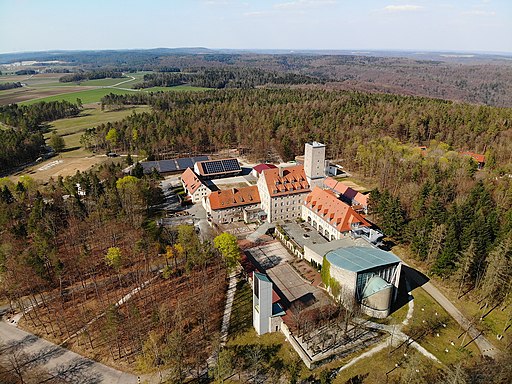
Rising above the gentle hills of Franconia in northern Bavaria, Burg Feuerstein occupies a landscape shaped by limestone cliffs, forests, and winding river valleys. The region around Ebermannstadt has long been a crossroads of trade and pilgrimage, and it was in this environment that the castle first took form. Like many medieval fortifications in the Holy Roman Empire, Burg Feuerstein began as a strategic stronghold designed to secure territory, oversee routes, and project authority across the surrounding countryside.
The name “Feuerstein,” literally meaning “fire stone,” likely refers to the flint-rich geology of the area or to the castle’s commanding, sunlit position atop its rocky spur. From its elevated perch, the structure would have provided sweeping views over fields and woodland, allowing early occupants to monitor movement and signal to allied settlements. Its placement was not accidental but carefully chosen to combine defensive advantage with symbolic prominence.
Architectural Character and Evolution
Burg Feuerstein reflects the layered architectural history typical of European castles that endured across centuries. The earliest sections were likely compact and practical, built from locally quarried stone with thick walls and narrow openings. These early fortifications emphasized defense: high curtain walls, a sturdy gatehouse, and perhaps a keep that served both as residence and last refuge in times of siege.
Over time, as military technology evolved and regional stability fluctuated, additions and modifications reshaped the structure. Windows widened, interior spaces became more refined, and residential comforts gradually replaced purely martial priorities. Stone vaulting, timbered upper floors, and expanded courtyards transformed the fortress into a more complex architectural ensemble. Rather than a static monument, Burg Feuerstein became an evolving organism, responding to political, economic, and cultural shifts in Franconia.
The surrounding landscape also influenced its design. Terraced grounds, defensive ditches, and outer walls integrated with the natural topography. The limestone formations characteristic of the Franconian Jura lent the castle a pale, almost luminous quality in certain light, reinforcing its dramatic visual presence.
Role in Regional Power Structures
During the medieval period, castles such as Burg Feuerstein were not isolated relics but active centers of governance and negotiation. They housed noble families who balanced loyalty to larger powers—whether bishops, dukes, or the emperor—while maintaining local authority. Within its walls, decisions were made that affected agriculture, trade tolls, and judicial matters across nearby villages.
The castle’s history likely intersected with the broader currents of Franconian politics, including ecclesiastical influence from Bamberg and shifting allegiances during imperial conflicts. Though it may not have been the stage for grand imperial assemblies, Burg Feuerstein would have played a meaningful role in shaping everyday life for those under its jurisdiction. The presence of retainers, craftsmen, and servants created a small but vibrant community within its walls.
Transformation Through the Centuries
Like many European castles, Burg Feuerstein endured periods of decline and renewal. As artillery warfare rendered traditional fortifications less effective, some castles fell into ruin while others adapted. Fires, weathering, and neglect may have taken their toll, leaving portions damaged or abandoned. Yet the enduring appeal of such structures often sparked restoration efforts in later centuries.
The romantic fascination with the medieval past that swept through Germany in the nineteenth century contributed to renewed interest in preserving historic sites. Burg Feuerstein, with its evocative silhouette and commanding views, would have been an ideal candidate for appreciation and conservation. Restoration projects may have aimed not only to stabilize the structure but also to reinterpret it, blending historical accuracy with contemporary needs.
In the twentieth century, many former castles across Bavaria found new purposes as educational centers, cultural venues, or retreat spaces. Burg Feuerstein followed this broader pattern of adaptive reuse, transforming from a feudal fortress into a site of community engagement and learning. This shift ensured that the castle remained relevant rather than becoming a mere static relic.
Cultural Significance and Modern Identity
Today, Burg Feuerstein stands as more than a remnant of stone and mortar. It embodies the layered identity of Franconia, where medieval heritage coexists with modern life. The castle’s silhouette against the Bavarian sky continues to inspire visitors, hikers, and history enthusiasts who approach it along forested paths.
Its modern role emphasizes connection rather than defense. Instead of guarding against invaders, Burg Feuerstein welcomes guests for gatherings, educational programs, and cultural events. Within its historic walls, conversations now center on creativity, reflection, and community building. The transformation from fortified residence to cultural landmark illustrates the adaptability of historic architecture when guided by thoughtful stewardship.
Moreover, the castle contributes to regional tourism and cultural continuity. Visitors who explore Burg Feuerstein also discover nearby villages, local cuisine, and the distinctive character of the Franconian landscape. In this way, the castle acts as a gateway to broader regional identity, linking past and present.
The Experience of Place
Standing within the courtyard of Burg Feuerstein, one senses the interplay of solidity and openness. The thick stone walls speak of endurance, while the expansive views remind visitors of the world beyond. Wind moves across the heights, and sunlight shifts along the masonry, revealing textures carved by centuries.
The experience of Burg Feuerstein is as much about atmosphere as about documented history. The castle’s elevated position creates a feeling of removal from ordinary routines, encouraging contemplation. Whether approached as a historical monument, architectural study, or cultural retreat, it offers a tangible connection to the continuum of human activity that has unfolded on its grounds.
In the enduring stones of Burg Feuerstein, the past is neither frozen nor distant. Instead, it forms a foundation for ongoing cultural life, demonstrating how historic sites can evolve while preserving their distinctive character. Through centuries of change, the castle remains a visible and meaningful landmark in the heart of Franconia.
.jpg)