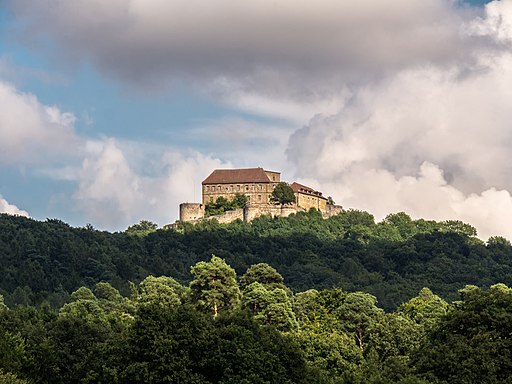
Perched high above the valley landscapes of Upper Franconia, Giechburg dominates its surroundings with a commanding and unmistakable silhouette. Located near the town of Scheßlitz in Bavaria, the castle occupies a strategic limestone ridge that provides expansive views over fields, forests, and scattered villages. From afar, its stone walls and towers seem to rise naturally from the rocky hilltop, as if carved from the terrain itself. This visual unity between architecture and landscape has long contributed to its reputation as one of the most striking castle sites in the region.
The elevation was not chosen for aesthetic reasons alone. In the Middle Ages, height meant security, visibility, and authority. Giechburg’s placement allowed its occupants to monitor trade routes and agricultural lands while projecting power across the surrounding territory. The castle’s presence would have shaped daily life for generations, serving as both a defensive stronghold and a center of administration.
Foundations in the Medieval World
Giechburg traces its origins back to the High Middle Ages, a period marked by territorial consolidation and ecclesiastical influence throughout Franconia. The castle became closely associated with the Prince-Bishops of Bamberg, linking it to the broader political and religious structures of the Holy Roman Empire. As a fortified residence and administrative hub, it embodied the dual nature of ecclesiastical rule, combining spiritual authority with temporal power.
Within its walls, officials managed lands, collected dues, and resolved disputes. The castle likely housed a garrison, servants, and representatives of episcopal authority, creating a small but active community behind its fortified gates. Thick defensive walls, watchtowers, and gate systems underscored its readiness for conflict, even as much of its function centered on governance rather than warfare. Its role was not merely symbolic; it was an operational node in a network of castles that maintained regional stability.
Architectural Character and Defensive Design
The architectural form of Giechburg reflects centuries of adaptation and expansion. Early structures emphasized military practicality, with sturdy curtain walls and limited openings to repel attackers. The irregular ground plan followed the contours of the hill, demonstrating how medieval builders integrated natural topography into defensive strategy. The limestone foundation provided both a stable base and an additional barrier against assault.
Over time, as immediate military threats diminished and administrative functions grew in importance, the castle evolved architecturally. Residential quarters became more refined, and interior spaces were adjusted for greater comfort and functionality. Courtyards offered areas for gatherings and daily activities, while towers continued to serve as vantage points across the Franconian landscape. Even in its altered state, the complex retains the imposing character of a fortress shaped by centuries of vigilance.
The castle’s stone surfaces bear the marks of weather and time, creating a textured façade that shifts in tone depending on light and season. In winter, frost outlines its walls against pale skies, while in summer, greenery frames its rugged contours. The interplay between masonry and environment reinforces its identity as a landmark deeply rooted in place.
Decline, Damage, and Renewal
Like many fortifications in Central Europe, Giechburg experienced periods of decline as political structures changed and warfare evolved. The introduction of advanced artillery rendered traditional hilltop castles less effective as defensive positions. Some sections fell into disrepair, and the once-bustling administrative center gradually lost its original function. The passage of time, exposure to the elements, and shifting economic priorities left visible traces on the structure.
Yet Giechburg did not disappear into obscurity. Later generations recognized its historical and cultural value, initiating preservation and restoration efforts that stabilized and revitalized the complex. Rather than attempting to reconstruct it into an idealized medieval vision, conservation work often focused on maintaining authenticity while adapting spaces for contemporary use. This careful balance allowed the castle to retain its historic aura while serving new purposes.
A Cultural and Social Venue in Modern Bavaria
In its modern incarnation, Giechburg has become a site of gathering rather than defense. The expansive courtyards and renovated interiors now host cultural events, celebrations, and community functions. Visitors arrive not as subjects seeking protection or petitioning authority, but as guests attending weddings, concerts, and exhibitions. The transformation from fortified residence to event venue illustrates how historic architecture can find renewed relevance without losing its essence.
The castle’s panoramic views remain one of its most compelling features. From its elevated terraces, one can observe the undulating hills of Franconia stretching toward the horizon. These vistas connect present-day visitors with the strategic perspective once essential to medieval rulers. The continuity of sightlines across centuries reinforces the idea that while functions change, the landscape endures.
Tourism also plays a significant role in Giechburg’s contemporary identity. Travelers exploring Upper Franconia often include the castle in broader itineraries that feature nearby towns, breweries, and hiking routes. In doing so, they contribute to a regional economy intertwined with heritage preservation and cultural pride.
The Atmosphere of Endurance
To walk through Giechburg today is to encounter layers of time embedded in stone. The cool interior corridors contrast with sunlit courtyards, creating a sensory experience shaped by architecture and environment. The thickness of the walls conveys solidity, while open viewpoints offer a sense of vastness and freedom. This juxtaposition of enclosure and openness defines the emotional character of the site.
Giechburg stands as a testament to adaptation. From medieval stronghold to administrative center, from partial ruin to restored landmark, its story reflects broader patterns in European history. The castle’s enduring presence above Scheßlitz symbolizes resilience and continuity in a region shaped by political shifts and cultural evolution.
