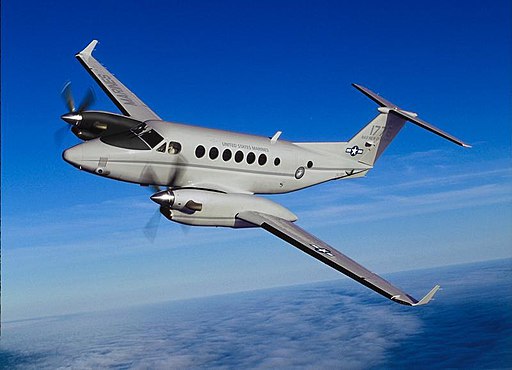
Beechcraft C-12 Huron – Technical Analysis of the U.S. Military Utility Aircraft
The Beechcraft C-12 Huron is a versatile twin-engine turboprop aircraft widely used by the armed forces of the United States and several allied countries. Developed as a military adaptation of the highly successful Beechcraft Super King Air, the C-12 Huron serves in numerous roles including personnel transport, cargo logistics, medical evacuation, reconnaissance, and electronic intelligence missions.
First entering military service in the mid-1970s, the C-12 family has evolved through many variants tailored to specific operational requirements. The aircraft’s design combines the reliability of a proven civilian platform with the flexibility required for military operations. Because of its moderate size, strong performance, and ability to operate from relatively short runways, the aircraft remains an important component of tactical airlift operations worldwide.
The following article provides an extensive technical overview of the Beechcraft C-12 Huron, including its development history, engineering design, propulsion system, avionics architecture, operational capabilities, and major variants. The article also presents a detailed table of technical specifications for the aircraft.
Origins and Development of the C-12 Huron
The story of the C-12 Huron begins with the development of the King Air series of business aircraft by Beechcraft. During the late 1960s and early 1970s, the company developed the King Air as a reliable twin-turboprop platform capable of transporting small groups of passengers over medium distances.
The United States military recognized the potential of the King Air platform for utility and liaison missions. In 1974 the U.S. Army began operating a military version of the aircraft designated C-12A, derived from the King Air A200. These aircraft were intended primarily for liaison transport and personnel movement between military installations.
The aircraft proved highly successful in this role, leading other branches of the U.S. military to adopt similar versions. The U.S. Navy ordered the UC-12B variant in 1979 for logistics support between naval air stations and operational facilities. These aircraft included modifications such as a cargo door to accommodate freight and equipment.
Over time, the C-12 designation came to encompass a large family of aircraft derived from the King Air series. Different variants were developed for specialized missions including training, surveillance, electronic intelligence, and tactical transport.
Today, the C-12 family continues to operate within the U.S. Air Force, U.S. Army, U.S. Navy, and U.S. Marine Corps, demonstrating the long-term value of the aircraft’s design.
Aircraft Classification and Operational Role
The C-12 Huron belongs to the category of light military utility aircraft. These aircraft are designed for flexibility rather than heavy payload capacity. Their primary mission is to transport personnel, small cargo loads, and mission equipment between operational bases.
Unlike large military transport aircraft such as strategic airlifters, utility aircraft like the C-12 are optimized for shorter distances and smaller airfields. Their turboprop engines provide efficient performance at moderate speeds while maintaining low operating costs.
Typical missions performed by the C-12 include:
- Personnel transport between military installations
- Cargo logistics and equipment delivery
- Medical evacuation missions
- Command and liaison transport
- Intelligence, surveillance, and reconnaissance (ISR)
The aircraft can typically carry up to 13 passengers or approximately 5,000 pounds of cargo, depending on the configuration used for a specific mission.
This flexibility allows the C-12 to support a wide range of operational scenarios.
Structural Design and Airframe Engineering
The structural design of the C-12 Huron closely follows that of the Super King Air series. The aircraft uses a low-wing monoplane configuration combined with a pressurized fuselage.
The airframe is primarily constructed from aluminum alloys, which provide a strong yet lightweight structure capable of withstanding repeated pressurization cycles. This durability is essential for aircraft that may perform several flights per day during operational deployments.
The fuselage design accommodates both passenger seating and cargo space. Many variants include a large cargo door that allows equipment and freight to be loaded quickly.
The aircraft incorporates retractable tricycle landing gear, consisting of a steerable nose wheel and two main landing gear assemblies. This configuration provides excellent ground handling and allows the aircraft to operate safely from paved or semi-prepared runways.
The landing gear retracts into the engine nacelles and fuselage to reduce aerodynamic drag during flight.
Wing Design and Aerodynamic Characteristics
The wing of the C-12 Huron is designed to deliver stable flight characteristics and efficient aerodynamic performance at turboprop cruise speeds.
The aircraft uses a straight-wing configuration with moderate taper toward the wingtips. This design enhances lift distribution while minimizing structural complexity.
The wing incorporates:
- Trailing-edge flaps for improved low-speed lift
- Ailerons for roll control
- Integrated fuel tanks within the wing structure
The wing profile is derived from the NACA 23000 airfoil series, which provides favorable lift characteristics and stable handling qualities.
These aerodynamic features allow the aircraft to perform well during takeoff and landing, particularly on shorter runways.
Propulsion System and Engine Technology
Power for the C-12 Huron comes from two Pratt & Whitney Canada PT6A‑42 engines.
Each engine produces approximately 850 shaft horsepower, providing sufficient thrust for the aircraft’s transport and reconnaissance roles.
The PT6A engine family is widely regarded as one of the most reliable turboprop engine designs in aviation history. Its reverse-flow turbine configuration improves efficiency while keeping the engine compact.
Key features of the PT6A-42 engine include:
- High power-to-weight ratio
- Modular construction for simplified maintenance
- Efficient fuel consumption
- Excellent reliability in diverse operating environments
Each engine drives a four-blade constant-speed propeller, which converts engine power into thrust efficiently. The propellers are optimized for performance at moderate speeds typical of turboprop aircraft.
The twin-engine configuration also improves safety by allowing the aircraft to continue flying in the event of an engine failure.
Avionics Systems and Flight Deck Architecture
The C-12 Huron is equipped with a sophisticated avionics suite designed to support military operations under various conditions.
The cockpit is typically configured for two pilots, although some missions may include additional crew members responsible for specialized equipment.
Standard avionics systems include:
- Weather radar
- Autopilot systems
- Tactical Air Navigation (TACAN) equipment
- High-frequency (HF) communication radios
- Very-high-frequency (VHF) and ultra-high-frequency (UHF) radios
These systems enable the aircraft to operate effectively during instrument flight conditions and in complex operational environments.
Many specialized variants also include advanced surveillance and intelligence equipment integrated into the avionics architecture.
Cabin Layout and Mission Configurations
The interior of the C-12 Huron can be configured for multiple mission roles.
In its standard transport configuration, the aircraft includes seating for approximately eight to thirteen passengers depending on the variant.
The cabin design prioritizes flexibility, allowing operators to reconfigure the interior quickly.
Common cabin configurations include:
- Passenger transport seating layout
- Cargo transport configuration
- Medical evacuation with stretcher positions
- Mission equipment installations for ISR operations
The pressurized cabin allows the aircraft to fly at high altitudes while maintaining a comfortable environment for passengers and crew.
Flight Performance and Operational Capabilities
The C-12 Huron provides strong performance for a utility transport aircraft.
Its maximum speed reaches approximately 289 knots (about 535 km/h) at cruising altitude. (Encyklopedie.org)
The aircraft’s range can exceed 1,450 nautical miles, depending on payload and fuel configuration.
This range allows the aircraft to perform regional transport missions without requiring refueling stops.
The aircraft also features a service ceiling of about 35,000 feet, enabling it to operate above weather systems and commercial air traffic routes.
Another key performance characteristic is the aircraft’s rate of climb of approximately 2,450 feet per minute, allowing rapid ascent to operational altitude.
These capabilities make the aircraft suitable for a wide range of military operations.
Specialized Variants and Mission Systems
Over the decades, numerous variants of the C-12 Huron have been developed.
Some of the most important versions include:
C-12A
The original U.S. Army version used for personnel transport and liaison missions.
UC-12B
A U.S. Navy and Marine Corps logistics transport variant equipped with a cargo door.
RC-12 Guardrail Series
A highly specialized intelligence platform equipped with signals intelligence (SIGINT) equipment used to intercept and analyze electronic transmissions.
MC-12W Liberty
An intelligence, surveillance, and reconnaissance aircraft used extensively during operations in Iraq and Afghanistan.
C-12J
A more modern transport variant with updated avionics and improved mission systems.
Each of these versions reflects the adaptability of the King Air platform for military applications.
Global Operators and Military Use
Although the aircraft was originally developed for the United States military, several allied nations also operate the C-12.
Countries operating variants of the aircraft include:
- Argentina
- Canada
- Greece
- Israel
- Pakistan
- Philippines
These operators use the aircraft for various roles including training, logistics support, and surveillance missions.
The widespread use of the aircraft demonstrates its reliability and operational effectiveness.
Legacy and Long-Term Impact
The Beechcraft C-12 Huron remains one of the most successful military adaptations of a civilian aircraft platform.
Its long service life reflects the durability of the King Air design and the versatility of the turboprop configuration. Even decades after its introduction, upgraded variants continue to operate in modern military environments.
The aircraft’s ability to perform diverse missions with relatively low operating costs ensures that it will likely remain in service for many years.
Technical Specifications – Beechcraft C-12 Huron
| Parameter | Specification |
|---|---|
| Aircraft Type | Military utility transport aircraft |
| Manufacturer | Beechcraft |
| Crew | 2 |
| Passenger Capacity | Up to 13 passengers |
| Length | 13.34 m |
| Wingspan | 16.61 m |
| Height | 4.57 m |
| Wing Area | 28.1 m² |
| Empty Weight | ~3,520 kg |
| Maximum Takeoff Weight | ~5,670–6,750 kg |
| Engines | 2 × Pratt & Whitney Canada PT6A-42 turboprop |
| Engine Power | 850 shp each |
| Propellers | Four-blade constant-speed |
| Maximum Speed | 289 knots (535 km/h) |
| Cruise Speed | ~540 km/h |
| Range | 1,450 nmi (2,690 km) |
| Ferry Range | Up to 1,800 nmi (3,300 km) |
| Service Ceiling | 35,000 ft (10,700 m) |
| Rate of Climb | 2,450 ft/min |
| Endurance | 5–6 hours |
