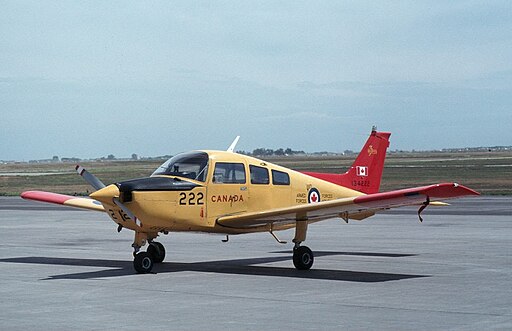
Beechcraft CT-134 Musketeer – Technical Overview of a Classic Military Training Aircraft
The Beechcraft CT-134 Musketeer is a light piston-engine training aircraft that served as an essential pilot training platform for the Royal Canadian Air Force for several decades. Derived from the civilian Beechcraft Musketeer, the CT-134 Musketeer was specifically adapted for military flight training, combining simple systems, stable flight characteristics, and reliable performance.
Introduced during the early 1970s, the aircraft became a fundamental component of Canada’s pilot training infrastructure. The aircraft’s design emphasizes ease of handling, strong structural integrity, and straightforward mechanical systems. These characteristics made it particularly well suited for primary pilot instruction, where safety and predictability are essential.
The CT-134 Musketeer represents an important chapter in military aviation training history. While it was never intended to perform combat missions, its role in shaping generations of pilots is significant. Many aviators who later transitioned to advanced jet aircraft first gained their flying experience in the cockpit of the CT-134.
This article provides an in-depth examination of the Beechcraft CT-134 Musketeer, including its development history, design philosophy, engineering features, propulsion system, avionics configuration, operational performance, and technical specifications.
Origins and Development of the Musketeer Series
The origins of the CT-134 Musketeer can be traced to the development of the Beechcraft Musketeer series during the early 1960s. At the time, the aviation market demanded a reliable light aircraft that could serve both private owners and flight training schools.
Beechcraft engineers designed the Musketeer as a simple yet durable aircraft capable of handling frequent training flights. Unlike some competing aircraft built primarily from aluminum alloys, the Musketeer series used a steel-tube fuselage structure combined with aluminum wing surfaces. This hybrid approach created a robust airframe capable of enduring repeated training maneuvers.
The first Musketeer aircraft flew in 1962, and production soon expanded to several variants with different engine configurations and performance characteristics.
Recognizing the aircraft’s potential as a training platform, the Royal Canadian Air Force evaluated the Musketeer as a possible replacement for older training aircraft. After a detailed evaluation process, Canada selected a modified version of the Musketeer for military use.
The military designation CT-134 Musketeer was assigned to these aircraft when they entered service in the early 1970s.
Role of the CT-134 in Canadian Military Pilot Training
Pilot training is a complex process requiring aircraft that are safe, predictable, and economical to operate. The CT-134 Musketeer was designed to fulfill these requirements in the earliest stages of pilot instruction.
Within the Royal Canadian Air Force training system, the aircraft was used primarily for primary flight training. During this phase, student pilots learn fundamental flying skills such as:
- Basic aircraft control
- Takeoff and landing procedures
- Navigation techniques
- Instrument flight fundamentals
- Emergency procedures
The aircraft’s forgiving handling characteristics made it an excellent training tool. Its stable flight behavior allowed instructors to demonstrate maneuvers clearly while providing students with a manageable learning environment.
Over several decades of operation, the CT-134 trained hundreds of pilots who later transitioned to advanced training aircraft and operational military platforms.
Airframe Design and Structural Engineering
The CT-134 Musketeer features a relatively simple yet durable structural design. The aircraft’s structure reflects the priorities of training aircraft engineering: strength, reliability, and ease of maintenance.
One of the most distinctive aspects of the Musketeer airframe is its steel-tube fuselage structure. Unlike many aircraft that rely entirely on aluminum skins for structural strength, the Musketeer incorporates a welded steel frame covered by aluminum panels. This design provides excellent resistance to structural fatigue and simplifies repairs when damage occurs.
The wings are constructed primarily from aluminum alloy and feature a conventional semi-monocoque structure. Internal spars and ribs distribute aerodynamic loads across the wing surface, ensuring structural stability during flight.
The aircraft employs a low-wing configuration, meaning the wings are mounted near the bottom of the fuselage. This arrangement improves stability and allows for efficient landing gear placement.
The landing gear itself is fixed tricycle landing gear, consisting of two main wheels and a nose wheel. Because the landing gear does not retract, the aircraft benefits from mechanical simplicity and reduced maintenance requirements. This design choice is common in training aircraft where reliability is prioritized over aerodynamic efficiency.
Aerodynamic Characteristics and Flight Stability
The aerodynamic design of the CT-134 Musketeer prioritizes stability and predictable handling rather than high performance. For a training aircraft, these qualities are essential because they allow student pilots to learn fundamental flight principles without encountering difficult or unpredictable behavior.
The wing of the Musketeer uses a relatively thick airfoil profile, which provides strong lift characteristics at low speeds. This allows the aircraft to perform takeoffs and landings at relatively modest speeds, making it easier for inexperienced pilots to control.
Large trailing-edge flaps are installed on the wings to increase lift during takeoff and landing. When extended, the flaps allow the aircraft to operate safely from shorter runways while maintaining stable flight characteristics.
The tail section consists of a conventional horizontal stabilizer and vertical stabilizer configuration. These surfaces provide pitch and yaw stability while enabling precise control inputs during flight.
Overall, the aerodynamic design ensures that the aircraft remains controllable even at low airspeeds, reducing the risk of stalls during training operations.
Powerplant and Engine Performance
The CT-134 Musketeer is powered by a Lycoming IO-360 piston engine, a widely used four-cylinder aircraft engine known for its reliability and smooth operation.
This engine produces approximately 180 horsepower, providing sufficient power for the aircraft’s training mission profile. The engine drives a two-blade constant-speed propeller, which converts engine power into forward thrust.
The Lycoming engine family is highly regarded within general aviation due to its durability and relatively simple mechanical design. Maintenance procedures are straightforward, and spare parts are widely available.
Fuel is stored in tanks located within the wings. The fuel system is designed for reliability and includes redundant pumps to ensure continuous engine operation.
Although the engine does not deliver the high performance associated with larger aircraft, it provides adequate climb capability and cruising speed for training missions.
Cockpit Layout and Flight Instruments
The cockpit of the CT-134 Musketeer is designed with training in mind. The aircraft features dual flight controls, allowing both the instructor and student pilot to operate the aircraft.
The instrument panel includes a standard set of flight instruments used in general aviation training, including:
- Airspeed indicator
- Altimeter
- Attitude indicator
- Turn coordinator
- Vertical speed indicator
- Heading indicator
These instruments provide pilots with essential flight information during both visual and instrument flight conditions.
Communication and navigation equipment typically include VHF radios and navigation receivers. These systems allow students to learn radio communication procedures and basic navigation techniques.
The cockpit seating arrangement places the instructor and student side by side, enabling clear communication and supervision during training flights.
Cabin and Pilot Training Environment
Although the CT-134 Musketeer is primarily a training aircraft, its cabin is designed to provide a functional and comfortable environment for flight instruction.
The aircraft typically accommodates two to four occupants, including the instructor and student pilot. Additional seating can be used for observers or training supervisors during certain training missions.
Large windows provide excellent external visibility, which is particularly important for visual flight training. Student pilots must be able to observe the horizon and surrounding airspace clearly while learning fundamental flight skills.
The aircraft also includes basic ventilation and heating systems to ensure pilot comfort during training operations in varying weather conditions.
Flight Performance and Operational Capabilities
The CT-134 Musketeer offers performance characteristics well suited to its training role. The aircraft’s moderate speed and stable handling allow instructors to demonstrate maneuvers safely.
Typical cruise speeds range between 110 and 120 knots, depending on altitude and engine power settings. This speed allows efficient cross-country training flights while remaining manageable for student pilots.
The aircraft’s maximum range exceeds 700 nautical miles, providing sufficient endurance for extended training missions.
The service ceiling of the aircraft is approximately 13,000 feet, allowing students to practice high-altitude flight operations when necessary.
Climb performance is adequate for training operations, typically around 700 to 900 feet per minute depending on aircraft weight and environmental conditions.
Operational History and Retirement
The CT-134 Musketeer served the Royal Canadian Air Force for many years as a primary training aircraft. During its operational life, the aircraft helped train numerous military pilots who later flew more advanced aircraft.
Eventually, the aircraft was replaced by more modern training platforms capable of supporting updated training curricula and avionics systems.
Despite its retirement from military service, the Musketeer family continues to operate in civilian aviation. Many aircraft remain active in flight schools and private ownership, demonstrating the durability and practicality of the design.
Legacy and Importance in Aviation Training
The Beechcraft CT-134 Musketeer played a significant role in military aviation training history. Its contribution lies not in combat achievements but in the education of pilots who went on to fly more complex aircraft.
Training aircraft like the CT-134 form the foundation of military aviation capability. Without reliable and effective primary training platforms, it would be impossible to develop skilled pilots capable of operating advanced military aircraft.
Even today, the Musketeer remains respected within the aviation community as a dependable and well-designed training aircraft.
Technical Specifications – Beechcraft CT-134 Musketeer
| Parameter | Specification |
|---|---|
| Aircraft Type | Primary military training aircraft |
| Manufacturer | Beechcraft |
| Crew | 1 instructor |
| Student Pilots | 1 |
| Additional Capacity | Up to 2 passengers |
| Length | 7.82 m |
| Wingspan | 10.97 m |
| Height | 2.62 m |
| Wing Area | 16.3 m² |
| Empty Weight | ~680 kg |
| Maximum Takeoff Weight | ~1,157 kg |
| Engine | Lycoming IO-360 piston engine |
| Engine Power | 180 hp |
| Propeller | Two-blade constant speed |
| Cruise Speed | ~120 knots (222 km/h) |
| Maximum Speed | ~130 knots (240 km/h) |
| Range | ~700 nautical miles (1,300 km) |
| Service Ceiling | ~13,000 ft (3,960 m) |
| Rate of Climb | ~800 ft/min |
| Fuel Capacity | ~50 gallons |
