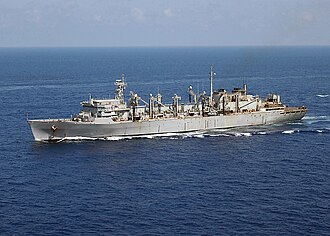
USNS Supply (T-AOE-6): The U.S. Navy’s High-Capacity Fast Combat Support Ship
Modern naval warfare and global maritime operations rely heavily on logistics. Warships operating thousands of miles from home ports require a constant supply of fuel, ammunition, spare parts, food, and other essential materials. Without a reliable supply chain at sea, even the most advanced naval fleet would quickly become ineffective. Among the most important vessels responsible for sustaining these operations is USNS Supply (T‑AOE‑6), one of the largest and most capable fast combat support ships ever built for the United States Navy.
The ship belongs to the Supply-class fast combat support ship, a class designed to combine the capabilities of fleet oilers, ammunition ships, and supply vessels into a single high-speed logistics platform. These ships were developed to operate alongside carrier strike groups, providing rapid replenishment of critical resources without forcing combat vessels to leave operational areas.
Unlike earlier replenishment ships that operated at slower speeds and often required escorts, the Supply-class vessels were engineered to keep pace with modern aircraft carriers and escort ships. Their powerful propulsion systems allow them to maintain high transit speeds, enabling them to move quickly between naval task forces across large operational theaters.
The construction of USNS Supply represented a major advancement in naval logistics technology. The vessel incorporates large cargo capacities, multiple underway replenishment stations, advanced cargo handling equipment, and aviation facilities that enable the rapid transfer of supplies to multiple ships simultaneously.
Today, USNS Supply continues to play a crucial role in supporting forward-deployed naval forces operated by the United States Navy and managed by the Military Sealift Command. The ship demonstrates how logistics vessels can be as strategically important as combat ships in sustaining global maritime power.
Development of the Supply-Class Fast Combat Support Ships
During the Cold War, the United States Navy increasingly relied on carrier strike groups as the core of its global maritime presence. These groups consisted of aircraft carriers, guided-missile cruisers, destroyers, submarines, and various support ships. Sustaining these fleets across oceans required highly efficient replenishment systems capable of operating under demanding conditions.
Earlier logistics ships were typically specialized vessels. Fleet oilers delivered fuel, ammunition ships carried ordnance, and supply ships transported food and spare parts. While functional, this approach required multiple ships to support a single task force.
Naval planners recognized that combining these roles into a single vessel would significantly increase operational efficiency. This concept led to the development of fast combat support ships, known by the hull classification symbol AOE.
The Supply-class ships represented the third generation of this concept. Designed in the late Cold War period, they were built to replace aging support vessels and increase the logistical capacity of carrier battle groups. Their design emphasized speed, cargo capacity, and advanced replenishment equipment.
USNS Supply became the lead ship of the class and set the standard for modern naval replenishment ships capable of sustaining high-tempo operations across the globe.
Construction and Shipbuilding Program
USNS Supply was constructed at the National Steel and Shipbuilding Company shipyard in San Diego, one of the most important naval shipbuilding facilities in the United States.
Construction began in the early 1990s as part of a modernization program for the Navy’s replenishment fleet. The ship was designed with a large steel hull capable of carrying enormous quantities of fuel, ammunition, and other supplies required by modern naval forces.
The vessel was launched in 1994 and later entered service with the U.S. Navy. Eventually the ship was transferred to the Military Sealift Command and redesignated as a United States Naval Ship (USNS), meaning it is operated primarily by civilian mariners rather than Navy sailors.
The construction of the Supply-class ships represented one of the most ambitious logistics shipbuilding programs undertaken by the United States Navy during the late twentieth century.
Hull Design and Structural Characteristics
The hull of USNS Supply is built from high-strength steel and designed to support extremely heavy cargo loads. With a displacement exceeding 48,000 tons when fully loaded, the ship is among the largest auxiliary vessels in the U.S. Navy fleet.
The vessel measures over 229 meters in length, giving it a size comparable to some smaller aircraft carriers from earlier generations. Its broad beam provides stability during underway replenishment operations, which require the ship to maintain precise positioning relative to receiving vessels.
The design includes multiple internal cargo holds and storage compartments separated by reinforced bulkheads. These spaces are engineered to safely store different types of materials, including aviation fuel, marine diesel fuel, missiles, bombs, and dry cargo supplies.
The hull also incorporates advanced stabilization systems that reduce rolling motion during replenishment operations. This stability is essential when transferring heavy loads between moving ships at sea.
Another important structural feature is the reinforced flight deck located at the stern. This deck allows the operation of large naval helicopters used for vertical replenishment missions.
Propulsion System and Power Generation
One of the defining characteristics of the Supply-class ships is their powerful propulsion system. Unlike slower replenishment ships, these vessels were designed to keep up with high-speed carrier strike groups.
USNS Supply is powered by four General Electric LM2500 gas turbines, the same type of engines used in many U.S. Navy destroyers and cruisers. These turbines drive two large propeller shafts through reduction gear systems.
The combined power output of the propulsion system exceeds 100,000 horsepower, enabling the ship to reach speeds of approximately 25 knots. This speed is significantly faster than traditional logistics ships and allows the vessel to rapidly reposition itself between naval task groups.
The propulsion system also includes advanced electrical power generation equipment that supplies energy to the ship’s cargo handling systems, radar, communication equipment, and aviation support facilities.
Cargo Storage and Logistics Capacity
The primary mission of USNS Supply is to transport and deliver large quantities of supplies to naval forces operating at sea. To fulfill this role, the ship is equipped with extensive storage capacity for multiple types of cargo.
The vessel can carry tens of thousands of barrels of fuel, including both marine diesel and aviation fuel. These fuels are stored in specialized tanks equipped with pumping systems capable of transferring fuel at high flow rates during replenishment operations.
In addition to fuel, the ship carries large quantities of ammunition, missiles, bombs, and other ordnance required by combat ships and aircraft carriers. These materials are stored in secure magazines designed to meet strict safety requirements.
The cargo holds also accommodate dry supplies such as food, spare parts, medical equipment, and maintenance materials. Together, these supplies allow carrier strike groups to remain at sea for extended periods without returning to port.
Underway Replenishment Capabilities
The most important operational capability of USNS Supply is its ability to conduct underway replenishment, a process in which ships transfer fuel and cargo while both vessels remain in motion.
The ship is equipped with multiple replenishment stations located along both sides of the hull. These stations allow simultaneous transfer operations to several ships at once.
Fuel is delivered through specialized hoses connected between vessels, while ammunition and cargo are transferred using tensioned cables and cargo rigs. These systems allow pallets and containers to move safely across the water between ships.
The ship’s advanced cargo handling cranes and automated systems significantly increase the speed and efficiency of replenishment operations. This capability enables naval forces to receive large quantities of supplies without interrupting their missions.
Aviation Facilities and Vertical Replenishment
In addition to traditional replenishment methods, USNS Supply supports vertical replenishment operations using helicopters. These operations involve transporting cargo via helicopter from the supply ship to other vessels.
The ship features a large flight deck capable of supporting heavy naval helicopters such as the Sikorsky MH‑60 Seahawk. These helicopters can carry pallets of supplies suspended beneath the aircraft.
Vertical replenishment allows ships to receive supplies without needing to sail directly alongside the support vessel. This capability is particularly useful in rough seas or tactical situations where ships must maintain greater separation.
The aviation facilities also include refueling equipment and storage areas for helicopter operations.
Defensive Systems and Survivability
Although USNS Supply is primarily a logistics vessel, it includes defensive systems designed to protect the ship against potential threats.
These systems typically include Phalanx Close-In Weapon Systems, radar-guided guns designed to intercept incoming missiles or aircraft. Additional machine gun mounts provide protection against small surface threats.
The ship also incorporates electronic warfare equipment and decoy systems that can help defeat guided missile attacks.
Despite these defensive features, the vessel is not intended to operate independently in high-threat combat environments. Instead, it usually operates as part of a protected naval task group.
Operational Role in Carrier Strike Groups
USNS Supply plays a central role in sustaining aircraft carrier strike groups deployed around the world. These groups require enormous quantities of fuel and supplies to maintain continuous operations.
Aircraft carriers alone consume vast amounts of aviation fuel and ordnance during flight operations. Escorting destroyers and cruisers also require frequent refueling.
By delivering these supplies directly at sea, USNS Supply enables naval forces to maintain a persistent presence in strategic regions without returning to port.
This logistical capability significantly enhances the operational reach and endurance of U.S. naval forces.
Role within the Military Sealift Command
Today the ship is operated by the Military Sealift Command, an organization responsible for providing logistical support to U.S. naval forces worldwide.
Military Sealift Command operates a large fleet of auxiliary ships staffed primarily by civilian mariners. These crews work alongside military personnel to support naval operations.
The use of civilian crews allows combat sailors to focus on operational missions while logistics specialists manage the supply chain that sustains the fleet.
USNS Supply represents one of the most capable logistics vessels in the Military Sealift Command fleet.
Strategic Importance in Modern Naval Warfare
In modern naval strategy, logistics ships like USNS Supply are often described as force multipliers. Although they are not front-line combat vessels, their ability to sustain fleets makes them indispensable.
Carrier strike groups can remain deployed for months at a time thanks to replenishment ships that deliver fuel, food, and ammunition directly at sea.
Without these ships, naval forces would be forced to return to port frequently, greatly reducing their operational effectiveness.
As global naval operations become more complex and geographically dispersed, the importance of high-capacity logistics ships continues to grow.
Technical Specifications of USNS Supply (T-AOE-6)
| Parameter | Specification |
|---|---|
| Ship Name | USNS Supply |
| Hull Number | T-AOE-6 |
| Class | Supply-class fast combat support ship |
| Operator | Military Sealift Command |
| Builder | National Steel and Shipbuilding Company |
| Length | 229.7 m |
| Beam | 32.3 m |
| Draft | 11.9 m |
| Full Load Displacement | ~48,800 tons |
| Propulsion | 4 × General Electric LM2500 gas turbines |
| Power Output | Over 100,000 horsepower |
| Propellers | 2 shafts |
| Maximum Speed | ~25 knots |
| Crew | Approx. 180 civilian mariners and naval personnel |
| Cargo Types | Fuel, ammunition, dry cargo |
| Aviation Fuel Capacity | Large aviation fuel storage tanks |
| Replenishment Stations | Multiple underway replenishment stations |
| Flight Deck | Helicopter landing deck |
| Helicopter Support | MH-60 Seahawk and similar aircraft |
| Defensive Systems | Phalanx CIWS, machine guns |
| Primary Mission | Fleet logistics and underway replenishment |
Conclusion
USNS Supply represents one of the most advanced and capable logistics ships ever constructed for the United States Navy. As the lead ship of the Supply-class fast combat support ships, it introduced a powerful combination of speed, cargo capacity, and replenishment technology.
The vessel’s ability to transport enormous quantities of fuel, ammunition, and supplies allows carrier strike groups to remain deployed across the world’s oceans for extended periods. Its sophisticated replenishment systems enable multiple ships to receive supplies simultaneously while underway.
Through its integration of powerful propulsion systems, advanced cargo handling equipment, aviation facilities, and defensive capabilities, USNS Supply demonstrates the essential role that logistics vessels play in modern naval warfare.
While warships often receive the most attention, it is ships like USNS Supply that ensure fleets can operate effectively across global theaters. Without these floating supply bases, the reach and endurance of naval forces would be dramatically limited.
