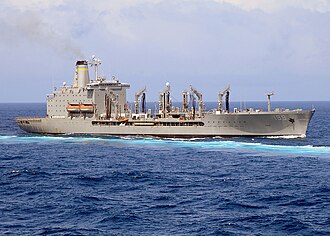
USNS Tippecanoe (T-AO-199): A Modern Fleet Replenishment Oiler of the U.S. Navy
Sustaining naval forces across the world’s oceans requires an enormous logistical effort. Warships deployed far from home ports rely on continuous supplies of fuel, aviation fuel, lubricants, and essential materials in order to remain operational. Without these support systems, even the most technologically advanced fleets would be forced to return to port frequently, limiting their strategic effectiveness. Among the ships responsible for maintaining this vital supply chain is USNS Tippecanoe (T-AO-199), a modern fleet replenishment oiler that plays a critical role in sustaining naval operations at sea.
USNS Tippecanoe belongs to the Henry J. Kaiser-class replenishment oiler, a class of auxiliary vessels specifically designed to deliver large quantities of fuel to naval task forces while underway. These ships form the backbone of the U.S. Navy’s at-sea refueling capability, enabling carrier strike groups, amphibious ready groups, and other naval formations to operate continuously across global maritime regions.
Unlike combat vessels designed for offensive operations, replenishment oilers focus on logistical support. Their main mission is to transport and transfer fuel to warships through sophisticated underway replenishment systems. By providing this capability, ships like USNS Tippecanoe allow naval forces to remain deployed for extended periods without returning to shore-based fuel depots.
The ship operates under the Military Sealift Command, an organization responsible for providing strategic and tactical logistics support to the United States Navy. Crewed primarily by civilian mariners, Military Sealift Command vessels form an essential component of the Navy’s global logistics network.
USNS Tippecanoe represents an evolution in replenishment ship design. It incorporates modern cargo handling systems, large fuel storage capacity, and advanced navigation and communications technologies. Through these capabilities, the ship contributes directly to the endurance and operational reach of U.S. naval forces.
Origins of the Henry J. Kaiser-Class Replenishment Oilers
The development of the Henry J. Kaiser-class oilers emerged from the United States Navy’s need to modernize its replenishment fleet during the late twentieth century. Earlier generations of fleet oilers were gradually becoming outdated, lacking the efficiency, automation, and cargo capacity required by modern naval operations.
During the Cold War, the U.S. Navy maintained large carrier battle groups deployed worldwide. These formations required frequent refueling, particularly because escort ships and aircraft carriers consumed significant quantities of marine diesel and aviation fuel. The logistical challenge of sustaining these fleets across multiple oceans led naval planners to design a new class of replenishment oilers capable of supporting high-tempo operations.
The Henry J. Kaiser-class ships were developed to meet this requirement. Their design was based partly on commercial tanker technology, which allowed shipbuilders to reduce construction costs while maintaining high cargo capacity and operational reliability.
USNS Tippecanoe, designated T-AO-199, became one of the later vessels built in this class. The ship was specifically designed to deliver fuel rapidly to naval task forces operating far from shore-based supply points.
Construction and Shipyard Background
USNS Tippecanoe was constructed at the Avondale Shipyard, a major American shipbuilding facility located in Louisiana. This shipyard played an important role in constructing auxiliary vessels for the United States Navy during the late twentieth century.
The ship was built using modern commercial tanker design principles combined with naval-specific systems for replenishment operations. Construction involved assembling large prefabricated hull sections before integrating complex mechanical systems, cargo handling equipment, and navigational technology.
Following completion of sea trials and system tests, the vessel entered service with the Military Sealift Command. As a United States Naval Ship (USNS), it is operated primarily by civilian mariners rather than active-duty Navy sailors.
This operational model allows the Navy to maintain a large logistics fleet without diverting personnel from combat vessels. Civilian crews handle navigation, engineering, and cargo operations while supporting naval missions worldwide.
Hull Design and Structural Characteristics
The hull of USNS Tippecanoe is designed to resemble that of a large commercial oil tanker, but it includes several specialized modifications that enable the vessel to perform naval replenishment missions.
The ship features a long steel hull optimized for carrying vast quantities of fuel. Its length exceeds 200 meters, and its wide beam provides stability during cargo transfer operations. Stability is particularly important during underway replenishment, when two ships must sail side by side in close proximity while transferring liquids and cargo.
The hull is divided into multiple fuel storage tanks, each designed to carry specific types of petroleum products. These tanks include compartments for marine diesel fuel as well as aviation fuel used by carrier-based aircraft and naval helicopters.
Reinforced internal bulkheads enhance the ship’s structural integrity and help contain fuel in case of damage. Safety systems such as fire suppression equipment and monitoring sensors are installed throughout the vessel to prevent accidents during fuel transfer operations.
Another key feature of the hull design is the integration of replenishment stations along both sides of the ship. These stations include the equipment necessary to connect fuel hoses and cargo transfer rigs between ships operating at sea.
Propulsion System and Engineering
USNS Tippecanoe is powered by a robust propulsion system designed to ensure reliability during extended deployments. Unlike fast combat support ships that rely on gas turbines, replenishment oilers typically use diesel engines for improved fuel efficiency and operational endurance.
The ship’s propulsion system consists of two large diesel engines that drive a single propeller shaft through reduction gears. This configuration provides a balance between efficiency and mechanical simplicity.
The propulsion system enables the vessel to reach speeds of approximately 20 knots, which is sufficient to keep pace with most naval task groups during replenishment operations. Although this speed is lower than that of combat ships, it is adequate for the logistical role performed by fleet oilers.
In addition to the main propulsion engines, the ship includes multiple auxiliary generators that supply electrical power to onboard systems. These systems include cargo pumps, navigation equipment, communications arrays, and crew facilities.
The engineering plant is designed for long-term reliability, allowing the ship to operate continuously for extended deployments without requiring frequent maintenance.
Fuel Storage and Transfer Systems
The primary mission of USNS Tippecanoe is the storage and transfer of fuel. The ship can carry enormous quantities of petroleum products, including marine diesel fuel and aviation fuel.
These fuels are stored in a network of large internal tanks equipped with advanced pumping systems. Powerful pumps allow the ship to transfer fuel at high rates during replenishment operations, ensuring that receiving vessels can refuel quickly.
Fuel transfer operations require precise coordination between ships. Specialized hoses are connected between the vessels using tensioned cables that stabilize the transfer equipment despite the movement of the sea.
The ship also includes sophisticated filtration and monitoring systems that ensure the quality of the fuel delivered to naval vessels.
Underway Replenishment Operations
Underway replenishment is the most critical operational capability of USNS Tippecanoe. This process allows ships to receive fuel and supplies while both vessels remain in motion.
During a replenishment operation, the receiving ship sails parallel to the oiler at a distance of approximately 30 to 50 meters. Crew members establish connection lines between the vessels using specialized launch equipment.
Once the lines are secured, fuel hoses are connected and pumping begins. The operation requires careful coordination between both ships to maintain a steady course and speed throughout the transfer process.
The replenishment stations aboard Tippecanoe allow the ship to service multiple vessels during a single operation. This capability greatly increases the efficiency of naval logistics operations.
Aviation Facilities and Helicopter Support
In addition to fuel transfer systems, USNS Tippecanoe is equipped with aviation facilities that support helicopter operations.
The ship features a flight deck located at the stern, which can accommodate medium-sized naval helicopters such as the Sikorsky MH-60 Seahawk. These helicopters are used for vertical replenishment missions, delivering cargo to ships that may not be able to sail alongside the oiler.
Vertical replenishment operations involve lifting cargo pallets suspended beneath the helicopter. The aircraft transports the cargo directly from the supply ship to the receiving vessel.
This method provides flexibility in situations where sea conditions or tactical considerations make traditional replenishment difficult.
Crew and Operational Management
USNS Tippecanoe operates with a mixed crew structure typical of Military Sealift Command vessels. Most personnel aboard the ship are civilian mariners responsible for navigation, engineering, and cargo operations.
In addition to civilian crew members, the ship may also carry a small detachment of Navy personnel responsible for communications and coordination with fleet operations.
The crew works in shifts to ensure that the ship can operate continuously during long deployments. Their duties include maintaining the ship’s propulsion systems, managing fuel transfer equipment, and supporting helicopter operations.
Despite being a logistics vessel, the operational demands placed on the crew are significant. Replenishment operations require precise teamwork and constant attention to safety procedures.
Defensive Systems and Security
Although USNS Tippecanoe is not designed for direct combat, it is equipped with basic defensive systems intended to protect the vessel from potential threats.
These systems typically include mounted heavy machine guns that provide protection against small boats or other surface threats. In some cases, ships may also carry close-in weapon systems designed to intercept incoming missiles.
However, replenishment oilers generally operate within protected naval formations that include escorting destroyers and cruisers. These warships provide the primary defense against air, surface, and submarine threats.
Strategic Importance in Modern Naval Operations
The strategic value of ships like USNS Tippecanoe lies in their ability to sustain naval operations far from home ports. Modern fleets depend on logistics vessels to maintain their operational readiness.
Aircraft carriers, cruisers, destroyers, and amphibious ships consume enormous quantities of fuel during extended deployments. Without replenishment oilers, these vessels would be forced to interrupt missions in order to refuel at shore-based facilities.
By providing fuel directly at sea, USNS Tippecanoe enables naval forces to remain deployed in strategic regions for months at a time.
This capability significantly enhances the global reach and endurance of the United States Navy.
Role within the Military Sealift Command Fleet
As part of the Military Sealift Command fleet, USNS Tippecanoe contributes to one of the largest maritime logistics networks in the world.
Military Sealift Command operates dozens of auxiliary ships that transport fuel, equipment, ammunition, and humanitarian supplies across the globe. These vessels support not only naval operations but also joint military missions and disaster relief efforts.
Through this network, logistics ships like Tippecanoe help ensure that U.S. naval forces can respond rapidly to crises anywhere in the world.
Technical Specifications of USNS Tippecanoe (T-AO-199)
| Parameter | Specification |
|---|---|
| Ship Name | USNS Tippecanoe |
| Hull Number | T-AO-199 |
| Class | Henry J. Kaiser-class replenishment oiler |
| Operator | Military Sealift Command |
| Builder | Avondale Shipyard |
| Length | ~206 m |
| Beam | ~29.7 m |
| Draft | ~11 m |
| Displacement | ~41,000 tons full load |
| Propulsion | 2 × diesel engines |
| Propeller | Single shaft |
| Maximum Speed | ~20 knots |
| Crew | ~89 civilian mariners and naval personnel |
| Cargo Type | Marine diesel fuel and aviation fuel |
| Fuel Capacity | Tens of thousands of barrels |
| Replenishment Stations | Multiple alongside fueling stations |
| Aviation Facilities | Helicopter landing deck |
| Supported Aircraft | MH-60 Seahawk helicopters |
| Defensive Systems | Machine gun mounts |
| Primary Mission | Fleet refueling and logistical support |
Conclusion
USNS Tippecanoe (T-AO-199) represents a vital component of the United States Navy’s global logistics infrastructure. As a Henry J. Kaiser-class replenishment oiler, the ship provides the fuel and support necessary for naval forces to operate far from home ports for extended periods.
Through its large fuel storage capacity, advanced pumping systems, and sophisticated replenishment equipment, the vessel enables warships to refuel while underway. This capability ensures that carrier strike groups and other naval formations can maintain continuous operations across the world’s oceans.
Although ships like Tippecanoe rarely receive the same attention as combat vessels, their role is essential to modern naval strategy. Without the logistical support provided by replenishment oilers, even the most powerful fleets would quickly lose their operational effectiveness.
By sustaining naval forces at sea, USNS Tippecanoe helps maintain the global reach and readiness of the United States Navy, demonstrating the indispensable importance of maritime logistics in modern naval warfare.
_steams_through_the_Indian_Ocean_after_conducting_a_replenishment_at_sea.jpg)