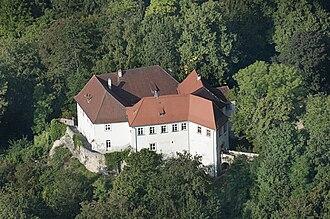
Hidden within the picturesque landscape of Franconian Switzerland in Bavaria, Germany, Schloss Hundshaupten stands as a remarkable testament to centuries of architectural evolution, feudal history, and cultural continuity. Situated in the small village of Hundshaupten, part of the municipality of Egloffstein in the district of Forchheim, this quadrangular castle is more than just a relic of medieval fortification—it is a living monument that reflects the layered narrative of Central European history.
Unlike many castles that exist today only as ruins or heavily reconstructed tourist attractions, Schloss Hundshaupten has maintained a continuous thread of habitation and ownership, preserving both its structural integrity and historical authenticity. Its location on a prominent hill spur of the Franconian Jura plateau adds both strategic significance and scenic beauty, making it a compelling subject for historical, architectural, and cultural exploration.
This article provides a comprehensive, in-depth exploration of Schloss Hundshaupten, covering its origins, historical transformations, architectural characteristics, ownership lineage, cultural importance, and its modern-day role within the region.
Geographical Setting and Landscape Context
Schloss Hundshaupten is located in Upper Franconia (Oberfranken), a region known for its rugged terrain, limestone formations, and dense forests. The castle occupies a hill spur that extends into a valley, a typical positioning for medieval fortifications in the Franconian Switzerland region.
The surrounding landscape is characterized by steep slopes, wooded hills, and agricultural clearings. This topography was not only advantageous for defense but also influenced settlement patterns and land use throughout the Middle Ages. The elevated position provided visibility across the valley, allowing early warning against approaching enemies while also symbolizing dominance over the surrounding territory.
The region itself is rich in castles and ruins, reflecting a fragmented feudal past where noble families competed for power and influence. Schloss Hundshaupten fits squarely into this historical mosaic, representing one of many fortified seats that once defined the political geography of the area.
In modern times, the castle is closely associated with the nearby wildlife park, which occupies part of the former estate lands. This integration of natural and historical heritage enhances the site’s appeal and demonstrates how historical landscapes can be adapted for contemporary use without losing their identity.
Origins and Early Development
The origins of Schloss Hundshaupten likely date back to the 13th century, although the first documented reference appears in 1369, when the castle was in the possession of the noble Lords of Wiesenthau. (egloffstein.de)
The early structure was a fortified medieval castle, designed primarily for defense rather than comfort. Its construction on a hill spur suggests that it was intended to control local routes and oversee economic activity in the surrounding region. The Lords of Wiesenthau, like many noble families of the time, relied on such fortifications to assert their authority and protect their holdings.
The name “Hundshaupten” itself reflects historical linguistic and administrative developments. The suffix “-haupten” likely refers to the elevated terrain or headland on which the castle stands, while the prefix “Hund-” may relate to an early administrative title or landholder, possibly a leader of a local community known as a “Hunno.”
These linguistic clues provide insight into the early medieval social structure, where territorial control and leadership roles were closely tied to land ownership and fortified residences.
Destruction and Repeated Rebuilding
One of the defining characteristics of Schloss Hundshaupten’s history is its repeated destruction and reconstruction, reflecting the turbulent nature of medieval and early modern Europe.
The War of the Cities (1388)
The castle suffered its first major destruction in 1388 during the War of the Cities, when forces from Nuremberg attacked and destroyed the stronghold. This conflict was part of a broader struggle between emerging urban centers and traditional feudal lords, highlighting the shifting balance of power in late medieval Germany.
Early 15th Century Conflicts
In 1412, the castle was again destroyed, this time by Burgrave Frederick VI of Nuremberg. These repeated attacks indicate that the castle was not only strategically important but also politically contentious.
The German Peasants’ War (1525)
The third major destruction occurred during the German Peasants’ War in 1525, a widespread uprising driven by social, economic, and religious tensions. Like many noble residences, Schloss Hundshaupten became a target of peasant forces seeking to challenge feudal authority.
Reconstruction in 1561
After this series of devastations, the castle was rebuilt in 1561. This reconstruction marked a transition from purely defensive architecture toward a more residential function, although the structure retained many of its fortified characteristics.
The repeated cycles of destruction and rebuilding contributed to the castle’s hybrid architectural identity, blending medieval defensive elements with later residential features.
Transition to a Noble Residence
Following its reconstruction in the 16th century, Schloss Hundshaupten gradually evolved from a fortress into a more comfortable noble residence.
This transformation was influenced by broader changes in European society. As centralized states became more stable and warfare shifted in nature, the need for heavily fortified castles diminished. Noble families began to prioritize comfort, aesthetics, and representation over purely defensive capabilities.
The addition of architectural features such as arcades in the courtyard and larger windows reflects this shift. These elements not only improved living conditions but also signaled the status and cultural sophistication of the castle’s occupants.
Ownership Changes and the Pölnitz Family
End of the Wiesenthau Line
In 1613, the Wiesenthau family line associated with the castle came to an end, and the property reverted to Michelsberg Abbey in Bamberg. This transition illustrates the complex relationships between secular and ecclesiastical authorities in the Holy Roman Empire.
Acquisition by the Pölnitz Family
In 1661, the castle was acquired by Hieronymus Christoph Freiherr von Pölnitz, a prominent figure who served as a town commandant and held various political roles.
The Pölnitz family would go on to play a central role in the history of Schloss Hundshaupten, maintaining ownership for centuries and shaping its development into a baroque country estate.
Baroque Modifications
Under the Pölnitz family, the castle underwent modifications that enhanced its residential character while preserving its historical structure. Large sandstone-framed windows and other baroque elements were introduced, giving the building a more refined appearance without erasing its medieval origins.
This balance between preservation and modernization is a defining feature of the castle, allowing it to retain its authenticity while adapting to changing needs.
Architectural Characteristics
Schloss Hundshaupten is described as a quadrangular castle, meaning it consists of four wings arranged around a central courtyard.
Layout and Structure
The four-wing design creates an enclosed space that would have served both defensive and functional purposes. The central courtyard acted as a hub for daily activities, including storage, gatherings, and possibly small-scale agricultural operations.
Defensive Features
Although the castle evolved into a residence, it retains elements of its defensive origins, such as thick walls and a strategic hilltop location. These features reflect the architectural priorities of its earliest phases.
Residential Enhancements
The addition of baroque windows and interior modifications transformed the castle into a more comfortable living space. These changes illustrate the gradual shift from military to residential architecture.
Materials and Construction
The castle is primarily constructed from local stone, typical of the region. The use of sandstone for window frames and decorative elements highlights the craftsmanship involved in its later modifications.
The Castle in the Context of Franconian Switzerland
Franconian Switzerland is one of the most castle-rich regions in Germany, with numerous fortifications scattered across its hills and valleys. Schloss Hundshaupten is part of this broader cultural landscape, contributing to the region’s identity as a historical and tourist destination.
The concentration of castles in this area reflects the fragmented political structure of the Holy Roman Empire, where numerous small territories were controlled by local lords. Each castle served as both a residence and a symbol of authority.
Schloss Hundshaupten stands out within this context due to its continuous habitation and relatively intact structure, offering a more complete picture of historical development than many nearby ruins.
Modern Developments and Preservation
Restoration Efforts
In recent years, significant efforts have been made to preserve and restore Schloss Hundshaupten. Renovation projects have focused on maintaining the structural integrity of the building while respecting its historical character.
These efforts have been supported by various organizations, including heritage foundations and government programs dedicated to monument preservation.
Recognition and Awards
The restoration work has received recognition, highlighting the importance of preserving cultural heritage. Such initiatives ensure that the castle remains a valuable historical resource for future generations.
Continued Private Ownership
Despite its historical significance, the castle remains in private ownership, continuing the tradition established by the Pölnitz family. This continuity contributes to the authenticity of the site and distinguishes it from many publicly managed historical monuments.
The Wildlife Park and Estate Integration
One of the most distinctive aspects of Schloss Hundshaupten is its integration with the surrounding wildlife park.
Established in 1971 by Gudila von Pölnitz, the park was designed to present wildlife in a naturalistic environment, reflecting a progressive approach to conservation and public education.
The park covers approximately 40 hectares, with a large portion consisting of forested land. Over time, it has expanded to include various species, offering visitors an immersive experience that complements the historical setting of the castle.
In 1991, parts of the estate, including the wildlife park, were transferred to the district of Forchheim, ensuring their continued operation and public accessibility.
Cultural and Historical Significance
Schloss Hundshaupten is more than just an architectural structure; it is a cultural artifact that embodies the history of the region.
Representation of Feudal Society
The castle reflects the hierarchical structure of medieval society, where power was concentrated in the hands of noble families who controlled land and resources.
Witness to Historical Events
Its repeated destruction and rebuilding illustrate the conflicts that shaped European history, from local feuds to broader social upheavals.
Continuity and Adaptation
The castle’s ability to adapt to changing circumstances—transitioning from fortress to residence and integrating with modern initiatives like the wildlife park—demonstrates the resilience of historical sites.
Tourism and Visitor Experience
While Schloss Hundshaupten itself is not always fully accessible to the public due to its private ownership, the surrounding area, including the wildlife park, attracts visitors interested in both history and nature.
The combination of historical architecture and natural landscapes creates a unique visitor experience, allowing for a deeper appreciation of the region’s heritage.
Technical Specifications
| Feature | Description |
|---|---|
| Name | Schloss Hundshaupten |
| Location | Hundshaupten, Egloffstein, Forchheim district, Bavaria, Germany |
| Coordinates | Approx. 49.7205° N, 11.2257° E |
| Elevation | Approx. 462 meters above sea level |
| Type | Quadrangular castle / Schloss |
| Original Construction | Likely 13th century |
| First Mention | 1369 |
| Major Reconstructions | 1561 (post-Peasants’ War) |
| Architectural Style | Medieval with Baroque modifications |
| Layout | Four-wing complex with central courtyard |
| Historical Owners | Lords of Wiesenthau; Michelsberg Abbey; Pölnitz family |
| Current Ownership | Private (Pölnitz family) |
| Associated Site | Wildlife Park Hundshaupten |
| Heritage Status | Listed monument (Bavarian Denkmalliste) (denkmalnetzbayern.de) |
Conclusion
Schloss Hundshaupten stands as a remarkable example of how historical structures can endure through centuries of conflict, transformation, and modernization. From its origins as a medieval fortress to its current status as a preserved noble residence integrated with a wildlife park, the castle embodies the dynamic interplay between history and continuity.
.jpg)