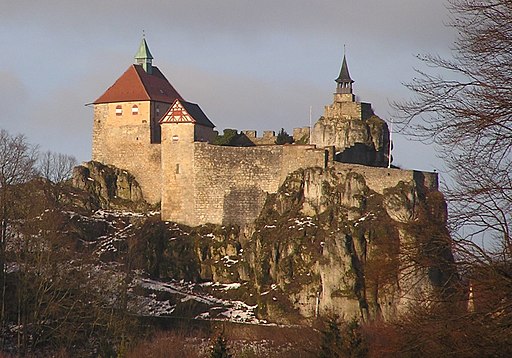
Standing prominently on a steep rocky ridge in the northern part of Middle Franconia, Burg Hohenstein dominates the surrounding countryside with an imposing silhouette that has shaped the identity of the region for centuries. The castle rises above the small settlement of Hohenstein, itself part of the municipality of Kirchensittenbach, in a landscape characterized by rolling hills, dense forests, and striking limestone outcrops. From afar, the fortress appears almost inseparable from the rock on which it stands, its thick stone walls blending into the rugged formations of the Franconian Jura.
The castle’s elevated location was carefully chosen. During the medieval era, height meant power, protection, and visibility. From the summit, one can observe large portions of the Pegnitz valley region, an area historically crossed by trade routes linking important Franconian towns. The ability to oversee movement across these routes made the castle strategically valuable, allowing its rulers to maintain influence over commerce, communication, and territorial security.
Origins in the High Middle Ages
The foundations of Burg Hohenstein reach back to the High Middle Ages, when noble families established fortified residences across Franconia to secure their authority and protect their lands. The castle was closely associated with the powerful Lords of Hohenstein, a noble lineage that emerged as an influential regional force during the twelfth and thirteenth centuries. Their stronghold served both as a residence and as an administrative center overseeing surrounding villages and agricultural estates.
In medieval society, castles such as Burg Hohenstein were more than military fortifications. They functioned as centers of governance where legal disputes were resolved, taxes and duties were organized, and alliances were negotiated. Within its walls lived not only the noble family but also a network of servants, guards, craftsmen, and officials who supported the daily operations of the estate.
The castle’s presence also reflected the complex political structure of the Holy Roman Empire, in which regional nobles balanced loyalty to larger authorities while maintaining significant autonomy over their territories. Burg Hohenstein therefore stood not only as a defensive structure but also as a symbol of feudal power and local identity.
Architecture and Defensive Strength
Burg Hohenstein’s architecture reflects the priorities of medieval fortress construction. Built largely from locally quarried stone, the castle features thick walls designed to resist attack and protect those within. The irregular layout follows the contours of the rocky hilltop, demonstrating how medieval builders adapted their designs to natural terrain rather than imposing rigid geometric plans.
One of the most striking features of the castle is its massive keep, which towers above the surrounding structures and served as the heart of the fortress. This central tower functioned as both a lookout and a final defensive refuge in the event of siege. From its upper levels, guards could observe distant valleys and signal to nearby settlements if danger approached.
Surrounding the keep were additional buildings that formed the living and working spaces of the castle. Residential quarters, storage areas, and defensive towers were arranged within protective curtain walls that enclosed the inner courtyard. Narrow gates and carefully controlled entry points ensured that access to the fortress could be defended even against determined attackers.
The architecture balanced practicality with symbolic authority. The towering walls and commanding position projected strength and permanence, reinforcing the power of the noble family that ruled from this elevated seat.
Life Within the Castle Walls
Life at Burg Hohenstein during the Middle Ages would have been both structured and demanding. Although the castle symbolized privilege and power, daily existence required careful management of resources and constant vigilance. Supplies had to be transported up the steep hill, wells maintained, and defensive preparations kept ready in case of conflict.
Within the courtyard, activity would have been constant. Servants carried water and food, craftsmen repaired tools and weapons, and guards rotated through their watch duties. The castle kitchen provided meals not only for the noble family but also for soldiers and workers who maintained the fortress.
Despite its defensive purpose, Burg Hohenstein also functioned as a place of ceremony and diplomacy. Visiting nobles, envoys, and travelers might pass through its gates, bringing news from distant territories. Feasts, negotiations, and celebrations would occasionally transform the fortress from a place of vigilance into a center of social life.
Decline and Historical Transformation
As the centuries progressed, the political and military significance of castles began to decline. Changes in warfare, particularly the development of gunpowder artillery, made traditional hilltop fortresses less effective as defensive structures. Administrative systems also evolved, shifting political authority toward larger urban centers.
Burg Hohenstein gradually lost its original role as a fortified residence. Parts of the complex fell into disrepair, and the castle experienced periods of neglect as the priorities of its owners changed. Like many medieval strongholds across Bavaria, it faced the possibility of slow decay as time and weather eroded its structures.
However, the dramatic presence of the castle ensured that it would never be entirely forgotten. Its towering walls and distinctive position above the Franconian hills captured the imagination of later generations who saw in its ruins a powerful connection to the region’s medieval heritage.
Restoration and Cultural Revival
In more recent centuries, appreciation for historic architecture led to renewed efforts to preserve Burg Hohenstein. Restoration initiatives focused on stabilizing the remaining structures and protecting them from further deterioration. These efforts aimed not only to safeguard the castle as a monument but also to allow visitors to experience its unique atmosphere.
Today the castle serves as a cultural landmark and educational site, welcoming travelers who wish to explore the history of Franconia. Walking through the gate and into the courtyard offers a tangible connection to centuries of regional history. The preserved walls, towers, and pathways allow visitors to imagine the daily life of those who once lived and worked within the fortress.
The castle also hosts cultural events and gatherings that bring new life to its ancient spaces. Music performances, historical exhibitions, and community celebrations transform the fortress into a vibrant meeting place where past and present intersect.
The View from the Summit
Perhaps the most memorable aspect of Burg Hohenstein is the panoramic view it offers across the Franconian countryside. From the castle’s elevated terraces, visitors can see forests, farmland, and distant hills stretching toward the horizon. This landscape has changed far less than the political structures that once shaped it, allowing modern observers to glimpse something of the world that medieval inhabitants would have known.
Standing on the castle walls, one can appreciate why this location was chosen centuries ago. The combination of natural beauty and strategic advantage makes the site both historically significant and visually inspiring. The wind sweeping across the hilltop and the vast open sky above create a sense of timelessness that connects visitors with the past.
An Enduring Symbol of Franconian Heritage
Today Burg Hohenstein remains one of the most recognizable historic landmarks in Middle Franconia. Although centuries have transformed its function and appearance, the castle continues to represent the region’s medieval roots and cultural continuity. Its towering presence above the village below reminds observers of the era when fortified strongholds shaped the political and social landscape of Bavaria.
More than a ruin, Burg Hohenstein stands as a living testament to the endurance of history within the Franconian landscape. The fortress, once a seat of noble authority and defense, now invites exploration, reflection, and admiration. Through preservation and public engagement, the castle continues to tell its story, linking modern visitors with the generations who once watched over the valleys from its ancient walls.
