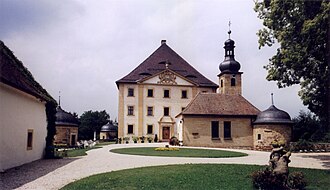
Located in the northern reaches of Bavaria, in the scenic region of Upper Franconia, Schloss Trockau is a historically rich and architecturally layered noble residence that reflects the evolution of aristocratic life from the late medieval period into the modern era. Unlike the dramatic hilltop fortresses that dominate the Franconian imagination, Schloss Trockau presents a more refined and integrated form of noble architecture, shaped by centuries of adaptation, ownership changes, and cultural transformation.
Situated in the village of Trockau, which is today part of the town of Pegnitz, the castle occupies a strategic yet less overtly defensive position compared to earlier medieval strongholds. Its development reflects a broader shift in European architecture, where the emphasis gradually moved from military necessity to residential comfort, administrative function, and aesthetic expression.
Schloss Trockau is particularly notable for its connection to prominent noble families and for its transformation over time into a baroque-style residence. It stands as a testament to continuity, resilience, and the ability of historical structures to evolve while preserving their identity. This extensive article explores the castle’s geographical context, historical development, architectural features, cultural significance, and modern relevance, offering a comprehensive portrait of one of Franconia’s lesser-known but highly significant heritage sites.
Geographic Setting and Landscape Context
The village of Trockau lies within the gently rolling terrain of Upper Franconia, a region characterized by a mixture of forested hills, agricultural land, and small rural settlements. Unlike the steep cliffs and dramatic rock formations found in nearby Franconian Switzerland, the landscape around Trockau is more subdued, offering a sense of openness and accessibility that influenced the development of its architectural landmarks.
Schloss Trockau is positioned within this landscape in a way that reflects both practicality and status. It is not isolated on a remote hilltop but integrated into the settlement, allowing for closer interaction with the surrounding community and agricultural lands. This positioning highlights its role not only as a residence but also as an administrative center overseeing local economic activity.
The surrounding environment has played a crucial role in shaping the castle’s history. The availability of fertile land supported agricultural production, while nearby trade routes connected the region to larger economic networks. These factors contributed to the prosperity of the castle’s owners and influenced the development of the estate.
In modern times, the setting of Schloss Trockau remains largely intact, preserving the historical relationship between the castle and its environment. The surrounding village, fields, and forests continue to provide a context that enhances the understanding of the site’s historical function and significance.
Origins and Early History
The origins of Schloss Trockau can be traced back to the late medieval period, likely in the 14th or early 15th century. During this time, the region was part of the fragmented political landscape of the Holy Roman Empire, where local noble families exercised significant autonomy over their territories.
The earliest structure on the site was probably a fortified manor or small castle designed to provide protection and serve as a seat of local authority. Unlike larger fortresses, which were built to withstand prolonged sieges, the early form of Schloss Trockau would have been more modest, focusing on defense against smaller-scale threats such as raids or local conflicts.
The name “Trockau” itself reflects the historical development of the settlement, possibly deriving from older Germanic linguistic roots associated with land use or settlement patterns. The castle would have played a central role in the development of the village, serving as both a symbol of authority and a hub of economic activity.
Over time, the structure was expanded and modified to accommodate the changing needs of its inhabitants. These early developments laid the foundation for the more elaborate residence that would emerge in later centuries.
Noble Ownership and Family Influence
One of the defining features of Schloss Trockau’s history is its association with various noble families, each of whom contributed to its development and character.
Among the most significant were the Hohenlohe family, a prominent aristocratic lineage with extensive holdings throughout southern Germany. Their involvement with Schloss Trockau marked a period of expansion and refinement, during which the castle was transformed into a more sophisticated residence.
The influence of noble families extended beyond architecture to include the management of land, the administration of justice, and the shaping of local society. Schloss Trockau served as a center of authority, where decisions affecting the surrounding region were made.
The continuity of noble ownership also contributed to the preservation of the castle. Unlike properties that changed hands frequently, Schloss Trockau benefited from a degree of stability that allowed for long-term planning and investment in its development.
Transformation into a Baroque Residence
The most significant transformation of Schloss Trockau occurred during the Baroque period, when the castle was redesigned to reflect the aesthetic and cultural ideals of the time.
Baroque architecture emphasized grandeur, symmetry, and decorative detail, creating buildings that were not only functional but also visually impressive. At Schloss Trockau, this transformation involved the addition of new wings, the enlargement of windows, and the introduction of decorative elements that enhanced the building’s appearance.
The interior spaces were also reconfigured to provide greater comfort and accommodate the social activities of aristocratic life. Reception rooms, salons, and private chambers were designed with attention to detail, reflecting the tastes and expectations of the period.
This transformation marked a shift in the castle’s function, from a primarily defensive structure to a residence focused on comfort, representation, and cultural expression. It also aligned Schloss Trockau with broader architectural trends across Europe, where many castles were converted into palaces or manor houses.
Architectural Characteristics
Schloss Trockau is a multi-wing complex that reflects its long history of development and adaptation. Its architecture combines elements from different periods, creating a layered and dynamic structure.
Layout and Structure
The castle is organized around a central courtyard, a common feature of noble residences. This layout provides both practical and aesthetic benefits, allowing for efficient movement within the complex while creating a sense of enclosure and order.
Exterior Features
The exterior of the castle displays a combination of medieval and Baroque elements. The overall structure retains the solidity of its early origins, while the decorative features introduced during the Baroque period add elegance and refinement.
Interior Spaces
Although not always accessible to the public, the interior of Schloss Trockau is believed to contain historical features that illustrate the evolution of aristocratic living. These may include decorative ceilings, period furnishings, and architectural details that reflect different stages of the castle’s development.
Materials and Construction
The castle is constructed primarily from local stone, with additional materials used for decorative elements. The use of regional resources reflects both practicality and the integration of the building into its environment.
Role in Regional History
Schloss Trockau has played an important role in the history of Upper Franconia, serving as a center of local authority and economic activity.
During the medieval period, the castle was part of a network of noble residences that defined the political landscape of the region. These structures were essential for maintaining control over land and resources, as well as for defending against external threats.
In later centuries, the castle’s role shifted toward administration and governance. It became a focal point for managing agricultural production and overseeing the local population.
The transition to modern state structures in the 19th century brought significant changes, but Schloss Trockau adapted to these developments, maintaining its relevance within a changing society.
Cultural Significance
Schloss Trockau is an important cultural landmark that reflects the heritage and identity of the region.
Representation of Aristocratic Life
The castle provides insight into the lifestyle of the nobility, illustrating how their residences evolved over time to meet changing needs and expectations.
Architectural Heritage
As a building that incorporates elements from multiple periods, Schloss Trockau offers valuable information about the development of architectural styles in Europe.
Local Identity
The castle is closely connected to the village of Trockau, serving as a symbol of local history and continuity.
Modern Use and Preservation
Today, Schloss Trockau remains a privately owned property, reflecting its long-standing association with noble families. While access to the interior may be limited, the exterior and surrounding grounds can still be appreciated as part of the cultural landscape.
Preservation efforts have focused on maintaining the structural integrity of the building while respecting its historical character. These efforts are essential for ensuring that the castle remains a valuable heritage site.
The castle also contributes to regional tourism, attracting visitors interested in history, architecture, and the cultural heritage of Upper Franconia.
Schloss Trockau in the Context of Franconian Architecture
Within the broader context of Franconian architecture, Schloss Trockau represents a transitional form between medieval castles and later manor houses. Its evolution reflects broader trends in European history, where the emphasis shifted from defense to comfort and representation.
This makes the castle an important example of architectural adaptation, illustrating how historical structures can evolve while preserving their core identity.
Technical Specifications
| Feature | Description |
|---|---|
| Name | Schloss Trockau |
| Location | Trockau (Pegnitz), Upper Franconia, Bavaria, Germany |
| Type | Noble residence / former castle |
| Construction Period | Late medieval origins (14th–15th century) |
| Architectural Style | Medieval core with Baroque modifications |
| Layout | Multi-wing complex with central courtyard |
| Primary Materials | Local stone with decorative additions |
| Historical Owners | Various noble families, including Hohenlohe family |
| Current Ownership | Private |
| Setting | Village-integrated estate |
| Historical Function | Noble residence, administrative center |
| Preservation Status | Maintained with ongoing conservation |
| Region | Upper Franconia, Bavaria, Germany |
Conclusion
Schloss Trockau stands as a compelling example of the evolution of aristocratic architecture in Bavaria. From its origins as a fortified medieval residence to its transformation into a Baroque-style estate, the castle reflects the changing needs and aspirations of its inhabitants.
Its integration within the village of Trockau, combined with its architectural diversity and historical continuity, makes it a unique and valuable heritage site. As both a historical monument and a living part of the cultural landscape, Schloss Trockau continues to preserve the legacy of the past while remaining relevant in the present.
