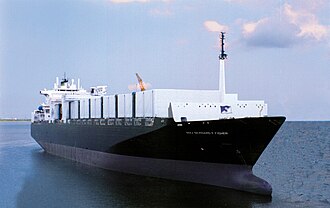
MV Maj. Bernard F. Fisher (T-AK-4396): A Strategic Lifeline of Modern Military Sealift
In the complex machinery of global military logistics, there exists a fleet of ships that rarely attract public attention yet play an indispensable role in sustaining operations across continents. Among these vessels, MV Maj. Bernard F. Fisher (T-AK-4396) stands as a critical component of the United States’ strategic sealift capability. Built for endurance, flexibility, and rapid deployment, this ship embodies the principle that logistics is not merely a support function—it is a decisive element of military power.
Operating under the Military Sealift Command (MSC), MV Maj. Bernard F. Fisher is part of a broader network of auxiliary vessels that ensure troops, vehicles, and supplies can be delivered wherever they are needed, often at short notice and under demanding conditions. Unlike combat ships, it carries no weapons and engages in no direct conflict, yet its contribution to operational readiness is profound.
This extensive blog-style article explores the ship in depth—its origins, engineering design, propulsion systems, cargo capabilities, operational doctrine, and strategic significance—before concluding with a comprehensive table of technical specifications.
Origins and Historical Context
Lessons from 20th-Century Warfare
The concept behind vessels like MV Maj. Bernard F. Fisher is rooted in the logistical lessons of the 20th century. World War II demonstrated that the ability to move vast quantities of matériel across oceans was essential to victory. Later conflicts, including Korea and Vietnam, reinforced the importance of maintaining a robust sealift capability.
By the late Cold War and into the post-Cold War era, the United States began investing in more modern, efficient cargo ships capable of supporting rapid global deployment. These vessels were designed to complement airlift capabilities by transporting heavy equipment that could not be flown economically or in sufficient quantities.
Naming and Legacy
The ship is named after Bernard F. Fisher, a United States Air Force officer and Medal of Honor recipient. His actions during the Vietnam War, particularly his daring rescue of a downed pilot under enemy fire, exemplify courage and dedication—qualities reflected in the mission of the vessel that bears his name.
Naming Military Sealift Command vessels after distinguished individuals serves both as a tribute and as a reminder of the human dimension behind military operations.
Construction and Entry into Service
MV Maj. Bernard F. Fisher was constructed in the late 20th century as part of the U.S. Navy’s effort to modernize its auxiliary fleet. Built to commercial standards with military enhancements, the ship reflects a hybrid design philosophy that prioritizes efficiency while meeting operational requirements.
Upon completion, the vessel was assigned to the Military Sealift Command, where it operates with a civilian crew supplemented by military and technical personnel when required.
Design Philosophy: Efficiency Meets Operational Readiness
Commercial Roots, Military Purpose
One of the defining characteristics of MV Maj. Bernard F. Fisher is its commercial lineage. Unlike warships designed from scratch for combat, this vessel is based on proven commercial cargo ship designs, adapted to meet military needs.
This approach offers several advantages:
- Reduced construction costs
- Proven reliability
- Simplified maintenance
- Operational flexibility
At the same time, modifications ensure that the ship can handle military cargo, operate in diverse environments, and integrate into defense logistics networks.
Flexibility in Cargo Handling
The ship is designed to handle a wide variety of cargo types, including:
- Vehicles and heavy equipment
- Containerized supplies
- Bulk cargo
This flexibility allows it to support different mission profiles, from humanitarian aid to large-scale military deployments.
Dimensions and Structural Characteristics
Hull and Size
MV Maj. Bernard F. Fisher is a large cargo vessel, measuring approximately 673 feet (205 meters) in length, with a beam of around 105 feet (32 meters). Its size allows it to carry substantial amounts of cargo while maintaining ocean-going stability.
The ship’s draft is typically around 30 feet (9 meters), enabling it to access major ports while still accommodating heavy loads.
Structural Layout
Internally, the vessel is divided into multiple cargo holds and decks, each designed to maximize storage efficiency. Reinforced decks allow for the transport of heavy vehicles, while container slots provide flexibility for different cargo configurations.
The ship’s structure is designed to withstand the stresses of long ocean voyages and heavy loading conditions.
Propulsion and Engineering Systems
Main Propulsion Plant
The vessel is powered by a diesel propulsion system, typically consisting of a single slow-speed diesel engine driving a fixed-pitch propeller. This configuration is widely used in commercial shipping due to its reliability and fuel efficiency.
The engine produces sufficient power to propel the ship at a cruising speed of approximately 20 knots, allowing it to keep pace with modern logistical demands.
Auxiliary Systems
In addition to the main engine, the ship is equipped with auxiliary generators that supply electricity for:
- Navigation systems
- Cargo handling equipment
- Crew accommodations
These systems ensure that the vessel remains fully operational during extended deployments.
Maneuverability
The ship is equipped with bow thrusters and advanced steering systems, enabling it to maneuver effectively in confined spaces such as ports and harbors.
Cargo Handling Capabilities
Container and Breakbulk Cargo
MV Maj. Bernard F. Fisher is capable of carrying both containerized and breakbulk cargo. This dual capability makes it highly versatile, allowing it to adapt to different mission requirements.
Cranes and Loading Equipment
The vessel is equipped with onboard cranes, enabling it to load and unload cargo without relying entirely on port infrastructure. This capability is particularly important in regions with limited facilities.
Cargo Capacity
The ship can carry tens of thousands of tons of cargo, including:
- Military vehicles
- Engineering equipment
- Supplies and provisions
Its large capacity makes it a key asset in large-scale operations.
Operational Role and Mission Profile
Strategic Sealift
The primary mission of MV Maj. Bernard F. Fisher is to provide strategic sealift—transporting equipment and supplies across oceans to support military operations.
Humanitarian Assistance
In addition to military missions, the ship can be used for humanitarian assistance and disaster relief, delivering aid to affected regions.
Global Deployment
With its long range and endurance, the vessel can operate worldwide, supporting operations in remote and challenging environments.
Crew and Life Onboard
Civilian Mariners
Like most MSC vessels, MV Maj. Bernard F. Fisher is operated by civilian mariners. These professionals are responsible for navigation, engineering, and daily operations.
Living Conditions
The ship provides accommodations designed for long deployments, including:
- Cabins for crew members
- Dining facilities
- Recreational areas
Life onboard requires discipline and teamwork, as crew members work together to ensure safe and efficient operations.
Strategic Importance
Enabling Military Operations
Without ships like MV Maj. Bernard F. Fisher, large-scale military operations would be impossible. The vessel ensures that troops have access to the equipment and supplies they need.
Supporting Rapid Response
The ship’s ability to transport large quantities of cargo quickly makes it a valuable asset in crisis situations.
Integration with Joint Forces
The vessel supports joint operations, working alongside airlift and ground logistics to provide a comprehensive supply chain.
Engineering Strengths and Limitations
Strengths
- High cargo capacity
- Operational flexibility
- Proven commercial design
- Global reach
Limitations
- Limited self-defense capabilities
- Dependence on port infrastructure
- Slower than air transport
Legacy and Future Outlook
Continued Relevance
As global logistics become increasingly complex, vessels like MV Maj. Bernard F. Fisher remain essential to military and humanitarian operations.
Future Developments
Advances in automation, fuel efficiency, and cargo handling may shape the next generation of sealift vessels.
Technical Specifications Table
| Parameter | Specification |
|---|---|
| Ship Name | MV Maj. Bernard F. Fisher (T-AK-4396) |
| Type | Strategic Sealift Cargo Ship |
| Operator | Military Sealift Command |
| Owner | U.S. Navy |
| Length | ~673 ft (205 m) |
| Beam | ~105 ft (32 m) |
| Draft | ~30 ft (9 m) |
| Displacement | ~35,000–40,000 tons |
| Propulsion | Single diesel engine, fixed-pitch propeller |
| Speed | ~20 knots |
| Range | Intercontinental |
| Crew | Civilian mariners (~25–30) |
| Cargo Capacity | Tens of thousands of tons |
| Cargo Types | Containers, vehicles, bulk cargo |
| Cranes | Onboard cargo cranes |
| Special Features | Multi-role cargo capability |
| Armament | None |
| Role | Strategic sealift and logistics support |
| Status | Active |
Final Thoughts
MV Maj. Bernard F. Fisher (T-AK-4396) represents the quiet strength of modern logistics. It does not engage in combat, yet it enables combat forces to function effectively. It does not carry weapons, yet it delivers the tools of defense and aid.
In the grand strategy of global operations, ships like this are indispensable. They form the backbone of mobility, ensuring that wherever the need arises—whether in war or peace—the necessary resources can be delivered swiftly and reliably.
.jpg)