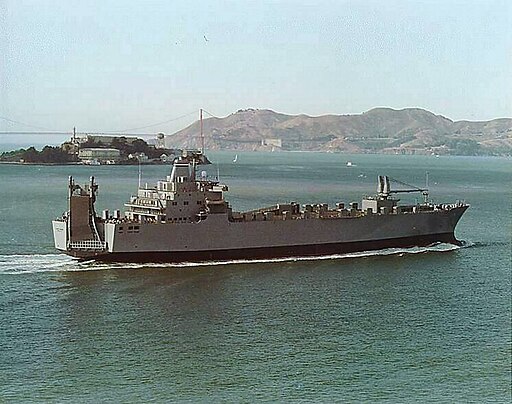
When discussions turn to military power, public attention naturally gravitates toward aircraft carriers, stealth fighters, submarines, and advanced missile systems. These platforms symbolize military strength and technological sophistication. Yet behind every deployment of troops, tanks, helicopters, and support equipment lies an often-overlooked network of logistics assets that make global military operations possible. Among these critical assets is the SS Cape Intrepid (T-AKR-11), a vessel whose importance extends far beyond its outward appearance.
The Cape Intrepid belongs to a specialized category of ships known as Large, Medium-Speed Roll-on/Roll-off (LMSR) vessels. These ships form the backbone of the United States’ strategic sealift capability, enabling the rapid movement of military equipment across oceans. Unlike traditional cargo ships that rely heavily on cranes and extensive cargo handling procedures, LMSR vessels are designed to load and unload vehicles quickly through integrated ramps and expansive cargo decks. This capability allows military forces to deploy rapidly in response to crises, conflicts, humanitarian emergencies, and disaster relief operations.
Since entering service during the final decade of the twentieth century, the Cape Intrepid has served as a vital component of America’s global logistics infrastructure. While it rarely attracts media attention, its ability to transport thousands of tons of military equipment represents an indispensable element of modern force projection. The ship demonstrates a simple but crucial reality: no military can operate effectively without a reliable system for moving personnel, vehicles, supplies, and equipment across vast distances.
The story of the Cape Intrepid is therefore much more than the history of a single ship. It is a story about logistics, preparedness, maritime innovation, and the strategic importance of maintaining the capability to respond quickly to events anywhere in the world.
The Evolution of Strategic Sealift
Why Sealift Matters
Modern military operations depend upon an extraordinary amount of equipment. A single armored brigade may require hundreds of vehicles, including tanks, armored personnel carriers, engineering machinery, fuel trucks, maintenance vehicles, and support systems. Transporting such equipment by air is possible but prohibitively expensive and limited in capacity.
Sealift provides the practical solution.
Historically, the movement of armies by sea has shaped the outcome of wars for centuries. From the great naval campaigns of the Age of Sail to the amphibious operations of the Second World War, maritime transportation has consistently played a decisive role in military strategy. As military equipment became larger and more sophisticated during the twentieth century, the importance of specialized cargo ships increased dramatically.
Following the Cold War, American defense planners recognized that future military operations would require the rapid deployment of forces to regions far from traditional bases. This realization led to investments in advanced sealift capabilities, including a new generation of roll-on/roll-off vessels specifically designed to transport military cargo.
The Cape Intrepid emerged from this strategic vision.
The Birth of the LMSR Program
During the early 1990s, the United States sought to modernize its sealift fleet. Lessons learned during major deployments demonstrated the need for vessels capable of transporting enormous quantities of equipment quickly and efficiently. The result was the Large, Medium-Speed Roll-on/Roll-off program.
LMSR ships were designed to combine several key characteristics. They needed large cargo capacities, rapid loading and unloading systems, relatively high transit speeds, and the flexibility to support operations in ports with varying levels of infrastructure. Unlike conventional cargo ships optimized solely for commercial profitability, LMSRs were purpose-built to meet military transportation requirements.
The Cape Intrepid became one of the ships acquired and converted to support this ambitious logistics strategy.
Origins of the Cape Intrepid
Construction in Denmark
The vessel that would eventually become Cape Intrepid was originally built in Denmark during the 1980s. Constructed by Odense Steel Shipyard, one of Europe’s most respected shipbuilding facilities, the ship was initially designed for commercial service within the international cargo transportation market.
The ship entered service under the name MV Nille Maersk, becoming part of the vast maritime network operated by the renowned Danish shipping company Maersk. During this period, the vessel participated in international commerce, transporting goods across major global trade routes.
At the time of its construction, global trade was undergoing rapid expansion. Containerization and specialized cargo transportation methods were transforming maritime commerce, and shipbuilders were developing increasingly capable vessels to meet market demands. The future Cape Intrepid benefited from this era of innovation, receiving a design that emphasized cargo capacity, efficiency, and reliability.
Although built for commercial purposes, the vessel possessed characteristics that later attracted the attention of military planners. Its large cargo spaces, robust engineering, and adaptability made it an excellent candidate for conversion into a strategic sealift asset.
Acquisition by the United States
As the United States expanded its strategic sealift capabilities during the 1990s, several commercial vessels were acquired and modified to support military operations. The future Cape Intrepid was among those selected for conversion.
The ship was purchased by the U.S. government and underwent extensive modifications to transform it from a commercial cargo carrier into a military support vessel. Following conversion, the ship entered service under the designation T-AKR-11 and received the name Cape Intrepid.
The prefix “T” indicates operation by the Military Sealift Command rather than direct commissioning as a warship. Unlike combat vessels operated by Navy crews, Military Sealift Command ships are generally crewed by civilian mariners who perform essential transportation missions in support of military operations.
This arrangement provides significant advantages. Civilian mariners possess extensive commercial maritime experience while allowing naval personnel to focus on combat-related responsibilities. Together, these systems create a highly effective logistics network capable of supporting military operations around the globe.
Conversion into a Military Logistics Giant
Transforming a Commercial Vessel
Converting a commercial cargo ship into a military sealift vessel involves much more than simply repainting the hull and changing the ship’s name. Extensive modifications are required to ensure compatibility with military equipment and operational requirements.
For the Cape Intrepid, these modifications included the installation of strengthened cargo decks, enhanced vehicle handling systems, military-compatible communications equipment, and improved cargo management infrastructure. Internal spaces were reconfigured to maximize the efficient storage and movement of military vehicles.
One of the ship’s most important features became its extensive roll-on/roll-off capability. Vehicles can enter and exit the vessel through large stern and side ramps, eliminating the need for complex crane operations. This capability dramatically reduces loading and unloading times, allowing military units to deploy more rapidly.
The conversion process effectively transformed the vessel into a floating logistics platform capable of supporting large-scale military operations anywhere in the world.
The Importance of Cargo Flexibility
Modern military operations require flexibility. A ship may be tasked with transporting tanks during one deployment, helicopters during another, and humanitarian relief supplies during a third mission.
The Cape Intrepid was designed to accommodate this diversity of cargo.
Its large internal decks can house thousands of tons of military equipment. Wide vehicle lanes facilitate movement throughout the ship, while adjustable cargo configurations enable planners to optimize loading arrangements for specific missions.
This flexibility is one of the vessel’s greatest strengths. Rather than being limited to a narrow operational role, the ship can adapt to changing mission requirements and support a broad range of military and humanitarian activities.
Operational Role in Military Sealift Command
Supporting Global Force Projection
The central mission of the Cape Intrepid is supporting global force projection.
Force projection refers to the ability of a nation to deploy military capabilities beyond its borders. While combat units often receive the most attention, force projection begins long before the first aircraft launches or the first vehicle enters a combat zone. It starts with transportation.
The Cape Intrepid enables the movement of entire military formations across oceans. Tanks, armored vehicles, trucks, engineering equipment, ammunition, and support supplies can all be transported aboard the vessel.
Without ships such as the Cape Intrepid, rapid overseas deployments would be significantly more difficult and far more expensive.
Participation in Military Exercises
Military readiness depends on training. As a result, the Cape Intrepid regularly supports exercises involving U.S. and allied forces.
These exercises provide opportunities to test logistics procedures, evaluate deployment timelines, and ensure equipment can be transported efficiently. By participating in such operations, the ship contributes directly to military preparedness.
Exercises also allow crews to maintain proficiency in cargo handling, navigation, communications, and operational coordination. Because logistics operations often occur under tight timelines, maintaining readiness is essential.
The Cape Intrepid’s participation in these activities reinforces its role as a key enabler of military effectiveness.
Humanitarian Assistance Missions
Although designed primarily for military transportation, the Cape Intrepid also possesses considerable value during humanitarian emergencies.
Natural disasters frequently create urgent requirements for transportation capacity. Earthquakes, hurricanes, tsunamis, and other catastrophic events can overwhelm local infrastructure and disrupt supply chains.
Ships like the Cape Intrepid can transport construction equipment, emergency vehicles, medical supplies, generators, water purification systems, and relief materials to affected regions. Their large cargo capacities make them uniquely suited to supporting disaster response operations.
In these situations, strategic sealift demonstrates that military logistics capabilities can serve humanitarian as well as defense-related objectives.
Engineering Excellence at Sea
Dimensions and Capacity
One of the most impressive aspects of the Cape Intrepid is its sheer size.
The vessel was designed to transport vast quantities of cargo while maintaining sufficient speed to support rapid deployments. Its enormous internal volume provides extensive storage space for vehicles and equipment, while multiple cargo decks maximize operational flexibility.
The ship’s dimensions place it among the largest logistics vessels in military service. Every aspect of the design reflects a focus on transportation efficiency, from deck layouts to cargo handling systems.
This combination of size and functionality enables the ship to move entire unit equipment sets during major deployments.
Propulsion and Performance
A logistics vessel must balance cargo capacity with operational speed.
The Cape Intrepid’s propulsion system was designed to achieve this balance effectively. Powered by modern marine engines, the ship can maintain speeds significantly higher than many traditional cargo vessels.
This speed advantage reduces transit times and enhances responsiveness during crises. When military planners require equipment to arrive quickly, every day saved during transportation can have operational significance.
The vessel’s engineering systems also emphasize reliability. Strategic sealift operations often involve long-distance voyages under demanding conditions, making dependable performance essential.
Cargo Handling Systems
The defining feature of the Cape Intrepid is its sophisticated cargo handling capability.
Internal ramps connect multiple vehicle decks, allowing equipment to move throughout the ship efficiently. Large access points facilitate loading and unloading operations, while reinforced surfaces accommodate heavy military vehicles.
These systems enable the rapid movement of cargo from port facilities to onboard storage areas and back again upon arrival. By minimizing handling requirements, the ship improves efficiency and reduces deployment timelines.
Such capabilities are fundamental to modern military logistics.
Life Aboard the Cape Intrepid
The Civilian Mariners
Unlike combat vessels operated by naval personnel, the Cape Intrepid is crewed primarily by civilian mariners.
These professionals possess extensive maritime expertise and perform a wide range of responsibilities, including navigation, engineering, maintenance, cargo operations, communications, and safety management.
Civilian mariners play a crucial role in sustaining military logistics capabilities. Their work often occurs behind the scenes, yet their contributions are indispensable to mission success.
Operating a ship of this size requires coordination, professionalism, and technical knowledge. Every voyage depends on the skills and dedication of the crew.
Daily Operations
Life aboard a large sealift vessel revolves around routine, preparation, and readiness.
Crew members maintain equipment, conduct inspections, monitor engineering systems, and ensure compliance with safety procedures. During cargo operations, teams coordinate closely to manage vehicle movements and cargo placement.
Long deployments demand discipline and adaptability. Mariners must operate effectively under varying weather conditions, changing schedules, and evolving mission requirements.
The result is a highly professional environment focused on reliability and operational excellence.
The Strategic Future of Sealift
Continuing Relevance
Despite advances in airlift capabilities and emerging transportation technologies, sealift remains indispensable.
Large-scale military operations require moving equipment in quantities that aircraft simply cannot match economically. Ships such as the Cape Intrepid therefore remain central to strategic planning.
Even as new technologies emerge, the fundamental requirement to transport heavy equipment across oceans will continue.
Challenges Ahead
The strategic sealift community faces several challenges, including aging vessels, infrastructure modernization requirements, and the need to recruit and retain skilled mariners.
Addressing these challenges will require continued investment and long-term planning. The Cape Intrepid serves as a reminder that logistics capabilities must be maintained continuously rather than developed only during crises.
Preparedness depends on sustained commitment.
Conclusion
The SS Cape Intrepid (T-AKR-11) represents one of the most important yet least visible components of American military capability. While it lacks the glamour of aircraft carriers and advanced combat systems, its role is no less critical. By transporting the equipment that enables military operations, the ship forms a vital link between strategic planning and operational execution.
From its origins as a Danish commercial vessel to its transformation into a high-capacity military sealift ship, the Cape Intrepid has demonstrated the enduring value of maritime logistics. Its enormous cargo capacity, rapid loading systems, dependable engineering, and operational flexibility make it an essential asset for military deployments, training exercises, and humanitarian missions alike.
Ultimately, the ship’s significance lies not merely in its size or technical specifications but in what it enables. Every tank delivered, every vehicle transported, and every piece of equipment moved across oceans contributes to the broader ability of the United States to respond to challenges around the world. In that sense, the Cape Intrepid is far more than a cargo ship—it is a cornerstone of strategic mobility and a powerful example of how logistics underpins national security.
Technical Parameters of SS Cape Intrepid (T-AKR-11)
| Parameter | Specification |
|---|---|
| Name | SS Cape Intrepid |
| Hull Number | T-AKR-11 |
| Class | Large, Medium-Speed Roll-on/Roll-off (LMSR) |
| Original Name | MV Nille Maersk |
| Builder | Odense Steel Shipyard, Denmark |
| Type | Strategic Sealift Cargo Ship |
| Operator | Military Sealift Command |
| Ownership | U.S. Department of Transportation / MARAD |
| Service Entry (U.S.) | 1990s |
| Length Overall | Approximately 950 ft (289.6 m) |
| Beam | Approximately 106 ft (32.3 m) |
| Draft | Approximately 34 ft (10.4 m) |
| Full Load Displacement | Approximately 62,000 tons |
| Deadweight Tonnage | Approximately 35,000+ tons |
| Propulsion | Diesel engines, single screw |
| Speed | Approximately 24 knots |
| Cargo Deck Area | Over 380,000 sq ft |
| Cargo Capacity | Tens of thousands of tons of military equipment |
| Vehicle Capacity | Hundreds of military vehicles |
| Helicopter Capability | Flight deck for helicopter operations |
| Crew | Civilian mariners under MSC |
| Primary Mission | Strategic Military Sealift |
| Cargo Loading Method | Roll-on/Roll-off (Ro-Ro) |
| Military Equipment Support | Tanks, armored vehicles, trucks, engineering equipment |
| Homeport Status | Operates globally as assigned |
| Armament | None |
| Aviation Facilities | Helicopter landing area |
| Role | Rapid deployment and force projection support |