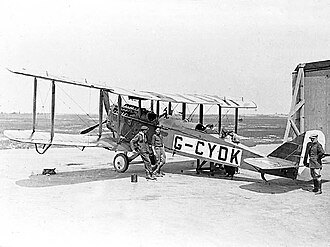
Airco DH.4 – The Classic British Two-Seat Bomber of the First World War
The Airco DH.4 occupies a special place in the history of military aviation as one of the most successful and influential British aircraft of the First World War. Designed during a period when aircraft were rapidly evolving from experimental machines into practical military tools, the DH.4 represented a major step forward in bomber and reconnaissance aircraft development. It combined speed, reliability, defensive capability, and impressive operational flexibility, allowing it to perform a wide variety of missions over the Western Front. Although remembered primarily as a bomber, the aircraft also served as a reconnaissance platform, artillery observer, trainer, ambulance aircraft, and later as a civilian transport machine after the war.
Developed by the Aircraft Manufacturing Company, commonly known as Airco, under the direction of the brilliant designer Geoffrey de Havilland, the DH.4 demonstrated how quickly aviation technology advanced during the First World War. When it first appeared in 1916, it was among the fastest and most capable aircraft in service. By the end of the conflict, thousands had been produced in Britain and the United States, and the design had become one of the principal Allied aircraft used for daylight bombing and reconnaissance operations. Its success was not based on a single revolutionary feature but rather on a balanced combination of aerodynamic efficiency, structural strength, dependable power, and excellent handling characteristics.
The story of the Airco DH.4 is also the story of aviation’s transformation during one of history’s most important technological periods. The aircraft emerged when pilots still relied heavily on personal skill and visual navigation, yet it incorporated increasingly sophisticated features such as synchronized defensive armament, specialized observation equipment, and advanced engines. Its operational career influenced the development of later bomber aircraft and helped establish principles that would shape military aviation throughout the twentieth century.
The Birth of Military Aviation During the First World War
At the beginning of the First World War in 1914, aircraft were considered little more than experimental tools. Military leaders initially viewed airplanes primarily as reconnaissance platforms rather than offensive weapons. Their ability to observe enemy positions, locate artillery batteries, and report battlefield movements quickly demonstrated enormous value, but early aircraft lacked the performance, reliability, and payload capacity required for serious bombing missions.
As trench warfare developed across Europe, the need for aerial reconnaissance became increasingly important. Armies depended on accurate information about enemy troop movements, defensive positions, and artillery locations. Aircraft crews flying over the front lines became essential sources of intelligence, but they also became targets themselves. This led to the development of dedicated fighter aircraft designed to protect reconnaissance machines and control the skies above the battlefield.
By 1916, military aviation had entered a period of rapid innovation. Designers were developing aircraft specifically optimized for bombing, reconnaissance, and combat. Engines became more powerful, airframes became stronger, and aircraft began carrying specialized equipment. It was within this environment that Geoffrey de Havilland designed the aircraft that would become the Airco DH.4.
Geoffrey de Havilland and the Airco Design Philosophy
Aviation’s Influential Designer
Geoffrey de Havilland was one of Britain’s most important aircraft designers during the early decades of aviation. Before founding his own company after the First World War, he worked with several British aircraft manufacturers and developed numerous successful designs. His approach emphasized practical engineering, excellent handling characteristics, and efficient construction methods. Many of his aircraft were appreciated by pilots because they combined performance with predictable behavior, an especially valuable quality during an era when flying remained dangerous.
When de Havilland joined Airco, he became responsible for designing a series of aircraft that would serve the Royal Flying Corps and later the Royal Air Force. The DH series became famous for producing reliable and versatile machines, including the DH.2 fighter, DH.5 fighter, DH.9 bomber, and numerous post-war aircraft. Among them, the DH.4 became one of the most successful examples of his design philosophy.
The Need for a New Day Bomber
The Royal Flying Corps required an aircraft capable of conducting daylight bombing missions while maintaining enough speed and defensive capability to survive operations over enemy territory. Existing bombers often sacrificed performance for payload capacity, making them vulnerable to enemy fighters. De Havilland sought to create a machine that could combine the qualities of a bomber and a fast reconnaissance aircraft.
The resulting design prioritized speed, altitude performance, and crew protection. Rather than relying solely on defensive weapons, the DH.4 was intended to avoid enemy interception through superior performance whenever possible. This approach reflected a growing understanding that survivability depended not only on armor and weapons but also on speed and tactical flexibility.
Development of the Airco DH.4
The prototype Airco DH.4 first flew in 1916, quickly demonstrating excellent performance compared with many existing aircraft. Early testing revealed that the design possessed impressive speed and climbing ability, making it suitable for both reconnaissance and bombing roles. The aircraft attracted immediate attention from military authorities, who recognized its potential as a modern replacement for older reconnaissance and bomber types.
One of the aircraft’s greatest advantages came from its ability to accommodate increasingly powerful engines as they became available. Early production aircraft used the Rolls-Royce Eagle engine, which provided exceptional performance and reliability. Later versions incorporated other powerplants due to wartime production demands, including American-built Liberty engines in large numbers.
Production began in Britain during 1916, and the DH.4 soon entered service with the Royal Flying Corps. Its arrival represented a significant improvement in British aerial capability, providing crews with an aircraft capable of carrying substantial bomb loads while still maintaining enough speed to challenge enemy fighters.
Design and Construction
Classic Wooden Biplane Structure
Like most aircraft of the First World War, the Airco DH.4 used a conventional wooden biplane configuration. Two wings provided excellent lift and structural strength while allowing designers to create a relatively lightweight aircraft using available materials. The wings consisted of wooden spars and ribs covered with fabric, a construction method that was common throughout the period due to its favorable balance of strength, weight, and manufacturing simplicity.
The fuselage followed traditional construction techniques, consisting of a wooden framework covered with fabric. Although fragile by modern standards, this approach produced aircraft that were surprisingly durable when properly maintained. Skilled ground crews could repair battle damage relatively quickly, an important advantage during intensive wartime operations.
Crew Arrangement
The DH.4 featured a two-seat configuration with the pilot positioned forward and the observer or gunner located behind. This arrangement was typical for reconnaissance and bomber aircraft of the era. The separation between crew members allowed the pilot to focus on flying while the observer managed navigation, communications, reconnaissance equipment, and defensive armament.
The observer’s position provided a flexible defensive capability through a manually operated machine gun mounted on a rotating ring. This allowed the aircraft to defend itself against attacking fighters approaching from the rear or sides. The observer also operated bombing equipment and assisted with navigation during long-distance missions.
Powerplant and Performance
The Airco DH.4 achieved much of its success through its powerful and reliable engines. The Rolls-Royce Eagle engine became the preferred powerplant for many early aircraft because of its excellent combination of performance and dependability. Its liquid-cooled V12 configuration provided smooth operation and sufficient power for demanding missions at high altitude.
The engine’s reliability proved particularly important during long bombing missions. Unlike fighter aircraft that often operated close to their bases, bomber crews could find themselves far behind enemy lines where engine failure could be catastrophic. A dependable powerplant significantly improved crew confidence and operational effectiveness.
Performance figures varied depending on the engine installed, but the DH.4 generally offered impressive speed for its class. It could often outrun enemy fighters when introduced, allowing crews to conduct daylight missions with a reasonable expectation of survival. Its ability to climb rapidly also helped it operate at altitudes where interception was more difficult.
Operational Service with the Royal Flying Corps
Arrival on the Western Front
The Airco DH.4 entered operational service with the Royal Flying Corps in early 1917. Its arrival came at a crucial moment when air forces on both sides were rapidly expanding their capabilities. The aircraft immediately became valuable for reconnaissance missions, artillery cooperation, and bombing operations against enemy targets.
Crews quickly appreciated the aircraft’s combination of speed, stability, and reliability. Compared with earlier reconnaissance aircraft, the DH.4 offered significantly improved protection against enemy fighters. Its performance allowed many crews to avoid combat entirely by maintaining distance from opposing aircraft.
Daylight Bombing Missions
The DH.4 became one of Britain’s primary daylight bombers during the First World War. Missions targeted railway junctions, supply depots, troop concentrations, airfields, and industrial facilities. These operations required careful coordination between pilots, observers, and ground planners because navigation and bombing accuracy remained challenging without modern instruments.
Daylight bombing was particularly dangerous because aircraft were visible from great distances and vulnerable during predictable attack patterns. Despite these risks, the DH.4’s speed and defensive armament allowed it to operate successfully in contested airspace.
The American DH.4 Production Program
The United States entered the First World War in 1917 and faced the urgent challenge of creating a modern military air service. American industry lacked the extensive aircraft manufacturing experience possessed by European nations, so planners adopted several proven Allied designs for domestic production. The Airco DH.4 became one of the most important aircraft selected for American manufacture.
American-built DH.4s differed significantly from British versions because they were equipped primarily with the American Liberty L-12 engine. This powerful and reliable engine became one of the most important American aviation developments of the era. Thousands of DH.4 aircraft were produced in the United States, making it one of the first mass-produced American military aircraft.
After the war, many American DH.4s remained in service and continued performing important roles within the United States military. They were used for observation, training, aerial photography, and experimental work, helping establish the foundations of American military aviation during the interwar period.
Variants and Modifications
DH.4A
After the First World War, modified versions of the DH.4 were developed for civilian and military applications. The DH.4A incorporated improvements intended to make the aircraft more suitable for transportation duties. Some versions featured redesigned fuselages and passenger accommodations, reflecting the growing interest in commercial aviation.
American DH-4 Variants
American-built aircraft received numerous modifications, including improved engines, stronger structures, and specialized equipment. These aircraft served various roles including observation, mail transport, and experimental testing. Some remained active well into the 1920s, demonstrating the fundamental strength of the original design.
Post-War Civilian Adaptations
Following the war, surplus military aircraft became widely available, and many DH.4s were converted for civilian use. They participated in early air mail services, passenger operations, aerial photography, and demonstration flights. This transition helped introduce aviation to the public and contributed to the growth of commercial aviation.
The DH.4 in Comparison with Contemporary Aircraft
When introduced, the Airco DH.4 represented one of the most capable aircraft in the world. Compared with earlier British reconnaissance aircraft, it offered superior speed, altitude capability, and payload capacity. Compared with dedicated fighters, it sacrificed maneuverability but compensated through endurance and defensive capabilities.
Its greatest competitor was arguably the German two-seat reconnaissance aircraft family, which performed similar missions over the Western Front. Both sides recognized that reliable observation and bombing aircraft were essential components of modern warfare. The DH.4’s combination of performance and versatility allowed it to remain competitive throughout the conflict.
Challenges and Limitations
Despite its success, the DH.4 was not without limitations. The separation between pilot and observer created communication difficulties, particularly during combat when rapid coordination was required. Later aircraft designs improved crew arrangements by placing crew members closer together, allowing more effective teamwork.
The aircraft’s wooden construction also required significant maintenance. Exposure to weather conditions, combat damage, and repeated operational use demanded constant attention from ground crews. However, these challenges were common among aircraft of the period and did not significantly diminish the DH.4’s overall effectiveness.
Legacy of the Airco DH.4
The Airco DH.4 left a lasting influence on aviation history because it represented one of the first truly successful multi-purpose military aircraft. Its ability to perform bombing, reconnaissance, and observation missions demonstrated the value of versatile aircraft designs capable of adapting to changing operational requirements.
The aircraft also played an important role in the development of American aviation. The large-scale production of DH.4s in the United States helped establish manufacturing expertise that would later support the rapid expansion of American aircraft production during the Second World War.
Beyond its technical achievements, the DH.4 symbolizes the remarkable transformation of aviation during the First World War. In only four years, aircraft evolved from fragile observation machines into sophisticated military systems capable of influencing battlefield strategy. The DH.4 was one of the aircraft that made this transformation possible.
Preserved Aircraft and Historical Importance
Today, surviving examples of the Airco DH.4 are preserved in museums and collections around the world. These aircraft provide valuable insight into the engineering methods, materials, and operational realities of early military aviation. Restored examples allow modern audiences to appreciate the craftsmanship required to construct and maintain aircraft during the pioneering era of flight.
For historians and aviation enthusiasts, the DH.4 remains a symbol of innovation, courage, and technological progress. It represents a generation of aircraft that helped define the future of military aviation and demonstrated the strategic importance of air power.
Technical Specifications
| Specification | Airco DH.4 |
|---|---|
| Manufacturer | Aircraft Manufacturing Company (Airco) |
| Designer | Geoffrey de Havilland |
| Country of Origin | United Kingdom |
| First Flight | 1916 |
| Role | Day bomber, reconnaissance aircraft |
| Crew | 2 (pilot and observer/gunner) |
| Length | 30 ft 8 in (9.35 m) |
| Wingspan | 42 ft 5 in (12.95 m) |
| Height | 11 ft 9 in (3.58 m) |
| Wing Area | 434 sq ft (40.3 m²) |
| Empty Weight | Approximately 2,450 lb (1,111 kg) |
| Maximum Takeoff Weight | Approximately 3,600 lb (1,633 kg) |
| Powerplant | 1 × Rolls-Royce Eagle VIII V12 engine |
| Engine Power | Approximately 375 hp (280 kW) |
| Maximum Speed | Approximately 143 mph (230 km/h) |
| Cruising Speed | Approximately 115 mph (185 km/h) |
| Range | Approximately 470 miles (756 km) |
| Service Ceiling | Approximately 23,500 ft (7,160 m) |
| Armament | 1–2 × .303 in machine guns; up to 460 lb of bombs |
| Construction | Wooden frame, fabric covering |
| Landing Gear | Fixed conventional landing gear |
| Major Operators | Royal Flying Corps, Royal Air Force, United States Army Air Service |
| Production | Over 5,000 aircraft built |
| Status | Retired |
