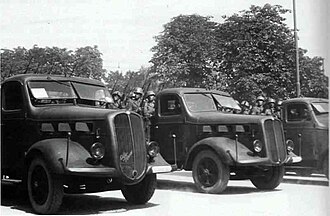
Alfa Romeo 500: The Story of Alfa Romeo’s Elegant Pre-War Workhorse
When most people hear the name Alfa Romeo, their minds naturally turn toward beautiful sports cars, Grand Prix victories, sophisticated engines, and legendary road cars. Yet the history of the Milanese manufacturer is considerably broader than its passenger-car and racing achievements. During the 1930s and 1940s, Alfa Romeo was also an important producer of commercial and military vehicles, developing trucks that combined practical engineering with the distinctive Italian styling for which the company had already become famous. Among the most interesting examples is the Alfa Romeo 500, a medium-duty truck produced from 1937 until 1945. Designed as a roughly three-ton-class vehicle, the 500 became a versatile platform available with diesel, petrol, and gas-powered engines, while its chassis was also adapted for buses, fire appliances, military vehicles, and even racing-car transporters.
The Alfa Romeo 500 is particularly significant because it represents a transitional point in the company’s commercial-vehicle history. It retained the conventional truck architecture of its era, with the engine mounted ahead of the driver, but its bodywork was noticeably more streamlined than that of many utilitarian trucks of the period. It was also the last conventional-cab truck produced by Alfa Romeo before the company increasingly moved toward cab-over-engine designs. In other words, the 500 was not simply another commercial vehicle in Alfa Romeo’s catalogue: it stood at the end of one engineering philosophy and just before a major change in the way the company approached truck design.
The Origins of the Alfa Romeo 500
A Truck for a Changing Italy
The Alfa Romeo 500 appeared in 1937 as the successor to the smaller Alfa Romeo 350, at a time when Italy’s transport requirements were expanding rapidly. Commercial vehicles were becoming increasingly important to industry, agriculture, public services, and military logistics, while governments were also becoming more interested in standardizing vehicle designs that could serve both civilian and military purposes. Alfa Romeo had already gained experience with larger trucks and diesel technology, so the 500 represented a natural expansion of that expertise into the medium-duty sector.
Although the 500 was not as large as Alfa Romeo’s heavy trucks, its approximately three-ton payload placed it in a useful category for general freight transportation. It could handle loads that were too substantial for light commercial vehicles while remaining more manageable than a full-size heavy lorry. This made it suitable for a remarkably wide variety of applications, from ordinary freight hauling to municipal services and specialized bodies. Its chassis could be adapted by different coachbuilders, allowing the same mechanical foundation to perform very different jobs.
The truck also reflected Alfa Romeo’s broader industrial ambitions. By this period, the company was far more than a manufacturer of sporting automobiles. Alfa Romeo’s official history emphasizes the company’s long-standing transformation and broad engineering heritage, while its commercial-vehicle activities formed an important part of that industrial story.
Design and Styling
A Surprisingly Aerodynamic Truck
The first thing that distinguishes the Alfa Romeo 500 from many trucks of its period is its appearance. Heavy commercial vehicles of the 1930s were generally shaped according to straightforward functional principles: a separate engine compartment, upright windshield, flat body panels, exposed running boards, and a relatively tall cabin. The 500 followed the same basic mechanical philosophy but introduced a much more rounded and aerodynamic visual treatment.
Its flowing front end was not merely decorative. During the 1930s, aerodynamic thinking was becoming increasingly influential throughout the automotive industry, and designers were beginning to recognize that even commercial vehicles could benefit from smoother shapes. The 500’s rounded nose and carefully integrated bodywork gave it an unusually modern appearance, while later production changes further refined its aerodynamic form.
The truck’s styling also demonstrated something characteristic of Alfa Romeo: even a practical vehicle could receive serious attention from designers. There was no expectation that a three-ton truck should look like a sports car, but Alfa Romeo nevertheless gave the 500 a strong visual identity. Its proportions, curved surfaces, and prominent front treatment make surviving examples immediately recognizable as products of the same company that produced some of Europe’s most admired automobiles.
The Last of the Conventional Alfa Trucks
Mechanically, the 500 belonged to an older school of truck design. Its engine sat ahead of the passenger compartment rather than beneath the cab, giving it the familiar bonneted appearance of a conventional truck. This layout offered straightforward access to the engine and was extremely common during the period.
Historically, however, that arrangement makes the 500 particularly interesting. It was the last conventional truck design produced by Alfa Romeo, after which the company concentrated increasingly on cab-over vehicles. The move toward cab-over-engine layouts was driven by the desire to maximize cargo capacity within a given overall vehicle length and to improve maneuverability in increasingly congested roads and cities. The 500 therefore represents the end of an era for Alfa Romeo’s truck engineering.
Engine and Mechanical Engineering
The Six-Cylinder Diesel
One of the most important versions of the Alfa Romeo 500 was its diesel-powered model, which used a six-cylinder engine of approximately 6.1 litres. Commonly cited specifications identify the engine as the Alfa Romeo F6M 313, producing around 75 PS at 2,000 rpm. This was an engine designed around the needs of commercial transportation rather than outright performance, with an emphasis on steady pulling power and durability.
A six-cylinder diesel of this size was substantial machinery by the standards of the late 1930s. Diesel technology was becoming increasingly attractive for trucks because of its fuel economy and suitability for sustained heavy-duty operation. Alfa Romeo’s experience with diesel engines was connected to its earlier commercial-vehicle work and to technical cooperation with Deutz, which had helped the Italian manufacturer develop its expertise in diesel-powered trucks.
The standard diesel 500 was capable of reaching approximately 56 km/h, although military versions were typically restricted to lower speeds. That figure may appear extremely modest today, but it was entirely appropriate for a three-ton truck of the era. Road surfaces, braking technology, tire construction, traffic conditions, and engine characteristics all imposed very different limitations compared with modern commercial vehicles.
Petrol and Gas Versions
The Alfa Romeo 500 was not restricted to diesel power. A range of alternative versions was developed, reflecting the fuel shortages and economic realities of the period. The 500 G used a gas-fueled six-cylinder engine of approximately 6.7 litres and was rated at around 70 PS. Other variants, including the 500 RB and 500 RM, used petrol engines, while gas and reinforced-chassis configurations broadened the truck’s usefulness.
Gas-powered vehicles were particularly relevant in an era when petroleum supplies could become uncertain. Producer-gas systems could allow vehicles to operate using locally available solid fuels, although they generally introduced compromises in convenience, performance, and packaging. The fact that Alfa Romeo offered such configurations demonstrates how manufacturers had to adapt their products to rapidly changing fuel conditions.
The various versions also show that the 500 was more than a single rigid specification. Alfa Romeo developed the platform as a flexible commercial vehicle capable of meeting different requirements, whether those requirements involved civilian freight, military service, municipal work, or specialized transport.
The Alfa Romeo 500 in Military Service
The 500 DR
The Alfa Romeo 500 became an important vehicle for the Royal Italian Army during the Second World War. The military version is generally identified as the 500 DR, and it was used as a transport vehicle during Italian military operations, including the campaign in Russia. An armored derivative was also employed during the Balkan campaign.
The importance of trucks during the Second World War cannot be overstated. Armies depended on road transport to move ammunition, fuel, food, spare parts, personnel, and equipment between railheads, depots, and front-line formations. A medium-duty vehicle such as the 500 could therefore perform an essential logistical function even though it was not designed as a combat vehicle.
The military 500 reportedly had a maximum speed of approximately 45 km/h, could negotiate gradients exceeding 27 percent, and had a range of roughly 400 kilometres with a full tank of approximately 100 litres. These characteristics made it a useful general-purpose military transport vehicle, particularly where a combination of payload capacity and reasonable road mobility was more important than high speed.
Adaptability in Wartime
The 500’s chassis was also used as a basis for military buses and other specialized vehicles. This was a practical advantage during wartime because manufacturers and military organizations could exploit an existing platform rather than develop an entirely new vehicle for every application.
The truck’s adaptability was especially valuable in an environment where production resources were limited and standardization was desirable. A common chassis could support different bodies while retaining a familiar mechanical package, simplifying maintenance and allowing existing manufacturing expertise to be reused.
Civilian Applications
Fire Engines and Municipal Vehicles
Before and during the early years of the Second World War, the Alfa Romeo 500 found an important role with Italy’s fire services. From approximately 1937 to 1940, examples were used as fire engines and trucks by the Italian Fire Department.
This application illustrates why the 500’s medium-duty configuration was so useful. Fire appliances required a strong chassis capable of carrying pumps, hoses, ladders, water, tools, and crews, but did not necessarily require the enormous carrying capacity of a heavy freight truck. The 500 provided a suitable foundation, while specialist bodybuilders could adapt it to the requirements of emergency services.
Its use by public authorities also helped establish the truck as a versatile platform rather than a vehicle designed solely for commercial freight.
The Alfa Romeo 500 as a Racing Transporter
Carrying Alfa Romeo’s Competition Cars
Perhaps the most charming chapter in the 500’s history is its connection with Alfa Romeo’s racing activities. Examples of the 500 were used by Alfa Romeo and Scuderia Ferrari as racing-car transporters, carrying Grand Prix and Formula 1 machinery.
There is a certain historical poetry in this application. Alfa Romeo’s racing cars of the period were among the most technologically sophisticated competition machines in the world, while the 500 was a practical three-ton truck designed to move goods. Yet both belonged to the same engineering organization, and the truck became part of the infrastructure that allowed the racing cars to reach circuits.
Transporters rarely receive the same attention as the cars they carry, but they are essential to motorsport. A racing machine cannot compete without being transported safely between workshops and circuits. The Alfa Romeo 500 therefore played a small but meaningful role behind the scenes of Alfa Romeo’s celebrated racing program.
Bus and Coach Development
A Versatile Chassis
The 500 was also adapted into bus and coach applications. Specialist Italian bodybuilders, including Viberti and Bergomi, produced various bodies using the Alfa Romeo 500 platform. There was also a dedicated 500 AL bus chassis, powered by the six-cylinder diesel engine.
This was typical of the Italian commercial-vehicle industry of the era, when chassis manufacturers frequently supplied rolling platforms to specialist coachbuilders. The resulting vehicles could differ dramatically in appearance and function while sharing the same basic mechanical foundation.
The 500’s use as a bus chassis further demonstrates the versatility of its engineering. Passenger transport placed different demands on a vehicle than freight hauling, particularly in terms of body construction, seating capacity, weight distribution, and comfort. Yet the underlying platform was sufficiently adaptable to support these requirements.
Production and Model Variants
A Broad Family Rather Than a Single Truck
The Alfa Romeo 500 should therefore be understood as a family of related commercial vehicles rather than one fixed specification. The basic 500 was introduced in 1937, while variants such as the 500 G, 500 RM, 500 RB, 500 AL, and military 500 RE expanded the range. Sources also report different production quantities and specifications for the individual versions, reflecting the changing requirements of the late 1930s and wartime years.
The standard 500 diesel used a 6,126 cc six-cylinder engine producing approximately 75 PS. The petrol-powered versions could offer higher power, with the 500 RB listed at approximately 90 PS, while the gas-powered 500 G used a larger 6,700 cc engine rated at around 70 PS. These differences were not simply matters of performance; they reflected the fuel and operational requirements for which each vehicle was intended.
The military 500 RE, meanwhile, was a more specialized configuration. It measured approximately 7.02 metres long, 2.069 metres wide, and 2.25 metres high, with a reported weight around 3,800 kg. Its diesel engine produced approximately 75 PS, and its maximum speed was around 45 km/h.
Why the Alfa Romeo 500 Matters Today
The Alfa Romeo 500 occupies an unusual place in automotive history because it connects several different aspects of Alfa Romeo’s identity. It was a commercial vehicle, a military truck, a fire appliance platform, a bus chassis, and a racing transporter. Few vehicles can claim such a diverse career.
It also demonstrates how much the Alfa Romeo brand has changed over the decades. Modern enthusiasts may associate the company almost entirely with passenger cars, but the manufacturer’s industrial heritage was considerably broader. Alfa Romeo’s commercial vehicles were an important part of its pre-war and wartime production, and the 500 shows how the company’s engineers approached practical transportation problems with the same attention to mechanical design and appearance that characterized its automobiles.
The truck is also significant as a technological bridge. Its conventional bonneted layout belonged to an earlier generation of truck design, while the increasingly aerodynamic bodywork hinted at the future. Soon afterward, Alfa Romeo would move more decisively toward cab-over-engine commercial vehicles, a configuration that made better use of available road space and would become increasingly important in European trucking.
Alfa Romeo 500 Technical Specifications
Because the Alfa Romeo 500 existed in several configurations, specifications vary according to engine, chassis, body, and intended use. The following table summarizes representative figures for the principal versions reported in historical references.
| Specification | Alfa Romeo 500 | 500 G | 500 RB | 500 RE |
|---|---|---|---|---|
| Production era | 1937–1938* | 1930s–1940s | 1930s–1940s | 1943–1944* |
| Layout | 4×2 | 4×2 | 4×2 | 4×2 |
| Engine | 6-cylinder diesel | 6-cylinder gas | 6-cylinder petrol | 6-cylinder diesel |
| Engine type | AR F6M 313 | AR BG | AR BG6B | AR F6M 313 |
| Displacement | 6,126 cc | 6,700 cc | 6,126 cc | 6,126 cc |
| Power | 75 PS @ 2,000 rpm | 70 PS @ 2,250 rpm | 90 PS @ 2,000 rpm | 75 PS @ 2,000 rpm |
| Approx. maximum speed | 56 km/h | 64 km/h | 80 km/h | 45 km/h |
| Approx. length | 7.15 m | 7.15 m | 7.15 m | 7.02 m |
| Approx. width | 2.20 m | 2.20 m | 2.20 m | 2.07 m |
| Approx. height | 2.25 m | 2.25 m | 2.25 m | 2.25 m |
| Approx. wheelbase | 4.50 m | 4.50 m | 4.50 m | 4.20 m |
| Typical role | Medium truck | Commercial truck | Petrol truck | Military truck |
| Payload class | Approx. 3 tonnes | Approx. 3–4 tonnes | Approx. 3–4 tonnes | Approx. 3 tonnes |
*Production dates and specifications can differ between individual references and versions.
Conclusion
The Alfa Romeo 500 is one of those fascinating vehicles that becomes more interesting the more closely its history is examined. At first glance, it is simply an old Italian truck from the late 1930s. Look closer, however, and it becomes a remarkably versatile machine that served commercial operators, emergency services, the military, bus operators, and even Alfa Romeo’s own racing organization.
Its six-cylinder diesel engine, approximately three-ton payload, aerodynamic conventional cab, and broad range of configurations made it a capable medium-duty vehicle for its era. More importantly, the 500 captured Alfa Romeo at a moment when the company was balancing traditional engineering with rapidly changing ideas about vehicle design. It was the final conventional-cab truck in Alfa Romeo’s commercial-vehicle lineage before the company moved toward cab-over designs, giving it a special place in the manufacturer’s industrial history.
Today, the Alfa Romeo 500 may be overshadowed by the marque’s famous sports and racing cars, but that obscurity makes it all the more compelling. It reveals an Alfa Romeo that many enthusiasts rarely encounter: an Alfa Romeo of diesel engines, freight loads, fire brigades, military logistics, buses, and racing transporters. The 500 was not built to win races itself, but it helped demonstrate the practical engineering ability that existed behind the famous badge. In that sense, it deserves to be remembered not as an unusual footnote, but as an important chapter in the long and remarkably varied history of Alfa Romeo.
