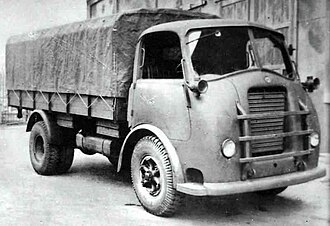
Alfa Romeo 800: The Story of Alfa Romeo’s Wartime Heavy Truck
The Alfa Romeo 800 is one of the less celebrated but remarkably important vehicles in the long history of Alfa Romeo. While the Italian marque is internationally associated with elegant sports cars, Grand Prix victories, sophisticated engines, and distinctive road cars, the company also built a substantial range of commercial and military vehicles. Among them, the 800 occupies a particularly interesting place because it emerged at the beginning of the 1940s, served extensively during the Second World War, and subsequently became a civilian workhorse in post-war Italy. Produced broadly between 1940 and 1947, the 800 was a heavy-duty truck with a large six-cylinder diesel engine, a conventional 4×2 layout, and a payload of roughly 6.5 tonnes. Its military designation, 800RE, is the version most closely associated with its wartime career.
The story of the Alfa Romeo 800 is also a reminder that Alfa Romeo’s engineering identity was never limited to passenger cars. In the years before and during the Second World War, manufacturers were expected to produce vehicles that could perform practical industrial and military tasks as well as showcase advanced engineering. The 800 was designed as a heavy, versatile truck capable of carrying substantial loads over difficult routes, and its design reflected the requirements of Italy’s “unified truck” policy, which encouraged civilian commercial vehicles to be suitable for military requisition. The result was a machine that looked very different from the glamorous Alfa Romeos normally remembered today, but which represented an important part of the company’s industrial history.
The Origins of the Alfa Romeo 800
From Commercial Truck to Military Vehicle
The Alfa Romeo 800 belonged to a period when Italy was attempting to standardize its commercial vehicle fleet. Government regulations introduced in the late 1930s encouraged manufacturers to develop “unified” trucks that could be used in civilian service but readily adapted to military duties when required. This approach was particularly significant in the years immediately preceding the Second World War, when transportation capacity was a strategic resource. Alfa Romeo’s 800 was therefore not simply designed as a private-sector delivery truck; its engineering had to accommodate the demanding requirements of military logistics.
The military version became known as the Alfa Romeo 800RE, and the earliest examples entered service with the Italian Army. Sources record testing of the 800RE in the Italian Alps in 1939, followed by production from 1940 to 1943 for the wartime military version. The truck subsequently saw service in several major theaters, particularly North Africa, Russia, and occupied France. It was also used by other branches of the Italian armed forces, illustrating how important heavy transport was to the country’s wartime logistics system.
Unlike a specialized armored fighting vehicle, the 800’s principal contribution was transportation. Trucks such as this carried ammunition, fuel, food, equipment, spare parts, and personnel, making them essential to the operation of larger military formations. The Alfa Romeo 800 was consequently part of the less glamorous but indispensable infrastructure of mechanized warfare.
Engineering and Mechanical Design
The 8.7-Litre Diesel Engine
At the heart of the Alfa Romeo 800 was a large six-cylinder diesel engine displacing approximately 8,725 cc. Contemporary specifications commonly give its output as around 108 horsepower, while some references distinguish between different rating conventions and quote approximately 90 hp under CUNA measurement. Regardless of the precise rating standard, the important characteristic was the engine’s combination of substantial displacement and diesel torque, which suited a heavy truck far better than a high-revving passenger-car engine.
The diesel was equipped with direct fuel injection, an important feature for a heavy vehicle intended to operate economically while carrying significant loads. With a displacement approaching nine litres, the engine was designed around pulling power rather than outright speed. The 800 was never intended to be fast; its reported maximum speed was approximately 50 km/h, a figure that makes perfect sense when the vehicle’s considerable weight and military role are taken into account.
The availability of alternative power systems also demonstrates the practical challenges facing manufacturers during the war. In addition to the principal diesel configuration, versions using gasoline and gas-generator systems were produced. Gas-generator trucks were particularly relevant during periods when conventional liquid fuels were difficult to obtain, although such systems were generally a compromise in performance and convenience.
Transmission and Chassis
The Alfa Romeo 800 used a four-speed manual transmission, with the military 800RE also described as having an additional transfer gearbox. The drivetrain was based on a conventional 4×2 configuration, meaning that only two wheels were driven. This is one of the most revealing aspects of the vehicle because the 800’s wartime duties sometimes took it far beyond the conditions for which a conventional road-going truck was ideally suited.
The truck’s 4×2 layout was adequate for normal road transport but inevitably limited its ability to cope with soft ground, mud, snow, and other difficult terrain compared with a four-wheel-drive vehicle. One historical account notes that the 800 performed reasonably well during wartime considering that it had originally been conceived primarily for road use. That distinction is important: the Alfa Romeo 800 was fundamentally a heavy transport truck rather than a purpose-built off-road tactical vehicle.
The Distinctive Cab
One of the most recognizable features of the Alfa Romeo 800 is its advanced-looking cab design. Rather than using the long conventional bonnet associated with many trucks of the period, the 800 employed a forward-control or cab-over-style arrangement, with the engine positioned beneath or within the forward portion of the cab. Its rounded, bulbous shape gave it an unmistakable appearance.
This design had several practical advantages. Moving the cab forward allowed the engineers to make better use of the truck’s overall length, potentially increasing usable cargo space without making the vehicle excessively long. It also gave the driver a more commanding view of the road immediately ahead. The rounded cab, meanwhile, was characteristic of the aerodynamic styling trends that were beginning to influence commercial vehicles in the late 1930s.
The result was an unusual combination of functional engineering and Italian styling. Even though the 800 was a military workhorse, its bodywork possessed a certain visual character that distinguished it from many of its contemporaries. This was perhaps inevitable from a company whose passenger cars were already renowned for elegant proportions and carefully considered design.
The Alfa Romeo 800 in World War II
North Africa and Russia
The 800RE became one of Alfa Romeo’s principal military trucks of the Second World War. Italian forces deployed it in North Africa, where trucks were absolutely fundamental to military operations. The enormous distances involved in desert warfare placed severe demands on logistics vehicles, requiring them to transport supplies and fuel over long routes under harsh environmental conditions.
The truck was also deployed on the Eastern Front. Conditions there were radically different from those of North Africa, with mud, snow, extreme cold, and poor roads creating a completely different set of challenges. A 4×2 heavy truck could be useful on established roads but was inevitably vulnerable when ground conditions deteriorated. Nevertheless, its ability to carry a large load made it a valuable part of the supply chain.
German Use and Captured Trucks
After Italy’s armistice in September 1943, German forces captured substantial quantities of Italian military equipment. Alfa Romeo 800RE trucks were among the vehicles taken into German service and were identified under the German designation Lastkraftwagen 6,5 t Alpha (i) Typ 800 R.E. Some examples continued to serve in Italy and elsewhere under German control.
This episode illustrates the durability and utility of the basic 800 design. A military truck could change operators without fundamentally changing its purpose: it remained a platform for moving supplies, personnel, and equipment. Some 800RE vehicles were also adapted into tracked or half-track configurations, demonstrating the interest in improving the truck’s mobility over difficult terrain. A notable experimental development was the CSEM 800RE, a half-track project associated with the Italian Army’s vehicle research organization.
Post-War Civilian Life
The end of the Second World War did not make the Alfa Romeo 800 obsolete. Quite the opposite: Italy faced an enormous need for transport vehicles as the country began rebuilding its infrastructure and economy. Trucks that had previously served military purposes could now be returned to civilian work, while new civilian versions could be produced for commercial operators.
The post-war Alfa Romeo 800 therefore represents an interesting transition from wartime engineering to reconstruction. Its fundamental strengths—large carrying capacity, robust construction, and a substantial diesel engine—were just as valuable for civilian freight transport as they had been for military logistics. Production continued into the post-war period, with the 800 ultimately giving way to the Alfa Romeo 900, introduced as its successor in 1947.
The 900 retained much of the 800’s basic concept but brought a larger 9.5-litre engine producing around 130 hp and increased payload capability. In this sense, the 800 should not be viewed as an isolated experiment but as part of a continuous line of Alfa Romeo heavy commercial vehicles that evolved alongside Italy’s changing economic needs.
Why the Alfa Romeo 800 Matters Today
An Overlooked Side of Alfa Romeo
For modern enthusiasts, the Alfa Romeo 800 is fascinating precisely because it does not fit the usual image of the marque. Alfa Romeo’s reputation is dominated by cars such as the 6C, 8C, Giulietta, Giulia, and later performance models, yet the company spent decades producing commercial vehicles, buses, engines, and industrial machinery. The 800 provides a tangible example of this broader industrial heritage.
It also demonstrates how automotive technology develops in response to circumstances. The 800’s large diesel, forward-control cab, manual transmission, and substantial payload were not glamorous features, but they were precisely the characteristics required from a heavy truck in the early 1940s. Its engineering was focused on usefulness rather than speed or luxury.
A Snapshot of Italian Industrial History
Perhaps the greatest significance of the Alfa Romeo 800 is historical. It was created during one of the most turbulent periods in European history, served in several theaters of war, passed into the hands of different armies, and then became part of Italy’s post-war recovery. Few surviving vehicles can tell such a broad story.
Its specifications may seem modest by modern heavy-truck standards, but judging the 800 by today’s expectations misses the point. A 6.5-ton payload, nearly nine litres of diesel displacement, and a 50-km/h top speed were entirely appropriate for its era. The truck was a product of its technological and economic environment, and its importance lies in how effectively it fulfilled the requirements placed upon it.
Alfa Romeo 800 Technical Specifications
The figures below summarize commonly reported specifications for the Alfa Romeo 800 and 800RE. Historical sources sometimes differ in production dates, power ratings, and individual measurements depending on the exact version and measurement standard, so these numbers should be treated as representative rather than as a single modern-style factory specification sheet.
| Specification | Alfa Romeo 800 / 800RE |
|---|---|
| Manufacturer | Alfa Romeo |
| Vehicle type | Heavy commercial / military truck |
| Production period | Approximately 1940–1947 |
| Military version | Alfa Romeo 800RE |
| Engine | Six-cylinder diesel |
| Displacement | 8,725 cc |
| Reported power | Approximately 108 hp |
| Transmission | 4-speed manual |
| Drive configuration | 4×2 |
| Payload | Approximately 6.5 tonnes |
| Kerb weight | Approximately 5,500 kg |
| Maximum speed | Approximately 50 km/h |
| Length | Approximately 6.84 m |
| Width | Approximately 2.35 m |
| Height | Approximately 2.85 m |
| Wheelbase | Approximately 3.80 m |
| Fuel alternatives | Diesel, gasoline and gas-generator versions |
| Principal wartime users | Italian Army and, after capture, German forces |
| Successor | Alfa Romeo 900 |
Conclusion
The Alfa Romeo 800 deserves far more attention than it usually receives. It was not a sports car, it did not compete on racetracks, and it lacked the glamorous image that has defined Alfa Romeo in popular culture. Yet it was an important piece of engineering from a company that had to adapt to one of the most demanding periods in European automotive history. Its 8.7-litre six-cylinder diesel, 6.5-tonne payload, forward-control cab, and rugged 4×2 chassis made it a serious heavy truck for its time, while its wartime service in North Africa, Russia, and France gave it a remarkable operational history.
More importantly, the 800 reveals a different side of Alfa Romeo. The same manufacturer celebrated for sophisticated racing machinery was also capable of designing vehicles intended to move enormous loads across long distances. The 800’s career continued beyond the war, helping illustrate how military-era technology could be repurposed for civilian reconstruction before the model was succeeded by the more powerful Alfa Romeo 900. Today, the truck stands as an intriguing reminder that Alfa Romeo’s heritage encompasses far more than beautiful passenger cars: it also includes practical engineering, industrial ambition, and some remarkably tough commercial vehicles.
