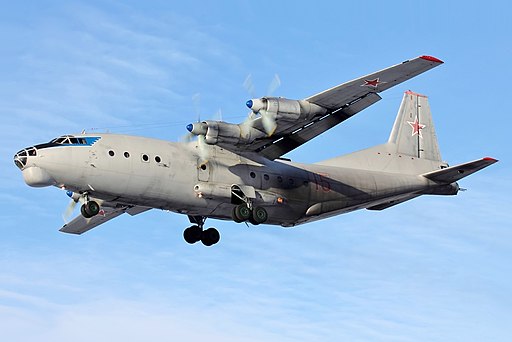
Antonov An-12
The Antonov An-12 emerged in the late 1950s as the Soviet Union’s premier four-engined turboprop transport. Designed to carry medium loads over strategic distances, it combined rugged field performance with a capacious cargo bay. More than 1,200 airframes rolled off the production lines, serving military, civilian, and special-mission roles across five decades. Its reliability and ease of maintenance cemented the An-12’s reputation as a global workhorse.
Design and Development
Conceptual Origins and Requirements
In 1956, Soviet planners sought a successor to piston-powered transports capable of hauling ten tonnes of cargo over 2,500 kilometers. The brief called for short-field performance, unprepared strip capability, and rapid loading. Antonov’s bureau responded with a four-engine layout, leveraging AI-20 turboprops for consistent power and low fuel consumption. High wings and a rear ramp enabled operations in austere environments.
Prototype and Flight Testing
The prototype An-12 flew in December 1957, initiating a two-year flight test program. Early trials revealed wing vibration at high speeds, addressed by reinforcing the wing box and adding mass balances on control surfaces. Engineers also optimized the AI-20 gearbox for improved durability under repeated combat-style cycles. By 1959, the transport achieved certification, leading to series production at Kyiv and Ulan-Ude.
Airframe and Structure
Fuselage and Cargo Bay
The cylindrical fuselage spans 23.6 meters and houses a 12.6 m × 3.4 m cargo deck. A hydraulically operated rear ramp supports self-loading of up to 10,000 kg. Interior tie-down rails and rollers facilitate palletized loads, vehicles, or paratrooper benches. Pressurized crew and navigator compartments sit forward, isolated from the unpressurized cargo hold.
Wing Configuration
A high-mounted, straight-tapered wing delivers stable low-speed lift essential for short fields. Double-slotted flaps and leading-edge slats extend automatically, trimming takeoff runs to under 1,200 m at MTOW. Integral tanks in the wing’s inner panels carry 10,500 L of fuel. Strut-braced fairings simplify access for maintenance and blend airflow from pods into the fuselage.
Landing Gear
The robust tricycle gear features a twin-wheel nose unit and two twin-wheel main bogies, totaling six wheels. Low-pressure tires distribute loads across soft surfaces, while oleo-pneumatic struts absorb hard touchdowns. Main gear doors retract flush, minimizing drag. Quick-disconnect hydraulic lines and bolt-on wheels allow field crews to replace a bogie in under 45 minutes.
Propulsion System
Engines
Four Ivchenko AI-20M turboprops, each rated at 4,250 shp, power the An-12. The two-shaft design excels in tropical and Arctic extremes, delivering consistent torque at altitudes up to 10,000 m. Modular construction enables frontline swap-outs of the power section in less than three hours. Engine intakes incorporate sand-jettison ports for dusty environments.
Propellers and Fuel System
Each engine drives a four-bladed constant-speed, reversible-pitch propeller built from composite-reinforced aluminum. Reversible thrust slashes landing rolls on short runways. Six wing-tank cells and two under-fuselage auxiliary tanks combine for a total of 10,500 L. Fuel transfer pumps balance wing loads and support inboard-outboard cell sequencing.
Avionics and Cockpit
Flight Deck Layout
The cockpit seats two pilots, a flight engineer, and a navigator in a stepped arrangement. Analog flight instruments occupy the main panel, while the engineer’s console monitors engine parameters and environmental systems. Cabin pressure, temperature, and anti-ice controls sit within reach of all crew. An overhead panel houses electrical bus selectors and fuel-pump switches.
Navigation and Communication
Standard avionics include VOR/ILS receivers, HF and VHF radios, an automatic direction finder, and marker beacons. Later upgrades added Doppler ground-speed radar and weather radar in a nose-mounted fairing. A blind-landing system enables Category II approaches in low visibility. Crew intercom and onboard public-address systems assist paratroop operations.
Operational Roles and Variants
Military Transport
Entering Soviet service in 1959, the An-12 became the backbone of medium airlift brigades. It carried troops, artillery pieces, light armor, and humanitarian relief supplies. Paratrooper doors and canopies on both sides supported mass drops of up to 90 soldiers. Night-vision-compatible cockpit lighting facilitated covert missions.
Civilian and Specialized Versions
Civil air carriers operated An-12s on freight routes, prized for low lead times and minimal ground support. Search-and-rescue conversions (An-12PS) added life-raft pods, homing beacons, and infrared scanners. Flight-test variants featured nose-boom instrumentation for aerodynamic research. VIP-configured An-12Bs offered executive interiors and extended-range fuel tanks.
Performance Characteristics
The An-12’s blend of power and aerodynamics yields competitive stats:
- Maximum speed: 660 km/h at 5,000 m
- Cruise speed: 550 km/h at 7,000 m
- Ferry range (no payload): 3,600 km
- Range with 10 t payload: 2,500 km
- Service ceiling: 10,000 m
- Takeoff run (MTOW, sea level): 1,200 m
- Landing run (MTOW, sea level): 1,000 m
- Rate of climb (sea level): 9 m/s
These figures enable operations from grass strips, gravel runways, and semi-prepared desert or tundra fields.
Legacy and Impact
The An-12’s production spanned 1959 to 1973, with more than 1,200 airframes delivered. It served in over 70 nations, from African cargo airlines to Warsaw Pact forces. Many remain in service today under civilian registration, testament to the design’s robustness. Its influence extends to derivative designs like the Chinese Y-8 and modern Western transports that copied its efficient freight-bay concept.
Technical Specifications
| Parameter | Specification |
|---|---|
| Crew | 4 (two pilots, flight engineer, navigator) |
| Payload Capacity | 10,000 kg |
| Cargo Deck Dimensions | 12.6 m × 3.4 m × 2.7 m |
| Length | 33.1 m |
| Wingspan | 38.0 m |
| Height | 10.5 m |
| Wing Area | 110 m² |
| Empty Weight | 28,000 kg |
| Maximum Takeoff Weight | 61,000 kg |
| Powerplant | 4 × Ivchenko AI-20M turboprops, 4,250 shp each |
| Maximum Speed | 660 km/h |
| Cruise Speed | 550 km/h |
| Ferry Range | 3,600 km |
| Range with Max Payload | 2,500 km |
| Service Ceiling | 10,000 m |
| Takeoff Distance (MTOW) | 1,200 m |
| Landing Distance (MTOW) | 1,000 m |
| Fuel Capacity | 10,500 L |
