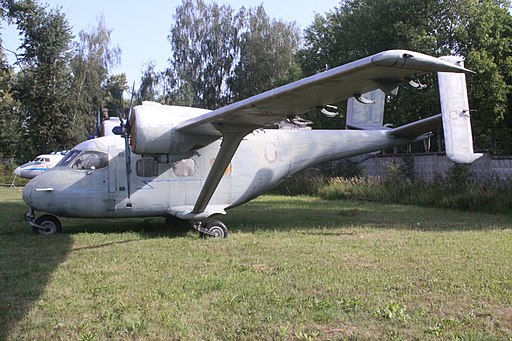
Antonov An-14
The Antonov An-14 “Pchelka” emerged in the late 1950s as a light twin-engine utility transport tailored to local feeder routes, geological survey, medevac, and liaison duties. Designed to replace aging single-engine biplanes, it combined rugged simplicity with improved payload and redundancy. Its fixed landing gear and straightforward systems made it ideal for operation from unprepared strips in remote regions.
Development and Design
Origins and Requirements
In the mid-1950s, Aeroflot and Soviet regional authorities needed a reliable aircraft for short-haul passenger and light cargo missions to villages lacking paved runways. The brief demanded:
- Twin-engine safety for overwater and adverse weather flights
- Capacity for at least six passengers plus pilot
- Simple maintenance with minimal tooling
- Short takeoff and landing (STOL) from grass, gravel or dirt
Antonov’s bureau adopted lessons from the An-2 workhorse yet opted for a low-wing monoplane layout to boost cruise speed and cabin comfort.
Prototypes and Production
The first An-14 prototype flew in July 1958. Early trials validated its gentle stall characteristics and short-field performance but revealed engine-cooling hotspots. Engineers enlarged the cowling intakes and added baffle seals to improve airflow. Series production began in 1960 at Kyiv, delivering over 300 airframes before manufacturing shifted to Samara in the late 1960s.
Airframe Structure
Fuselage
The semi-monocoque fuselage uses riveted aluminum alloys with foam-filled panels for sound dampening. The forward cabin accommodates pilot and co-pilot side by side, with seating for six passengers on bench seats. Large windows afford excellent visibility, while a sliding cargo door on the port side eases baggage loading.
Wings and Control Surfaces
A straight, tapered low wing spans 15.55 meters and houses integral fuel tanks in its inner panels. Pneumatically actuated double-slotted flaps and aluminum ailerons ensure predictable handling at low speeds. Wingtip fuel tanks add 150 liters per side, extending range without compromising ground clearance.
Landing Gear
The fixed tricycle undercarriage features streamlined fairings over each leg to reduce drag. Main legs use oleo-pneumatic shock absorbers and low-pressure tires to absorb rough-field operations. The steerable nose wheel simplifies taxiing on soft surfaces. Quick-release fittings allow wheel assembly swap in under 20 minutes.
Powerplant and Propulsion
The An-14 is powered by two Ivchenko AI-14RF nine-cylinder air-cooled radial engines, each rated at 300 horsepower (220 kW). Paired with two-blade constant-speed metal propellers, the drivetrain offers:
- Reliable cold-start performance down to –40 °C
- Redundancy for overwater or mountainous routes
- Simple modular design for frontline overhauls
Standard fuel capacity of 1,200 L (including tip tanks) yields up to four hours of endurance at economy cruise.
Flight Deck and Avionics
The instrument panel combines essential flight, engine and navigation displays. Standard equipment includes:
- Airspeed indicator, altimeter, vertical speed indicator
- Engine tachometers, oil pressure and temperature gauges
- VHF radio, automatic direction finder (ADF)
- Magnetic compass and standby altimeter
Optional upgrades added VOR receivers and marker beacon indicators for operations into busier airfields.
Payload and Capacity
With an empty weight of 1,650 kg and maximum takeoff weight of 2,750 kg, the An-14 can carry:
- Up to six passengers plus two crew (useful load ~1,100 kg)
- 800 kg of freight on cabin floor or in external cargo pod
- Medevac module fitting two stretchers and attendant seat
- Geological survey gear mounted under wing-mounted pods
Tie-downs in the cabin floor secure irregular loads for aerial photography or crop spraying equipment.
Operational History
Civilian Service
Aeroflot deployed the An-14 on regional networks across Central Asia, Siberia and the Russian Far East. Its ability to link remote villages to district centers transformed mail delivery, passenger movement and urgent medical evacuations. Several hundred remained in frontline service into the 1980s.
Military and Specialized Roles
The Soviet Air Force and DOSAAF used An-14s for liaison, calibration of navigation aids and paratroop training. Variants equipped with downward-looking cameras supported border patrols. After retirement from core airlines, many airframes served in Africa and Asia under civilian registrations.
Variants
- An-14A: Baseline production model with AI-14RF engines and standard avionics
- An-14M: Upgraded engines (AI-14V) producing 350 hp, enlarged tail surfaces, higher MTOW
- An-14P Medevac: Modified cabin with medical equipment racks and stretcher mounts
- An-14G Geological: Wing-mounted pods for magnetometer and seismic sensors
Each variant maintained the core STOL traits while tailoring equipment to mission needs.
Performance and Specifications
| Parameter | Value |
|---|---|
| Crew | 2 pilots |
| Passenger capacity | 6 |
| Length | 10.13 m |
| Wingspan | 15.55 m |
| Height | 3.26 m |
| Wing area | 33.5 m² |
| Empty weight | 1,650 kg |
| Maximum takeoff weight | 2,750 kg |
| Powerplant | 2 × Ivchenko AI-14RF radial engines, 300 hp each |
| Maximum speed | 260 km/h |
| Cruise speed | 240 km/h |
| Stall speed (flaps down) | 95 km/h |
| Range (with reserves) | 800 km |
| Endurance | 4 hours |
| Service ceiling | 4,500 m |
| Takeoff distance | 360 m over 15 m obstacle |
| Landing distance | 300 m over 15 m obstacle |
| Fuel capacity | 1,200 L (including wingtip tanks) |
The Antonov An-14’s blend of simplicity, redundancy and STOL capability ensured reliable service in some of the world’s most remote regions. Its various adaptations for survey, medevac and liaison underscored the design’s flexibility, and many airframes continued operating decades beyond their expected lifespan.
.jpg)