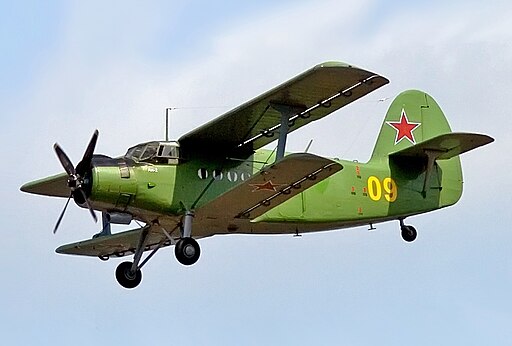
Antonov An-2
The Antonov An-2 stands as one of the most versatile and enduring utility aircraft ever built. Introduced in 1947, it combines remarkable short-takeoff and landing (STOL) capability with a rugged, simple design. Over 18,000 airframes were produced, and many remain in service on five continents, performing roles from agricultural spraying to passenger and cargo transport in remote regions.
Development and Design
Origins and Requirements
In the aftermath of World War II, the Soviet Union needed a multi-role biplane capable of operating from unprepared strips. The design brief called for:
- Outstanding low-speed handling
- Ability to carry passengers, cargo, or aerial applicator equipment
- Ease of maintenance in austere environments
Oleg Antonov’s team responded with a large single-bay biplane powered by a reliable radial engine.
Design Philosophy
Simplicity and robustness guided every aspect of the An-2:
- Straightforward tubular steel fuselage frame
- Fabric-covered control surfaces interchangeable in the field
- Fixed landing gear with low‐pressure tires
This philosophy enabled operation in Arctic tundra, Central African bush, and Himalayan valleys alike.
Structure and Materials
Fuselage and Cockpit
The fuselage comprises welded steel tubes braced with cables and covered in doped fabric. The deep cabin accommodates up to twelve passengers or equivalent cargo volume. Large side doors and a rear freight hatch facilitate rapid loading.
Empennage and Control Surfaces
Empennage members use wooden spars and ribs with fabric covering. Generous tailplane area ensures stability at low speeds. All control surfaces are manually actuated via push–pull rods and cables, minimizing potential failure points.
Wings and Aerodynamics
Wing Configuration
The An-2’s unequal-span biplane wing features:
- Upper wing span of 18.2 m and lower wing span of 13.1 m
- Strong stagger and slight sweep for center-of-gravity balance
- Full-span slats on the upper wing for stall prevention
The lower wing attaches directly to the fuselage, while the upper wing rests on cabane struts with single-bay interplane V-struts.
High-Lift Devices
Leading-edge slats deploy automatically at low speeds, delaying stall. Frise ailerons on both wings provide effective roll control even when partially stalled. Single-panel airbrakes on the upper wing allow for steep, controlled descents.
Powerplant and Propulsion
Shvetsov ASh-62 Radial Engine
Most An-2s mount the Shvetsov ASh-62 nine-cylinder air-cooled radial engine, delivering 1,000 shp:
- Proven reliability in harsh climates
- Simple carburetor and ignition systems for easy field maintenance
- Large spinnerless propeller hub to protect from debris
Variants in some countries use Polish-built Ivchenko-AI-14 or turboprop conversions.
Propeller
Standard setup features a two-blade wooden or metal propeller with manual pitch adjustment on the ground. Some modernizations install three-blade constant-speed props to improve climb and cruise performance.
Performance and Flight Characteristics
Speed and Climb
- Maximum speed: 258 km/h at sea level
- Cruise speed: 190 km/h
- Initial rate of climb: 3.2 m/s
The An-2 excels at climbs from short strips, reaching 1,000 m in under six minutes.
STOL Capability
Thanks to slats, broad wings, and low wing loading, the An-2 can:
- Take off in as little as 170 m with full load
- Land within 215 m using full flaps and airbrakes
Such performance proves invaluable in mountain valleys and marshland operations.
Operational Use and Roles
Military Service
Soviet and allied air forces employed the An-2 for:
- Paratroop drops and liaison duties
- Maritime patrol with underwing sonar buoys
- Forest firefighting and glider tugging
Its low-speed handling allowed safe operations near front lines.
Civilian Service
Civil operators adapted the An-2 to:
- Crop spraying and aerial seeding
- Remote passenger shuttle in Siberia, Canada, and Alaska
- Cargo lifter in logging and mining camps
Customizable interior fittings let each operator tailor the cabin to mission requirements.
Variants and Modifications
- An-2T: Standard transport version for passengers and cargo
- An-2P: Civil passenger model with glazed cabin and seats for up to 12
- An-2S: Agricultural sprayer with 1,200 L chemical tank
- An-2M: Floatplane variant with twin floats for water operations
- Turbo-An-2: Experimental turboprop conversion improving power and altitude
- An-2R: Arctic version with skis and reinforced landing gear
Each variant highlights the platform’s adaptability to diverse mission sets.
Technical Parameters
| Parameter | Specification |
|---|---|
| Crew | 1 or 2 |
| Capacity | Up to 12 passengers or 1,500 kg cargo |
| Length | 12.4 m |
| Wingspan (upper/lower) | 18.2 m / 13.1 m |
| Height | 4.1 m |
| Wing area | 71.5 m² |
| Empty weight | 3,100 kg |
| Maximum takeoff weight | 5,500 kg |
| Powerplant | 1 × Shvetsov ASh-62 radial, 1,000 shp |
| Maximum speed | 258 km/h |
| Cruise speed | 190 km/h |
| Range | 845 km |
| Service ceiling | 4,500 m |
| Rate of climb | 3.2 m/s |
| Takeoff run (MTOW) | 170 m |
| Landing distance | 215 m |
| Stall speed (flaps/slats down) | 55 km/h |
| Fuel capacity | 1,000 L total |
Legacy and Impact
Decades after its first flight, the An-2 remains in production under license in China and Poland. Its enduring success stems from unmatched STOL performance, ease of maintenance, and structural resilience. Generations of bush pilots, agricultural operators, and military aviators continue to rely on the An-2’s timeless design in environments where modern turboprops cannot match its simplicity.
.jpg)