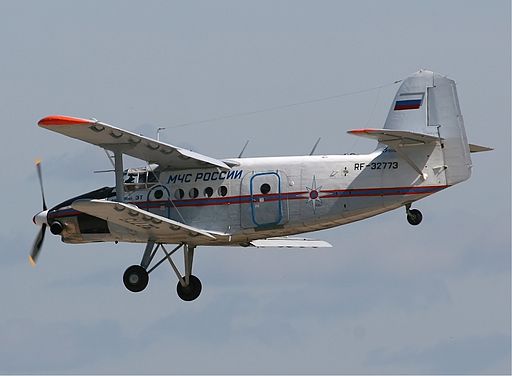
Antonov An-3
The Antonov An-3 is a rugged utility aircraft evolved from the legendary An-2 biplane. By integrating a turboprop engine in place of its original radial piston powerplant, the An-3 delivers enhanced performance, reliability, and operational flexibility. It retains the An-2’s famed short takeoff and landing (STOL) capabilities, making it ideal for austere fields and remote airstrips. Designed primarily for passenger and cargo transport, aerial survey, and agricultural missions, the An-3 bridges the gap between simplicity and modern turboprop efficiency.
Design and Development
Turboprop Conversion
The core innovation of the An-3 lies in replacing the Shvetsov ASh-62 radial engine with a Glushenkov TVD-20 turboprop. Producing approximately 1,500 shaft horsepower, this powerplant upgrade boosts cruise speed, climb rate, and fuel economy. The new propeller system—a four-blade constant-speed unit—optimizes thrust across varying flight regimes. Engine mounts, cowling, and oil-cooling arrangements were extensively redesigned to accommodate the different thermal and vibration characteristics of the turboprop.
Airframe and Structure
Although sharing its fundamental biplane layout with the An-2, the An-3 incorporates airframe reinforcements to handle higher cruise speeds and increased gross weights. Wing spars and attachment fittings received material upgrades, while stressed-skin panels were strengthened at key load points. Landing gear components were also beefed up, with improved oleo struts to absorb harder touchdowns. Despite these enhancements, the An-3 maintains easy field maintenance and simple construction, with most panels and assemblies accessible via fasteners and inspection hatches.
Aerodynamic Enhancements
To exploit the turboprop’s power, slight aerodynamic refinements were introduced. Leading-edge slats are now pneumatically activated, improving low-speed handling and shortening landing runs. Wingtip fairings reduce induced drag, marginally increasing cruise efficiency. The fuselage features subtle fillets at wing roots and strut intersections to smooth airflow. Combined, these tweaks help the An-3 achieve a cruise speed up to 280 km/h, roughly 30 km/h faster than its piston-powered predecessor.
Technical Specifications
General Characteristics
- Crew: 1 or 2 pilots
- Passenger capacity: up to 12 seats in commuter configuration
- Cargo compartment: 12 m³ with quick-change pallet system
- Cabin: heated and sound-insulated for operation in extreme climates
- Access: large rear cargo door and optional ski, float, or wheel-and-track landing gear
Dimensions
- Length: 12.40 m
- Wingspan: 18.17 m
- Height: 4.13 m
- Wing area: 71.4 m²
- Wing aspect ratio: 4.6:1
Weights
- Empty weight: 3,350 kg
- Maximum takeoff weight: 5,500 kg
- Maximum payload: 1,600 kg
- Fuel capacity (standard): 900 L
Powerplant
- Engine: 1 × Glushenkov TVD-20 turboprop
- Power output: 1,500 shp (1,120 kW) at takeoff
- Propeller: Four-blade, constant-speed, reversible
Performance
- Maximum cruise speed: 280 km/h
- Economy cruise speed: 230 km/h
- Stall speed (landing configuration): 65 km/h
- Service ceiling: 4,500 m
- Rate of climb (sea level): 6.0 m/s
- Takeoff distance (over 15 m obstacle): 220 m
- Landing distance (over 15 m obstacle): 190 m
Fuel and Range
- Fuel consumption (cruise): 250 L/h
- Maximum range (with reserves): 1,300 km
- Endurance: 5–6 hours
Avionics and Systems
- Navigation: VHF omnidirectional range (VOR), GPS/WAAS
- Communications: Dual VHF radios, optional HF
- Flight instruments: Gyro horizon, altimeter, airspeed indicator, vertical speed indicator
- Weather radar and traffic collision avoidance system (optional)
- Electrical: 28 V DC main bus with dual alternators
Payload and Capacity
- Passenger layout: forward-facing club seating or utility bench
- Cargo pallets: two standard-sized containers
- Agricultural kit: 1,200 L hopper with spray booms
- Medevac conversion: space for two stretchers and attendant station
Operational History
Entry into Service
The An-3 first flew in 1980 and entered limited military evaluation before transitioning to civilian certification in the mid-1980s. Early users included Aeroflot subdivisions, agricultural enterprises, and northern mining companies. Its turboprop reliability proved a game changer for far-north operations, where piston-engine servicing and winter cold starts had been major headaches.
Operators and Roles
Government agencies in Russia, Ukraine, and neighboring states deployed the An-3 for border patrol, airborne medevac, and forest fire monitoring. Charter airlines adopted the type for feeder routes on unpaved strips, appreciating its low operating cost and STOL performance. In recent decades, a handful of Western agricultural contractors have imported and converted An-3s for aerial spraying, drawn by its hopper capacity and turbine endurance.
Notable Missions
- Arctic resupply runs to icebound outposts, demonstrating reliable cold-weather starts down to –50 °C.
- Bush pilot operations in Siberia, showcasing its ability to carry full payloads off 300 m gravel runways.
- High-altitude survey flights over the Caucasus, exploiting the turboprop’s superior climb and ceiling.
Variants and Upgrades
Several specialized versions of the An-3 have been developed:
- An-3T: Dedicated freighter with reinforced floor, cargo handling rollers, and large swing tail.
- An-3P: Passenger model with deluxe cabin, soundproofing, and in-flight oxygen for high-altitude tourism.
- An-3 Agricultural: Equipped with hopper, spray system, and GPS-guided application controls.
- An-3M: Modern upgrade featuring composite rotor blades, Garmin G1000 avionics suite, and digital engine management.
Each variant retains core STOL traits while tailoring the airframe and systems to mission requirements.
Conclusion
The Antonov An-3 stands as a testament to the enduring value of the An-2 platform, modernized through turboprop power and contemporary systems. It seamlessly blends rugged simplicity with improved performance, making it a versatile asset for commercial, governmental, and specialized operations. Whether ferrying passengers to remote villages, applying crop protection over vast fields, or supporting scientific expeditions in extreme latitudes, the An-3 continues to prove that incremental innovation can breathe new life into a classic design.
