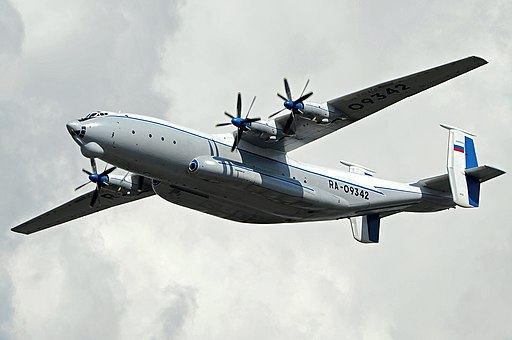
Antonov An-22
The Antonov An-22 Antei stands as a milestone in aviation history as the world’s largest turboprop transport aircraft when it first flew in 1965. Designed by the Soviet Antonov Design Bureau, it combined exceptional payload capacity with short-field performance for strategic airlift missions. Its distinctive contra-rotating propellers and high-wing layout made it instantly recognizable, while its robust construction allowed operations from primitive runways in remote regions.
Development and Design
Origins and Strategic Requirements
In the early 1960s, Soviet military planners sought an airlifter capable of moving heavy armored vehicles, helicopters, and oversized equipment across continental distances. The goal was to match or exceed Western heavy transports while exploiting the greater fuel efficiency of turboprops. Key requirements included:
- Payload of at least 80,000 kilograms
- Range of 5,000 kilometers with maximum load
- Operation from unpaved airstrips under austere conditions
Antonov’s engineering team leveraged experience from the An-12 and An-10 projects to create a purpose-built giant.
Prototype Development and Flight Testing
The first An-22 prototype rolled out in Kiev in late 1964 and took to the air on February 27, 1965. Early flight trials focused on validating structural integrity under full payload and verifying STOL characteristics. Engineers assessed:
- Wing loading and lift augmentation devices
- Effectiveness of contra-rotating propellers on climb and cruise
- Behavior of airframe under asymmetric engine failure
By 1967, serial production commenced at the Kiev-Svyatoshino plant, delivering over 60 aircraft by the mid-1970s.
Airframe and Structure
Fuselage Configuration
The An-22 adopts a circular cross-section fuselage with a reinforced keel beam to support heavy cargo. The cockpit sits atop the forward fuselage, providing excellent ground visibility. Beneath the cockpit, a hydraulically operated nose section tilts forward to form a ramp for roll-on/roll-off loading of vehicles.
Wing Design
A high-mounted wing spans 64.4 meters and features a double-slotted flap system for enhanced low-speed lift. The wing structure incorporates integral fuel tanks with a total capacity exceeding 120,000 liters. Wingtip extensions and sizeable end-plates reduce induced drag and improve roll stability at heavy weight.
Landing Gear
The An-22’s landing gear is a multi-wheel system comprising 12 main wheels on three struts and two steerable nose wheels. Low-pressure tires permit operations on soft or uneven surfaces. Each strut uses oleo-pneumatic shock absorbers calibrated for heavy-load landings and rapid turnarounds in forward operating bases.
Powerplant and Propulsion
Turboprop Engines
Four Kuznetsov NK-12MA turboprop engines drive the An-22, each producing 15,000 shaft horsepower. These are the most powerful turboprops ever built, giving the aircraft its remarkable lift and cruise performance. The engines incorporate modular construction for quick field maintenance and can sustain continuous cruise at altitudes up to 10,000 meters.
Contra-Rotating Propellers
Each engine turns a set of contra-rotating eight-blade propellers measuring 7.2 meters in diameter. This arrangement doubles the blade area in a compact disc and cancels out torque, ensuring stable handling. The propellers’ variable-pitch mechanism allows automatic adjustment for optimum efficiency across different flight regimes.
Cargo Handling and Loading Systems
Cargo Bay Layout
The An-22’s cavernous cargo hold measures 33 meters in length, 4.4 meters in width, and 4.4 meters in height. Its reinforced floor accepts heavy tracked vehicles and oversized equipment up to 5 meters in height. Overhead crane rails permit internal lifting of palletized loads and machinery.
Airdrop and Rapid Deployment
For military missions, the An-22 can deploy paratroopers and heavy cargo via side and rear doors. The aircraft features a parachute-release system with synchronized door opening and ramp extension. Maximum airdrop capacity reaches 60,000 kilograms of equipment or up to 600 personnel in rapid succession.
Flight Deck and Avionics
Cockpit Layout
The flight deck houses a three-crew team consisting of pilot, co-pilot, and navigator. Ergonomic panel arrangement clusters primary flight instruments centrally, with engine parameters and navigation displays flanking either side. A large overhead panel manages electrical, hydraulic, and environmental systems.
Navigation and Communication Systems
Original avionics included VOR/ILS receivers, HF and VHF radios, and a gyroscopic autopilot for long-range cruise. Later upgrades added GPS navigation, digital flight management, and weather radar. Built-in redundancy in critical systems ensures mission reliability even if one system fails.
Operational History
Military Service
The An-22 entered Soviet Air Force service in 1969, primarily with the 223rd Independent Air Regiment. Its first public display at Domodedovo in 1969 demonstrated its ability to lift a T-54 tank and troop platoon in one sortie. During the 1970s, An-22s supported missions in Afghanistan, delivering armored vehicles and supplies to remote airstrips at high altitude.
Humanitarian and Civilian Missions
Beyond military use, the An-22 excelled in humanitarian relief, transporting disaster relief convoys to regions cut off by earthquakes or floods. Special missions included airlifting generators, water purification units, and medical teams. A handful of An-22s operated under Allied contracts, demonstrating its value in global logistics.
Variants
- An-22B: Civilian freighter version with simplified cargo interfaces and fewer military-specific systems
- An-22P: Passenger variant refitted to carry up to 290 troops or 150 passengers with basic amenities
- An-22MD: Dual-role model with a detachable deck for medical evacuation and cargo transport
- An-22MKMC: Meteorological calibration platform equipped with sensors for weather data collection
Each variant retained the core airframe and powerplants while customizing equipment for specific roles.
Technical Specifications
| Parameter | Value |
|---|---|
| Crew | 3 (pilot, co-pilot, navigator) |
| Passenger/Troop Capacity | 150 passengers or 290 troops |
| Cargo Volume | 1,200 m³ |
| Length | 57.9 m |
| Wingspan | 64.4 m |
| Height | 12.1 m |
| Wing Area | 389 m² |
| Empty Weight | 110,000 kg |
| Maximum Takeoff Weight | 250,000 kg |
| Powerplant | 4 × Kuznetsov NK-12MA, 15,000 shp each |
| Maximum Speed | 740 km/h |
| Cruise Speed | 700 km/h |
| Service Ceiling | 12,000 m |
| Range (max payload) | 5,000 km |
| Takeoff Distance (MTOW, sea level) | 2,500 m |
| Landing Distance (MTOW, sea level) | 2,200 m |
| Fuel Capacity | 124,000 L |
The Antonov An-22 combined groundbreaking engineering with sheer brute force to redefine strategic airlift. Its enduring legacy lives on in subsequent heavy-lift transports and in the lessons it provided on integrating turboprop power with large-scale logistics.
