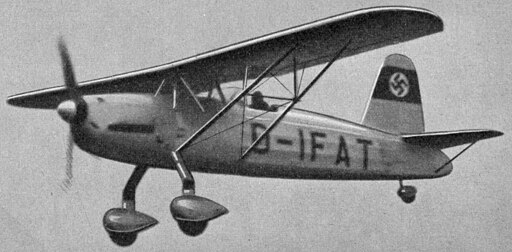
Arado Ar 76
The Arado Ar 76 emerged in the mid-1930s as Germany’s answer to a dual-role requirement for a light emergency fighter and an advanced trainer. Designed by Walter Blume at Arado Flugzeugwerke, it first took to the skies in April 1934 and entered limited production by 1936. Compact yet agile, the Ar 76 bridged the gap between elementary trainers and frontline monoplanes, preparing pilots for the high demands of aerial combat.
Development and Design
Origins and Prototyping
In 1933, the Reichsluftfahrtministerium issued a call for a pocket fighter capable of both home-defense interception and advanced pilot instruction. Arado responded with three successive prototypes—V1, V2 and V3—each powered by an Argus As 10C air-cooled inverted V8 motor. Early trials focused on refining wing bracing, tailplane geometry and engine cowling to balance speed, stability and ease of maintenance.
Airframe and Structure
The Ar 76 adopted a parasol-wing monoplane layout with streamlined cabane struts and fixed tailwheel undercarriage. A welded steel-tube fuselage provided rugged crashworthiness, while fabric-covered wooden wings kept weight low. Metal sheet panels clad the forward fuselage for added torsional stiffness and heating protection around the cockpit and firewall.
Powerplant
At its heart sat the Argus As 10C, a reliable eight-cylinder engine producing 240 hp at 2 400 rpm. Its simple carburetor and robust cooling jackets allowed operations from improvised fields. Power transmitted through a two-bladed fixed-pitch wooden propeller delivered smooth throttle response and predictable spin-entry characteristics—vital for novice fighter pilots mastering aerobatics.
Cockpit and Controls
An open cockpit with sliding windscreen granted excellent upward visibility, essential for spotting adversaries from below. Flight controls linked to horn-balanced ailerons, elevator and rudder offered a crisp, direct feel without heavy forces. A minimal instrument panel featured basic engine gauges, a magnetic compass and a turn-and-bank indicator, teaching pilots fundamental attitude management.
Armament and Equipment
When employed in the fighter role, the Ar 76 mounted two synchronized 7.92 mm MG 17 machine guns above the engine, each supplied with 250 rounds. For ground-attack twilight or emergency missions, three under-fuselage bomb shackles carried 10 kg SC 10 bombs. Training variants typically removed one gun and all bomb fittings to reduce weight and focus on weapons-handling drills.
Variants
Ar 76a
The initial prototype designated V1, registered D-ISEN, validated the basic parasol-monoplane layout. Flight tests highlighted the need for greater fin area to improve yaw stability during aerobatic sequences.
Ar 76V2
In the second prototype, engineers lengthened the tailplane and refined rudder balancing. Minor tweaks to the wing center section ties stiffened the structure, allowing sharper pull-out loads without hinging issues.
Ar 76V3
The third airframe introduced a faired engine cowling and streamlined undercarriage fairings. These changes trimmed drag, boosting top speed by roughly 5 km/h and improving fuel economy on long-duration sorties.
Ar 76A
The production Ar 76A series entered service in early 1936. Standard features included dual guns, bomb provisions and full dual-ignition engine fit. Approximately 180 airframes rolled off the Arado line, destined primarily for fighter schools rather than frontline Jagdgeschwader.
Operational History
By mid-1936, Ar 76As equipped Jagdfliegerschulen across Germany, from Döberitz to Schleißheim. Cadets learned deflection shooting, formation tactics and diving attacks on towed banners. Although evaluated against the Focke-Wulf Fw 56 Stösser, the Ar 76 found its niche as a training workhorse rather than a mass-produced interceptor.
Limited frontline dispatch of Ar 76s occurred in early 1937 under emergency reserve schemes, but the arrival of modern monoplanes soon relegated it to instructional duties. Pilots who cut their teeth on the Ar 76 often commented on its forgiving stall behavior and rugged undercarriage, which survived even the roughest student mishaps.
Technical Specifications
| Parameter | Value |
|---|---|
| Crew | 1 pilot |
| Length | 7.20 m |
| Wingspan | 9.50 m |
| Height | 2.55 m |
| Wing area | 13.34 m² |
| Empty weight | 751 kg |
| Maximum takeoff weight | 1 072 kg |
| Powerplant | 1 × Argus As 10C, 240 hp |
| Propeller | 2-blade wooden, fixed-pitch |
| Maximum speed | 267 km/h at sea level |
| Cruise speed | 221 km/h |
| Range | 470 km |
| Service ceiling | 6 400 m |
| Rate of climb | 7.2 m/s |
| Armament | 2 × 7.92 mm MG 17; up to 3 × SC 10 bombs (10 kg each) |
Legacy
Though the Arado Ar 76 never secured a major fighter contract, its influence resonated through Luftwaffe pilot training doctrine. It bridged rudimentary primary trainers and high-performance fighters, instilling gunnery precision and aerobatic confidence. As a stepping stone to faster monoplanes, the Ar 76 helped forge the cadre of pilots who would later shape early aerial campaigns. Its compact “pocket fighter” concept also presaged later light-attack designs, cementing the Ar 76’s place in aviation history.
