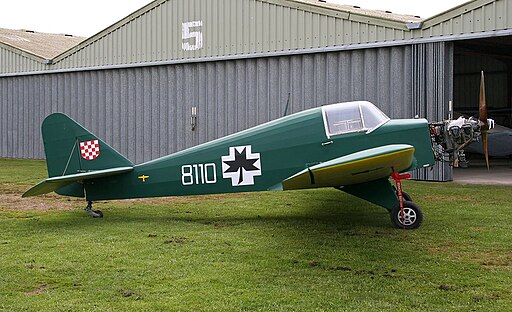
The Avia FL.3 was a light, two-seat, low-wing aircraft developed in Italy in the late 1930s for training, touring, and liaison duties. Designed by Francis Lombardi, it represented a refined example of interwar Italian aeronautical engineering—combining simplicity, light weight, and excellent flight handling. The aircraft’s design philosophy focused on ease of production and maintenance, making it suitable for both civil and military use.
Produced in various forms before and after World War II, the FL.3 became one of the most widely used light aircraft in Italy during the 1940s and 1950s. Its adaptability, sturdy construction, and forgiving flight behavior made it an ideal choice for flight schools, aero clubs, and military flying units. After the war, it continued production under different manufacturers, including Meteor and Lombardi, cementing its legacy as one of Italy’s most successful light trainers.
Development History
The Avia FL.3 was designed by Francis Lombardi, an Italian pilot, engineer, and aircraft designer known for his practical and elegant designs. Lombardi’s goal was to create a light, economical aircraft that could serve both civilian flying clubs and the Regia Aeronautica (Royal Italian Air Force) as a basic trainer.
The prototype made its first flight in 1938, built by Avia (Azionaria Vercellese Industrie Aeronautiche), based in Vercelli. Its design immediately attracted attention for its simplicity and low production cost. The Regia Aeronautica evaluated the aircraft and found it suitable for ab initio (primary) training. Consequently, orders followed for use in both civil and military flight schools.
During World War II, the FL.3 was widely employed for pilot training, liaison, and communication duties. After the war, production was resumed by several Italian companies, notably Meteor SpA, which produced updated models under designations such as Meteor FL.53 and Meteor FL.55. These postwar variants featured more powerful engines and modernized fittings, extending the aircraft’s operational life well into the 1950s and 1960s.
Design and Construction
The Avia FL.3 was designed to be compact, light, and aerodynamically efficient. Its all-wood structure and straightforward systems made it inexpensive to build and maintain—an essential characteristic for an aircraft aimed at mass production for training purposes.
Fuselage
The fuselage of the FL.3 was of wooden semi-monocoque construction, built from plywood over wooden frames. This provided a smooth aerodynamic contour and sufficient structural strength for basic training maneuvers. The aircraft featured side-by-side seating for two occupants under a clear canopy or open cockpit, depending on the version. Dual controls were standard, allowing instructors and students to share the same instrumentation.
The cockpit layout was simple and uncluttered, with the essential flight instruments arranged for easy readability. Visibility from both seats was excellent thanks to the aircraft’s low engine cowling and the pilot’s relatively high seating position.
Wings
The low-mounted wings were constructed of wood and covered with fabric. They had a single main spar and employed a straight-tapered planform with rounded wingtips. The wings were braced by short struts connecting them to the lower fuselage sides, enhancing rigidity without adding significant drag. Ailerons were fitted for lateral control, and the overall wing design provided high lift and stable handling characteristics—ideal for student pilots.
Empennage and Landing Gear
The tail unit was conventional, featuring a vertical fin and balanced rudder, with a fixed horizontal stabilizer and elevators. The landing gear was of the fixed tailwheel type, using two main wheels mounted on cantilever struts with shock absorbers. The wide undercarriage track improved ground stability during taxiing and takeoff, while the tailwheel made the aircraft easy to maneuver on grass airfields.
Powerplant and Performance
The Avia FL.3 was powered by a range of small piston engines over its production life, the most common being the Continental A65, Fiat A.50, and CMASA Alfa Romeo 110. The aircraft’s modest power output was balanced by its light weight and efficient aerodynamic design, providing satisfactory performance for training and touring roles.
Technical Parameters (Typical Avia FL.3 Configuration):
-
Type: Two-seat light trainer and touring aircraft
-
Manufacturer: Avia (Italy)
-
Designer: Francis Lombardi
-
Crew: 2 (pilot and passenger or instructor and student)
-
Engine: Fiat A.50, 5-cylinder air-cooled radial engine
-
Power Output: 85 hp (63 kW)
-
Propeller: Two-bladed fixed-pitch wooden propeller
-
Maximum Speed: 175 km/h (109 mph)
-
Cruising Speed: 150 km/h (93 mph)
-
Range: 450 km (280 mi)
-
Service Ceiling: 4,500 m (14,760 ft)
-
Rate of Climb: 3.5 m/s (690 ft/min)
-
Wingspan: 9.40 m (30 ft 10 in)
-
Length: 6.50 m (21 ft 4 in)
-
Height: 1.90 m (6 ft 3 in)
-
Wing Area: 14.8 m² (159 sq ft)
-
Empty Weight: 420 kg (925 lb)
-
Maximum Takeoff Weight: 680 kg (1,500 lb)
Later postwar versions, such as the Meteor FL.53, used engines producing up to 100 hp, improving climb performance and maximum speed to nearly 200 km/h.
Flight Characteristics
The Avia FL.3 was widely praised for its forgiving handling, stability, and ease of operation. It was designed with training in mind, offering predictable stall behavior and a wide speed envelope. Its low wing loading allowed for gentle landings, while its responsive control surfaces provided smooth, balanced flight performance.
The aircraft’s structure was light yet durable, able to withstand repeated training use. Its low-wing configuration enhanced visibility during flight instruction, especially in turns, and the side-by-side seating arrangement made communication between instructor and student much easier compared to tandem trainers of the era.
While not a fast aircraft, the FL.3 excelled in fuel economy and maneuverability. It was capable of mild aerobatics, including loops and rolls, making it suitable for advanced instruction as well as basic flight training. Ground handling was also excellent due to its stable undercarriage and effective tailwheel steering.
Variants
Over time, several variants and derivatives of the Avia FL.3 were produced, both before and after World War II:
-
Avia FL.3 (Standard): Original production version with Fiat A.50 or Continental engine, side-by-side seating, and open or enclosed cockpit.
-
Avia FL.3L: Lightened version with structural improvements and slightly modified control surfaces.
-
Meteor FL.53: Postwar production by Meteor SpA, equipped with a more powerful 90–100 hp engine and minor aerodynamic refinements.
-
Meteor FL.54: A three-seat version developed for touring and utility use.
-
Meteor FL.55: Improved postwar trainer and sport variant with enhanced cockpit and modernized avionics.
Each of these variants shared the same airframe concept, differing primarily in powerplant and equipment levels. The Meteor-built aircraft maintained the FL.3’s general design philosophy but benefited from postwar materials and manufacturing improvements.
Operational Use
During World War II, the Regia Aeronautica used the FL.3 primarily as a basic trainer for new pilots. It served at numerous Italian flight schools, where its docile handling characteristics made it ideal for student instruction. The aircraft was also used for light liaison duties, carrying messages and personnel between airfields.
After the war, the FL.3 transitioned to civilian use in Italy and abroad. Its affordable operating costs and ease of maintenance made it a favorite among flying clubs and private owners. Dozens of aircraft were exported to other European nations, and a few found use in Latin America.
In postwar Italy, the type became a common sight in aero clubs under the Meteor FL.53 and FL.55 designations. These versions contributed significantly to the revival of general aviation in Italy during the 1950s, helping train a new generation of pilots.
Legacy and Preservation
The Avia FL.3 stands as one of the most enduring designs of the Italian interwar and postwar aviation industry. Its success lay not in performance but in practicality—it was reliable, economical, and safe, precisely what was needed in the years before and after the war.
Today, several restored examples of the FL.3 and its Meteor derivatives remain airworthy and are displayed in Italian aviation museums, including the Museo dell’Aeronautica Gianni Caproni and private collections. Enthusiasts value the aircraft for its simplicity, elegant lines, and historical significance as one of Italy’s most important light trainers.
Conclusion
The Avia FL.3 epitomized Italian light aircraft design at the threshold of World War II—a blend of craftsmanship, aerodynamic efficiency, and simplicity. Its wooden structure, side-by-side seating, and dependable performance made it an essential training platform for both military and civilian pilots.
Though overshadowed by faster, more advanced aircraft in later years, the FL.3’s contribution to flight training and postwar aviation cannot be overstated. It bridged the gap between prewar artisanal aircraft and modern postwar trainers, earning a respected place in the lineage of European light aviation.
