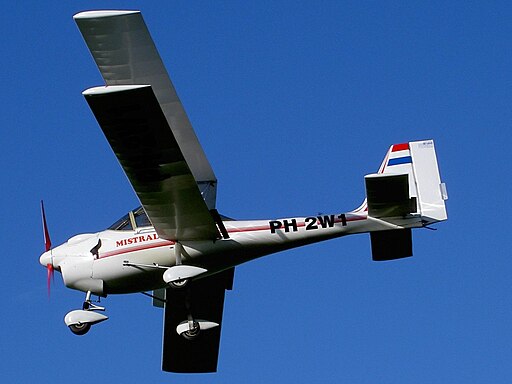
The Aviasud Mistral was a light two-seat ultralight and homebuilt aircraft developed in France during the early 1980s. Designed for sport flying, training, and recreational use, the Mistral embodied the spirit of the European ultralight aviation movement—a period characterized by innovation, affordability, and accessibility. Its elegant, streamlined design and efficient performance made it one of the most notable European ultralights of its era.
Produced by Aviasud Engineering, a French company specializing in composite aircraft construction, the Mistral stood out for its advanced materials and aerodynamic efficiency. It offered both factory-built and kit-built versions, appealing to private owners, flight clubs, and amateur builders seeking a reliable, low-cost aircraft with refined handling.
Development History
Aviasud Engineering was founded in 1980 in Aix-en-Provence, France, with the aim of producing innovative light aircraft using composite technology—a relatively new concept at the time. The company’s founders, Hubert Camille and Roger Joly, were experienced aeronautical engineers who wanted to design an aircraft that was lightweight, safe, and aerodynamically clean while offering performance levels beyond typical ultralights.
The Mistral project began around 1982, with its first flight occurring soon after. The design was based on a side-by-side seating configuration, allowing easy communication between pilot and passenger or instructor and student. Emphasis was placed on aerodynamic purity, low drag, and excellent visibility.
The Mistral’s composite structure gave it a unique advantage over many ultralights of the era, which were typically constructed from aluminum tubing and fabric. Aviasud used fiberglass-reinforced epoxy resin for the primary airframe, reducing weight while enhancing strength and corrosion resistance. This approach also enabled smoother contours and a cleaner aerodynamic profile.
The aircraft was certified under French ultralight regulations and later accepted in several European countries. It remained in production through the late 1980s and early 1990s, earning a reputation for reliability and graceful handling.
Design and Construction
The Aviasud Mistral was a low-wing, two-seat light aircraft with fixed tricycle landing gear. Its clean aerodynamic design and composite structure provided both efficiency and aesthetic appeal. Every component—from the fuselage to the wings and empennage—was optimized for simplicity, lightness, and safety.
Fuselage
The fuselage was made entirely of fiberglass composite, with integrated bulkheads and ribs providing rigidity. This monocoque structure eliminated the need for internal metal frames, reducing both weight and maintenance requirements. The cockpit featured side-by-side seating under a large bubble canopy, providing excellent all-around visibility. The canopy hinged forward for easy entry and exit.
The seats were equipped with dual flight controls, making the aircraft suitable for training purposes. The cockpit layout was ergonomic and straightforward, featuring essential flight instruments and engine gauges arranged for quick readability.
Wings
The Mistral’s low-mounted wings were also of composite construction, built in one piece with a single main spar. The airfoil was optimized for low-speed stability and gentle stall behavior, ensuring forgiving handling for less experienced pilots. The wings incorporated flaperons—a combination of flaps and ailerons—to enhance both roll control and lift at low speeds.
The wingtips were rounded, contributing to aerodynamic efficiency and reducing induced drag. Wing attachment points were designed for easy assembly and disassembly, facilitating transport and maintenance.
Empennage
The tail unit featured a conventional T-tail configuration, with the horizontal stabilizer mounted high on the fin. This arrangement provided clean airflow over the tail surfaces and improved pitch stability during low-speed operations. Like the rest of the aircraft, the tail surfaces were made of composite materials with internal reinforcements.
Landing Gear
The Mistral used fixed tricycle landing gear with a steerable nose wheel, offering stable ground handling and straightforward taxiing. The main gear was mounted on spring composite struts that absorbed shocks effectively without the need for hydraulic systems. Wheel fairings were typically fitted to reduce drag.
Powerplant and Performance
The Aviasud Mistral was typically powered by small, reliable, and fuel-efficient engines popular in the light aviation community. The most common installation was the Rotax 532 or Rotax 582 two-stroke engine, although some variants were equipped with four-stroke powerplants for improved endurance and smoothness.
Technical Parameters (Standard Aviasud Mistral Configuration):
-
Type: Two-seat ultralight/sport aircraft
-
Manufacturer: Aviasud Engineering (France)
-
Crew: 2 (pilot and passenger or instructor and student)
-
Engine: Rotax 532 or Rotax 582, 2-cylinder, liquid-cooled, two-stroke engine
-
Power Output: 64 hp (48 kW) at 6,500 rpm
-
Propeller: Two-bladed fixed-pitch wooden or composite propeller
-
Maximum Speed: 210 km/h (130 mph)
-
Cruising Speed: 170 km/h (106 mph)
-
Stall Speed: 65 km/h (40 mph)
-
Range: 600 km (373 mi)
-
Service Ceiling: 4,500 m (14,760 ft)
-
Rate of Climb: 5.5 m/s (1,080 ft/min)
-
Wingspan: 8.90 m (29 ft 2 in)
-
Length: 6.30 m (20 ft 8 in)
-
Height: 2.10 m (6 ft 11 in)
-
Wing Area: 10.6 m² (114 sq ft)
-
Empty Weight: 245 kg (540 lb)
-
Maximum Takeoff Weight: 450 kg (992 lb)
These specifications placed the Mistral among the more capable ultralights of its generation, offering high cruise speeds and good fuel economy while maintaining compliance with European microlight regulations.
Flight Characteristics
Pilots praised the Aviasud Mistral for its smooth, responsive, and predictable flight handling. Its composite construction and aerodynamic design produced a clean, efficient airflow, resulting in a low drag coefficient and excellent glide ratio.
At low speeds, the aircraft remained stable and forgiving—ideal for training applications. The wing design, combined with the flaperon system, ensured gentle stall characteristics, typically accompanied by a mild nose drop and easy recovery.
In cruise flight, the Mistral was stable and efficient, capable of sustained flight at around 170 km/h while consuming minimal fuel. Its light control forces and excellent visibility made it particularly popular among recreational pilots who valued relaxed cross-country flying.
Ground handling was equally straightforward thanks to the tricycle gear configuration, which minimized the risk of nose-overs and provided excellent directional control during taxiing and takeoff.
Variants and Developments
Over its production life, several versions and experimental variants of the Mistral were developed to suit different markets and regulations.
-
Aviasud Mistral Standard: The initial production model equipped with Rotax 532 or 582 engines and basic analog instrumentation.
-
Aviasud Mistral F: A factory-built version with improved finish, optional enclosed cockpit heating, and enhanced canopy sealing for colder climates.
-
Aviasud Mistral RG: A proposed retractable-gear version, built as a prototype for improved aerodynamic performance (limited production).
-
Homebuilt Kit Version: Offered to amateur builders, allowing private construction under light aircraft certification.
Later iterations of the Mistral influenced the design of Aviasud’s subsequent aircraft, including the Aviasud Albatros and Aviasud Sirocco, both of which shared similar composite structures and aerodynamic principles.
Operational Use
The Aviasud Mistral was primarily used by private owners, flight schools, and aero clubs across France and Europe. Its reliability, straightforward operation, and low running costs made it ideal for initial flight training and recreational flying.
In many cases, Mistrals served as the first aircraft for ultralight pilots, bridging the gap between very light trikes or open-frame ultralights and larger general aviation aircraft. A number of Mistrals were exported to countries such as Germany, the United Kingdom, and Belgium, where they continued to serve as popular sport planes through the 1990s.
Despite its modest production numbers compared to mainstream trainers, the Mistral maintained a loyal following among enthusiasts who appreciated its smooth lines, modern materials, and refined flight behavior.
Legacy and Preservation
The Aviasud Mistral occupies a notable place in the evolution of European ultralight aviation. It demonstrated how composite materials could revolutionize light aircraft design—offering strength, efficiency, and durability without sacrificing affordability. Its construction techniques influenced numerous later light aircraft manufacturers across Europe.
Today, several examples of the Mistral remain operational, often lovingly maintained by private owners and aviation clubs. A few have been restored for display in aviation museums in France, where they stand as reminders of the innovative spirit of early composite aircraft design.
Conclusion
The Aviasud Mistral was more than just an ultralight—it was a pioneering step in modern light aircraft engineering. Its composite structure, elegant aerodynamics, and balanced flight performance showcased the capabilities of lightweight technology during a transformative era in aviation.
Designed with practicality and pleasure in mind, the Mistral combined performance, safety, and simplicity in one sleek package. Though production eventually ceased, its legacy endured through the aircraft it inspired and the pilots it trained. As an early ambassador of advanced materials in aviation, the Aviasud Mistral remains a shining example of French ingenuity and the timeless appeal of light flight.
