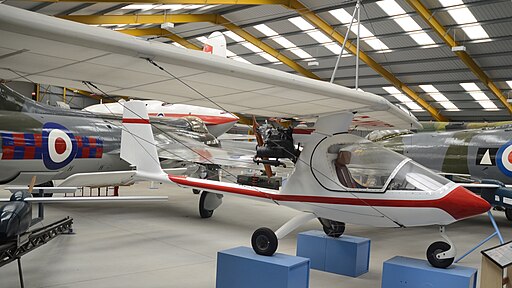
The Aviasud Sirocco is a single‑seat ultralight aircraft originally designed and manufactured by Aviasud Engineering (France) in the early 1980s. Production was later taken over by Aériane (Belgium) in 1989. Designed with a pod‑and‑boom style fuselage, composite materials and a pusher propeller configuration, the Sirocco gained recognition for its innovative construction and competitive performance in the microlight category. This article provides a detailed and technical overview of the aircraft’s development, structure, powerplant, flying characteristics, and variants.
Development and Design Origins
Concept and background
In the late 1970s and early 1980s the ultralight (‘microlight’) segment in Europe was rapidly evolving. Aviasud Engineering, founded by François Goethals and Bernard d’Otreppe, set out to design a high‑performance single‑seat ultralight using composite materials, efficient aerodynamics, and light weight.
The Sirocco first flew on 26 July 1982. From January 1983 it entered production. With its structural and aerodynamic design optimised via computer‑analysis, the aircraft was engineered for competitiveness as well as leisure flying.
Transfer of production
In 1989 Aviasud transferred production of the Sirocco to Aériane in Belgium. Later, in 2007, rights to the design were acquired by Aero Consult Light Aircraft (Netherlands), which developed an upgraded version known as the Sirocco nG.
Airframe and Construction
Fuselage and structural layout
The Sirocco employs a pod‑and‑boom fuselage configuration. The fuselage and vertical fin are constructed from composite materials — typically a fiberglass‑polyester shell made of two half‑shells that are molded and stiffened by internal frames, then glued together for rigidity.
The pilot occupies a recumbent seating position inside a cockpit which may have a removable canopy for open‑cockpit flying in warm weather.
Wing and control surfaces
The wing is a high‑mounted, cable‑braced structure carried above the fuselage via a kingpost and stay cables, with further bracing from below via cables. The wing utilises a spar plus a fibreglass leading edge, aluminium pre‑formed ribs, and a laminated fibreglass trailing‑edge spar. These structural components are interconnected via compression rods, cables and ribs to maintain the shape and fabric tension of the covering (typically Dacron).
The wing profile selected is the American TK7315 (designed by Paul McCready) with a thickness ratio of about 14%. Control for roll is achieved via spoilerons (on earlier versions), while pitch is managed via an all‑flying tailplane/trimming surface and yaw by a fin‑mounted rudder.
Landing gear and undercarriage
The landing gear uses a tricycle configuration: two main wheels and a steerable nose wheel. The main gear legs are flexible glass‑epoxy composite elements. The nose gear is steerable, with a lever on the right of the cockpit for ground steering, and a drum brake on the nose wheel. The design emphasises lightness and simplicity while retaining sufficient strength for microlight operations.
Materials and fabric covering
The wing covering uses Dacron fabric of approx. 170 g/m² (“Bainbridge” brand) to cover the double‑surface wing structure. Composite materials feature significantly in the fuselage, tail surfaces and undercarriage, contributing to the low empty weight of the design.
Powerplant and Propulsion
Engine options
The Sirocco was produced with a range of two‑stroke engines, depending on market and regulatory requirements. Early powerplants included the JPX PUL425 engine producing about 26 hp at 4,600 rpm. Later versions used the Rotax 377 or other equivalents producing up to 35‑42 hp. The engine is mounted in pusher configuration behind the central mast structure, driving a propeller behind the fuselage pod.
Propeller and thrust
For example, one specification notes a propeller diameter and pitch of 57 × 33 in (1.45 × 0.85 m) in one version. The max static thrust in one configuration is quoted as 232 lb (105 kg) when using the Rotax 377 with reduction gear.
Performance and Flight Characteristics
General flight behaviour
The Sirocco enjoys a reputation for efficient wing aerodynamics, good stability, and manoeuvrability — partly credited to its low wing loading and carefully engineered control responses. Roll‑control via spoilerons is effective; for example one test report noted rolling from +45° to –45° in about 4 seconds.
Representative specifications (selected variants)
Here are representative figures drawn from published documents:
External Dimensions & Areas (one version):
-
Length overall: 19.0 ft (5.80 m)
-
Height overall: 8.9 ft (2.70 m)
-
Wing span: 33.2 ft (10.12 m)
-
Wing area: 151 ft² (14.1 m²)
-
Aspect ratio: 7.3 : 1
Weights & Loadings:
-
Empty weight: 287 lb (130 kg)
-
Maximum take‑off weight: 552 lb (250 kg)
-
Wing loading at max weight: approx. 3.66 lb/ft² (17.7 kg/m²)
Performance:
-
Maximum level speed: 71 mph (115 km/h)
-
Never exceed speed (VNE): 75 mph (121 km/h)
-
Stall speed: 28 mph (45 km/h)
-
Rate of climb (sea level): 980 ft/min (5.0 m/s) for one version.
-
Service ceiling: up to 19,680 ft (6,000 m) in one configuration.
-
Range: 156 miles (250 km) at average cruising speed for one configuration.
Take‑off and landing
One source lists take‑off distance of 115 ft (35 m) in favourable conditions, landing distance about 165 ft (50 m) for the version cited. The low wing loading and efficient wing profile contribute to the Sirocco’s short‐field capability.
Handling traits
Pilots of the Sirocco report that the aircraft is responsive yet stable, thanks to a well‑designed control layout, efficient wing and light weight. The use of spoilerons rather than full ailerons in early versions offers crisp roll response but requires pilot coordination. Elevator trimming helps adjust for differing flight speeds, reducing pilot workload on longer flights.
Variants and Evolution
Original single‑seat Sirocco
The original production model was a single‑seat, three‑axis control microlight. It was available both as a kit and ready‑to‑fly, depending on the market.
Sirocco nG
In the late 2000s the design was updated and re‑launched as the AC Sirocco nG. This version featured a shorter composite wing (span ~9 m, area ~12.15 m²), new composite fuselage, and replaced the earlier spoilerons with full ailerons. The standard engine is the 33 hp Briggs & Stratton V‑2 four‑stroke. The enhancements improved safety, stall characteristics, and ease of transport.
Other planned variants
At the time of early documentation, a two‑seat “Sirocco Biplace” version was discussed (a biplane configuration) though its production state is less confirmed.
Operational Use and Legacy
One significant achievement: a Sirocco was flown around the world by Patrice Franceschi in 1984, marking the first microlight to complete a globe‑circumnavigation.
Its efficient design and strong performance in competitions earned it a reputation as one of the leading European ultralights of its era.
Although production has ceased (the Sirocco is listed by Aériane as a discontinued product) the aircraft remains of interest to ultralight enthusiasts, home‑builders and vintage ULM operators.
Technical Strengths and Considerations
Strengths
-
Low empty weight and efficient composite construction help deliver good payload for microlight category.
-
Efficient wing profile and comparatively low wing loading yield short take‑off/landing performance and good climb rate.
-
Pusher configuration offers good pilot visibility and reduced propeller noise impact in front.
-
Detachable wings (on some versions) facilitate transport and storage. For example the wing folds to approx. 5.8 m length for trailer transport.
Considerations
-
Being an older design, some parts or spare‐components may be harder to find; maintenance of composite structures may require specialist skills.
-
Early versions used two‑stroke engines, which require more frequent maintenance and have higher fuel/maintenance demands than modern four‑stroke equivalents.
-
The roll control via spoilerons may feel different from conventional ailerons and may demand familiarisation.
-
Given the low maximum speeds and relatively modest powerplants, the aircraft is best suited to leisure and sport flying, not high‑performance cross‑country operations.
Summary
The Aviasud Sirocco stands as a noteworthy example of microlight aircraft engineering from the early 1980s: combining composite materials, efficient wing design, and light weight to deliver good performance and handling in the ultralight category. With its heritage, global circumnavigation and subsequent evolution into the Sirocco nG, the aircraft has left a lasting legacy in the sport aviation world. For pilots or builders seeking a classic single‑seat ultralight with proven capabilities and interesting design features, the Sirocco remains a strong option, provided availability of parts and regulatory compliance are addressed.
