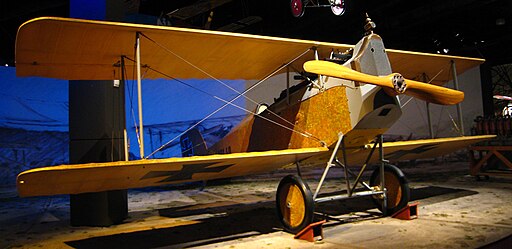
The Aviatik (Berg) D.I represents a significant milestone in Austro-Hungarian aviation history during World War I. Designed and built by the Austrian manufacturer Aviatik under the leadership of engineer Julius von Berg, the D.I was the empire’s first indigenous fighter aircraft, aiming to compete with contemporary German and Allied fighters. Its introduction marked a transition from reconnaissance-focused biplanes to dedicated single-seat fighters optimized for agility and firepower. Despite its relatively limited production and operational use, the Aviatik (Berg) D.I remains a notable example of early fighter design in the Central Powers’ aviation efforts. This article provides a detailed technical and historical examination of the Aviatik (Berg) D.I, exploring its design characteristics, performance parameters, and operational legacy.
Historical Context and Development
Origins and design motivation
During the early years of World War I, the Austro-Hungarian Air Service (Luftfahrtruppen) primarily employed reconnaissance and observation aircraft built under license or imported from Germany and France. As air combat evolved, the need for a homegrown fighter capable of defending Austro-Hungarian airspace became critical. The Aviatik (Berg) D.I was developed in 1916 by Julius von Berg, the chief designer at Aviatik, to fulfill this requirement. It was conceived as a single-seat biplane fighter intended to replace obsolete aircraft and counter the increasing threat posed by Allied fighters.
Design objectives
The primary goals were to produce a lightweight, maneuverable, and fast aircraft with adequate firepower to challenge enemy planes. The aircraft needed to be structurally sound for frontline service while incorporating the latest aerodynamic concepts. Emphasis was placed on a streamlined fuselage, effective wing design, and synchronization gear to allow forward-firing machine guns to operate through the propeller arc safely.
Airframe Design and Construction
Fuselage and materials
The Aviatik (Berg) D.I utilized a wooden frame fuselage constructed from spruce and ash, covered with plywood and fabric. The semi-monocoque plywood-covered forward fuselage provided smooth aerodynamic lines and structural rigidity. The rear fuselage framework was fabric-covered over wooden longerons and stringers, reducing weight while maintaining adequate strength.
Wing configuration
The aircraft was a single-bay biplane with equal-span, unstaggered wings. Both upper and lower wings featured two spars and wooden ribs, covered with fabric. The wings had a slight sweepback and moderate dihedral on the lower wing to enhance stability. The interplane struts were of the I-type, providing structural support and minimizing drag.
Tail assembly
The tailplane consisted of a fixed horizontal stabilizer with balanced elevators, fabric-covered for lightness. The vertical stabilizer was a fixed fin with a large, rounded rudder to provide effective yaw control. The tail surfaces used a wooden framework with fabric covering.
Landing gear
The fixed conventional landing gear had a sturdy wooden V-strut configuration with a single axle connecting the two main wheels. The wheels were spoked and fitted with pneumatic tires suitable for rough front-line airfields. A simple tailskid was used for ground handling.
Powerplant and Propulsion
Engine specifications
The Aviatik (Berg) D.I was powered by a 185-horsepower Austro-Daimler inline six-cylinder water-cooled engine. This powerplant was renowned for its reliability and smooth operation, enabling respectable speed and climb performance for the era. The engine was mounted at the nose with a streamlined cowling to reduce drag, and it drove a two-bladed wooden fixed-pitch propeller.
Cooling system
A prominent radiator was mounted on the nose, just behind the propeller hub, to provide adequate cooling for the liquid-cooled engine during various flight conditions. The radiator design was optimized to balance cooling efficiency with aerodynamic drag.
Armament and Combat Capabilities
Machine guns
The primary armament consisted of two synchronized 8 mm Schwarzlose machine guns mounted on either side of the fuselage, firing forward through the propeller arc. The synchronization gear was an essential advancement allowing pilots to fire without damaging the propeller blades.
Ammunition capacity and reload
Each machine gun was fed by a belt containing several hundred rounds, sufficient for typical combat sorties. The ammunition belts were housed within the fuselage behind the guns, allowing relatively straightforward reloading between missions.
Combat role
The Aviatik (Berg) D.I was designed to engage enemy reconnaissance aircraft and fighters, providing air superiority for Austro-Hungarian units. Its twin-gun armament and respectable maneuverability made it a capable adversary, although it faced stiff competition from more advanced German fighters like the Albatros D.III.
Performance Characteristics
Dimensions
-
Wingspan: 9.40 meters (30 feet 10 inches)
-
Length: 6.60 meters (21 feet 8 inches)
-
Height: 2.60 meters (8 feet 6 inches)
-
Wing area: 22.2 square meters (239 square feet)
Weight
-
Empty weight: Approximately 780 kilograms (1,720 pounds)
-
Gross weight: Approximately 1,030 kilograms (2,270 pounds)
Speed and climb
-
Maximum speed: Approximately 180 km/h (112 mph) at sea level
-
Service ceiling: Around 5,000 meters (16,400 feet)
-
Rate of climb: About 4.5 meters per second (885 feet per minute)
Range and endurance
-
Operational range: Approximately 350 kilometers (217 miles)
-
Endurance: Roughly 1.5 to 2 hours, depending on power settings and mission profile
Handling characteristics
The Aviatik (Berg) D.I was praised for its stable and predictable handling, making it relatively easy to fly compared to some contemporaries. It exhibited good roll rates and gentle stall behavior, suitable for both novice and experienced pilots. However, it was less agile than newer German fighters introduced later in the war.
Operational History and Legacy
Deployment and units
The Aviatik (Berg) D.I entered service in late 1916 and saw frontline action with various Austro-Hungarian fighter squadrons (Fliegerkompanien). It was primarily deployed on the Italian Front, where air combat was intense and critical for reconnaissance protection and air superiority.
Combat effectiveness
While the D.I was an important step forward for Austro-Hungarian aviation, its relatively limited speed and firepower compared to German and Allied contemporaries limited its long-term effectiveness. It was soon supplemented and then replaced by more advanced designs such as the Albatros D.III and later Austro-Hungarian-built fighters.
Production and variants
Approximately 80 to 100 Aviatik (Berg) D.I aircraft were produced. There were minor variations throughout production runs, including changes to armament mounting, cockpit layout, and engine installation refinements. No major variants were officially designated, but the D.I set the stage for further Austro-Hungarian fighter development.
Post-war influence
After the war, the Aviatik (Berg) D.I faded from active service, overshadowed by rapid advancements in fighter technology. Nevertheless, it holds historical importance as the first true indigenous Austro-Hungarian fighter, influencing later designs and demonstrating the empire’s industrial capability during the conflict.
Technical Strengths and Limitations
Strengths
-
Robust construction suitable for frontline operations
-
Reliable Austro-Daimler engine offering consistent performance
-
Twin synchronized machine guns providing effective offensive capability
-
Good handling characteristics aiding pilot confidence and combat effectiveness
Limitations
-
Speed and climb rate lagged behind more modern fighters by late 1917
-
Limited production numbers constrained its impact on the broader air war
-
Lack of stagger in wing design reduced aerodynamic efficiency compared to other biplanes
-
Water-cooled engine made it vulnerable to damage and complicated maintenance in field conditions
Conclusion
The Aviatik (Berg) D.I stands as a pioneering fighter aircraft for the Austro-Hungarian Empire during World War I. While not the most advanced or numerous fighter of its time, it was a vital step in the development of indigenous military aviation and reflected the strategic need for air superiority in a rapidly evolving combat environment. Its blend of solid construction, respectable performance, and effective armament made it a respected opponent in the skies over the Italian Front. Today, the Aviatik (Berg) D.I remains a symbol of early 20th-century aviation innovation and Austro-Hungarian aeronautical engineering heritage.
