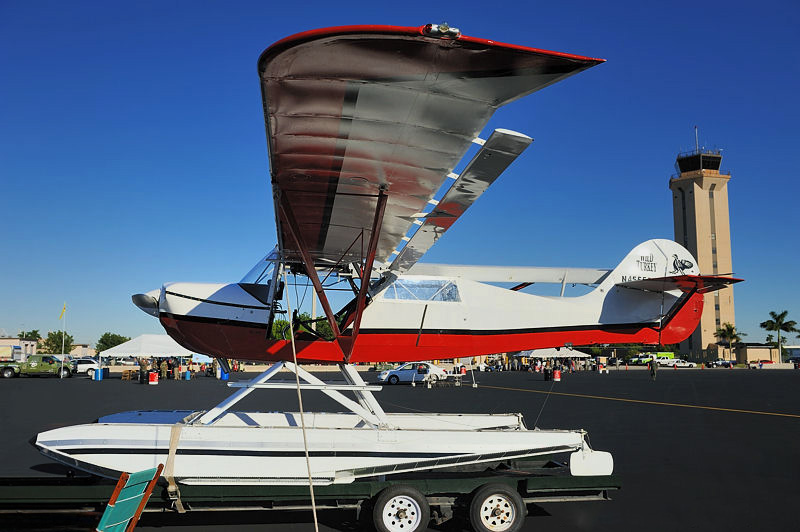
The Avid Aircraft Magnum is a two-seat, high-wing homebuilt monoplane that grew out of the popular family of Avid kit designs and was offered to builders as a rugged, Lycoming-powered alternative aimed at serious back-country and high-density-altitude operations. Designed with simplicity, strong structure, and trailerability in mind, the Magnum takes the Avid philosophy of easy-to-build welded steel fuselage and mixed-material wings and scales it up to accept conventional general-aviation engines in the 115–180 hp range, enabling significantly higher cruise and climb performance than smaller ultralight-derived kits.
Design origins and development
The Magnum was conceived as an enlarged, heavier-gross-weight descendant of the earlier Avid Flyer family, intended to bridge the gap between light kitplanes and conventional two-seat general-aviation aircraft. Its structural layout follows classic homebuilt practice: a welded 4130 steel-tube fuselage for occupant protection, bolt-on wings with aluminum spars and wooden ribs, and fabric covering (Ceconite or similar) for the flying surfaces. The design was sold in kit form and — after Avid’s original operations wound down — saw new life through successor kit manufacturers and aftermarket support groups that adapted a few features (landing gear sizes, optional tricycle gear, float installations) while preserving the original geometry and handling traits.
Airframe and materials
Structurally the Magnum blends a welded 4130 chromium-molybdenum steel tube fuselage with conventional “stick” wing construction: main spars in extruded aluminum, plywood or wooden ribs, and a lightweight fabric covering. The fuselage structure is engineered to accept a range of Lycoming horizontally opposed engines mounted to a conventional engine mount/firewall assembly, and the cabin is enclosed with large glazing for excellent visibility. Designers prioritized a roomy baggage bay aft of the seats and a wide 44-inch cabin that can accommodate larger pilots and modest cargo while retaining a compact prototype length for trailer storage.
Wing design and high-lift features
The Magnum’s wing is a high-lift, strut-braced semi-cantilever arrangement with full-span flaperons on many examples and a relatively large wing area intended to produce low wing loading at the published gross weight. The wing geometry (span roughly 32–33 ft, wing area around 136 sq ft, wing chord including flaperons approximately 51 in) produces an aspect ratio in the mid-sevens — a compromise that favors slow-speed lift, docile stall behavior, and good climb rate rather than top-end cruise speed. The wing fold feature present on many Avid designs was retained on the Magnum, enabling trailering and storage in standard garages when wings are folded and pinned.
Empennage and control surfaces
Tail surfaces follow conventional lines: a welded-tube vertical fin and rudder with fabric covering and a horizontal stabilizer mounted to the aft fuselage with cable or bolt-on bracing depending on builder preference. Control linkage uses push-pull tubes for primary surfaces where prudent and cables for secondary linkages when weight and simplicity win. Designers kept elevator authority relatively large to ensure positive pitch control at very low speeds and to provide steep approach capability for backcountry landings; however, flaperons trade some flap effectiveness for combined flap/aileron simplicity, so landing technique may differ from aircraft with dedicated flaps.
Landing gear and bush-capability
The Magnum was offered primarily with conventional (tailwheel) fixed gear optimized for rough-field operations: beefy main gear legs, large-diameter tires, and generous ground clearance. Many builders and later kit suppliers added reinforced gear legs and optional larger tires for true bush operations. A tricycle-gear conversion was offered by some aftermarket firms and optional floats have been fitted to a number of Magnums, turning the airframe into a capable floatplane with only modest modifications to step height and gear attach points. Braking systems are conventional hydraulic or mechanical drum/disc systems specified by builders.
Powerplant options and installation
The airframe is designed around Lycoming flat-four engines and can accept a broad envelope from roughly 115 hp (O-235 family) up to 180 hp (O-360 family) depending on builder goals. Typical installations reported and advertised in listings include 160 hp O-320 installations, which provide a balance of weight, power, and fuel economy for a useful-load-focused kitplane; some builders choose 180 hp O-360 installations for aggressive short-field performance or operations at very high density altitude. Engine cowling and baffling, spinner and firewall forward systems are builder-supplied items; builders typically fit standard general-aviation accessories (alternator, starter, dual ignition, typical A-65/Bendix mags or equivalents) and an oil-cooling and baffling package sized to the chosen engine. Propeller choices are matched to cruise and climb goals; three-blade props have been used on some installations for ground-handling benefits and noise/takeoff performance.
Performance and operational numbers
Published and community-reported performance figures vary with engine selection, propeller, weight and density altitude, but representative numbers for a Magnum fitted with a 160 hp Lycoming O-320 point to the following order of magnitude: cruise speeds near 120–130 ktas (≈140–155 mph) in cruise configuration, stall speeds in the vicinity of 36–40 kt (≈40–46 mph) depending on flap/flaperon settings, and initial climb rates exceeding 1,200–1,800 ft/min in favorable conditions. Reported takeoff runs for well-equipped examples are short — in the 150 ft range on soft or prepared surfaces under ideal conditions — and landing rolls are similarly short when energy is managed correctly, making the Magnum an attractive option for backcountry pilots. Service ceiling and range are functions of engine, fuel tank choice, and loading but published ranges for standard tanks approximate several hundred nautical miles with reserves.
Dimensions, weights, and critical specifications
The Magnum’s empirical dimensional data seen in kit literature and aircraft registries cluster around these values for a typical configuration:
- Wingspan: ~32–33 ft (9.75–10.0 m).
- Wing area: ~136 sq ft (≈12.6 m²).
- Length: ~21 ft (≈6.4 m).
- Height: ~6.1–6.2 ft (≈1.85–1.9 m).
- Cabin width: ~44 in (≈1.12 m).
- Empty weight: ~975 lb (≈442 kg) typical for a lightly equipped build.
- Gross weight: ~1,750 lb (≈794 kg) — target design gross.
- Useful load: roughly 700–775 lb depending on options and empty weight.
- Fuel capacity (typical): around 25–30 US gallons (≈95–114 liters) in common tank setups; auxiliary tanks may be fitted.
These numbers represent typical builds and can vary significantly with individual builder choices, engine installation, and optional equipment; prospective builders should treat them as baseline targets for weight and balance planning, not guaranteed values.
Cockpit, ergonomics, and systems
The Magnum’s cabin is a simple two-seat side-by-side layout with large glazing panels for excellent visibility. Instrumentation is whatever the builder specifies — early kits frequently used analog “six-pack” suites with basic radios and transponders, while more recent owner completions often install modern panel upgrades including EFIS, GPS/NAV/COM stacks, ADS-B Out, and digital engine monitors. Heating systems are cabin heat via firewall muff, ventilation via sliding windows and vents; builders often fit a baggage shelf behind the seats capable of carrying heavy, compact loads but not meant for large, bulky cargo unless the aircraft is derated and balanced accordingly. Electrical systems follow conventional 14–28 V DC architectures matched to the chosen alternator and battery; avionics and optional autopilots are aftermarket.
Handling characteristics and pilot notes
Pilot reports characterize the Magnum as having strong climb capability, generous visibility, and benign low-speed handling, though nuances exist. Because many Magnums use flaperons rather than dedicated full-span flaps and ailerons, flare and landing technique may require adaptation; some pilots report less effective landing-configuration drag and the need to manage energy carefully on final to avoid long floaty landings. Ground handling can be brisk — taildragger examples demand standard tailwheel technique — and some owners note that nose-wheel conversions can have steering quirks unless properly set up. The combination of heavy wing area, generous power, and robust gear make it forgiving for rough-field work when the pilot is current and uses appropriate speeds.
Variants, modifications, and common builder options
Because the Magnum was sold as a kit to homebuilders, multiple variations exist: floatplane installations with specially adapted floats and step geometry, STOL-spec modifications with slats or modified leading edges and lower-speed flaps, reinforced landing gear for true bush operations, and tricycle-gear conversions promoted by some aftermarket suppliers. Some builders have experimented with lightweight composite engine cowlings, three-blade props, and vortex generators to trim cruise speed and handling. The Airdale Flyer Company and other small firms that acquired kit rights offered modest factory modifications in later production runs — larger landing gear, optional tricycle geometry, and updated hardware kits to simplify assembly.
Building, maintenance, and community support
As a kit aircraft, successful Magnum construction depends on a methodical builder who follows plans, performs accurate jigging for the welded fuselage, and adheres to recommended corrosion protection and fabric covering practices. Welding the 4130 steel fuselage is a critical stage; many builders elect to have the fuselage professionally tig/welded if they lack the experience. Regular maintenance follows standard experimental-category practices: airframe inspections, annual condition inspections (or the country equivalent), and engine maintenance dictated by the engine manufacturer. Because original manufacturer support has shifted over time, owners rely heavily on owner groups, online forums, and expatriate suppliers for parts, plans advice, and best practices—communities which have kept the Magnum viable as a backcountry platform long after initial kit runs.
Strengths, limitations, and who the Magnum is for
The Magnum’s strengths are its payload capacity, rugged airframe, strong climb performance with suitable engines, and the flexibility offered by kit-built customization. It is attractive to pilots who need real payload at low speeds — photographers, bush pilots, and those operating at high altitudes. Limitations include variability in finish and systems (since every kit is unique), parts-support challenges in some eras, and the compromise inherent in flaperon wings for certain short-field landing profiles. It is not a plug-and-play certified GA aircraft; builders should be experienced or work with experienced builders and shops during the most safety-critical phases (fuselage welding, engine installation, and flight testing). (AirplanesUSA)
Conclusion — legacy and practical considerations
The Avid Magnum remains an interesting footnote and a pragmatic choice among homebuilders seeking a two-seat, Lycoming-powered kit that can be tailored for serious backcountry work. Its combination of conventional materials, robust fuselage, and roomy cabin make it a compelling airplane for pilots who prioritize payload, climb, and short-field capability over certified fleet commonality. Prospective builders should gather example build logs, seek out community support, and perform conservative weight and performance planning for their planned engine and operations; in return they get an adaptable, strong, and characterful aircraft that continues to be seen at grass strips and lakes around the world.
