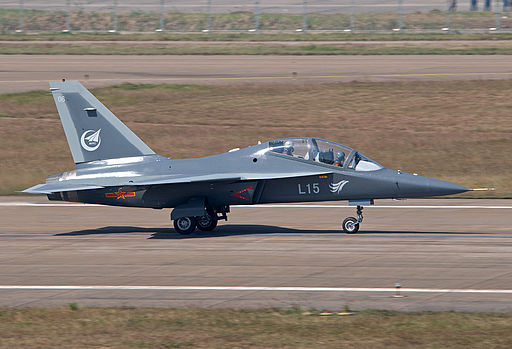
The JL-10 is a modern Chinese advanced jet trainer and light combat aircraft developed by Hongdu Aviation Industry Corporation (HAIC), under the umbrella of Aviation Industry Corporation of China (AVIC). It is intended to serve as a Lead-In Fighter Trainer (LIFT) for pilots moving on to 4th and 5th generation fighters, and also has a light attack/weapon-training variant. Its export designation is “L-15 Falcon”.
It represents a significant step for Chinese aviation in closing the gap between basic jet trainers and full combat fighters by offering a high-performance platform with supersonic capability, modern avionics, and weapon simulation/training capability.
Development and Operational Role
The JL-10 programme commenced in the early 2000s, aiming to replace older sub-sonic trainer types and to provide a training bridge for advanced fast-jet conversion. It draws upon foreign design experience (in particular consultation with Russian Yakovlev OKB) while integrating domestic Chinese technologies. The prototype made its first flight on 13 March 2006.
The aircraft entered service with the People’s Liberation Army Air Force (PLAAF) in the late 2010s and has been selected for export sales as the L-15. Its dual role includes:
-
Advanced jet training: high performance, supersonic capability, simulation of combat roles.
-
Light attack / weapon training: ability to carry external stores and weapon systems for air-to-air, air-to-ground training and missions.
Airframe and Aerodynamics
The JL-10 features a sleek low-wing monoplane design with twin-engine configuration mounted in the fuselage. It incorporates modern aerodynamic features: leading-edge root extensions (LEX) for improved high angle of attack behaviour, a large vertical tail, and a wing with trailing-edge flaps and slats to support training/attack roles.
The airframe makes use of composite materials—approximately 25 % of the structure is stated to be composite—reducing weight and improving corrosion resistance and fatigue life. The expected structural service life is around 10,000 flight hours in some variants.
The avionics and flight controls are modern: the aircraft uses a digital fly-by-wire (FBW) system with three axes and multiple redundancy, enabling realistic handling for transition to fighter aircraft. The cockpit is a glass-cockpit layout with multifunction displays (MFDs), hands-on-throttle-and-stick (HOTAS) controls and a head-up display (HUD), offering a training environment close to that of full combat aircraft.
Propulsion and Performance
Engines
In its standard trainer configuration, the JL-10 is powered by two non-afterburning Ivchenko-Progress AI-222-25 turbofan engines. For the light attack / supersonic variant (L-15B / JL-10B) it uses afterburning versions (AI-222K-25F or AI-322) which provide significantly higher thrust and supersonic capability.
Performance Parameters
Key performance figures include:
-
Maximum speed: up to Mach 1.4 (approximately 1,700+ km/h at altitude) in the afterburning variant.
-
Service ceiling: around 16,000 m (52,000 ft) in high performance versions.
-
Rate of climb: quoted at up to ~150 m/s in some sources for the high-thrust variant.
-
Ferry range: around ~2,600-3,100 km for some configurations.
-
Maximum take-off weight (MTOW): up to approximately 9,800 kg for certain versions.
-
Empty weight: around 4,960 kg for the standard version.
-
Wing area: estimated ~24.5 m² in some references.
Take-off / Landing and Handling
Because the aircraft is intended both as a trainer and a light attack platform, it offers relatively short take-off and landing distances for an advanced jet, good agility, and high angle-of-attack capability (thanks to the LEX and aerodynamic design). This allows for realistic simulation of combat manoeuvres and transition training.
Technical Specifications (Representative)
Here is a summary of representative specifications for the JL-10 / L-15 family (figures may vary by variant):
-
Crew: 2 (Instructor + Trainee)
-
Length: ~12.27 m
-
Wingspan: ~9.48 m
-
Height: ~4.81 m
-
Wing area: ~24.5 m²
-
Empty weight: ~4,960 kg
-
Maximum take-off weight (MTOW): ~9,800 kg
-
Powerplant: 2 × Ivchenko-Progress AI-222-25 turbofans (trainer), or 2 × AI-222K-25F/AI-322 afterburning for attack variant
-
Maximum speed: up to Mach 1.4 (~1,700-1,730 km/h)
-
Service ceiling: ~16,000 m
-
Range (ferry): ~2,600-3,100 km
-
Hardpoints / external stores: Up to 9 hardpoints in some attack variants, with external load up to ~3,500 kg
-
Structure life: ~10,000 flight hours
Systems and Avionics
The JL-10 is equipped with advanced systems for its class:
-
Digital fly-by-wire flight control system with high redundancy for safe training of advanced manoeuvres.
-
A modern glass cockpit featuring multifunction displays, HUD, HOTAS and instructor/trainee seating arrangements.
-
Avionics suite capable of weapon simulation and light combat roles: training radar (in some variants) including a Passive Electronically Scanned Array (PESA) radar for the attack version, integrated navigation (INS/GPS), mission computer, datalink capability.
-
External hardpoints for weapon training, air-to-air missiles, air-to-ground munitions, and simulated stores.
-
Designed to simulate advanced fighter operation profiles so that pilot transition to fighters such as the Chengdu J‑10 or newer types is smoother.
Weapon and Light Attack Capability
Though primarily a trainer, the JL-10/L-15 variant family is designed with an operational light attack capability:
-
External hardpoints: 7 in early trainer versions; some attack variants offer up to 9 hardpoints.
-
Payload: up to ~3,000-3,500 kg on external stores in attack variants.
-
Typical weapons: short-range air-to-air missiles (e.g., PL-8), beyond-visual-range missiles (e.g., PL-12/SD-10) in export/attack versions, guided bombs (e.g., LS-6), rocket pods, gun pods.
-
The aircraft can conduct training for simulated air-to-air combat, air-to-ground attacks and weapons delivery, making it a versatile platform for both training and light strike missions.
Variants and Export Versions
The family includes multiple versions:
-
Standard trainer version (often designated L-15A or JL-10) with non-afterburning engines for cost-effective training.
-
Supersonic/Light attack version (L-15B / JL-10B) with afterburning engines, higher performance, additional hardpoints and weapon capability.
-
Carrier-capable variant (JL-10J) under development for naval aviation with strengthened landing gear, arrestor hook, and possibly catapult-launch compatibility.
-
Export versions marketed under the L-15 designation with customised avionics/weapons for customer needs.
Operational Use and Training Impact
The JL-10 plays a key role in the PLAAF’s training pipeline, offering high-performance training so that pilots move from basic trainers to this platform before transitioning to frontline fighters. Its dual-role nature means it also can perform light combat sorties, providing more value to operators. For export customers, it offers a lower-cost alternative to Western advanced jet trainers while providing supersonic capability and modern systems.
Maintenance, Lifecycle and Logistics
The aircraft’s design emphasises maintainability: the composite structure reduces corrosion, and the engines (especially in the non-afterburning trainer variant) offer lower operating costs. The aircraft’s service life target (around 10,000 flight hours) is competitive for its class. Because of its dual-role nature, operators can train and then use the same platform for light attack missions, improving lifecycle cost-effectiveness.
Conclusion
The Hongdu JL-10 / L-15 Falcon is a sophisticated advanced jet trainer / light combat aircraft that bridges the gap between dedicated jet trainers and full combat fighters. With supersonic performance (in attack variants), modern avionics, fly-by-wire controls, and a weapons capable hardpoint system, it provides both advanced pilot training and light strike capability. For nations seeking to modernise their pilot training pipeline and obtain a cost-effective dual-role aircraft, the JL-10 offers compelling value. Its design, reduced operating cost, and export orientation position it as a significant player in the advanced trainer market.
