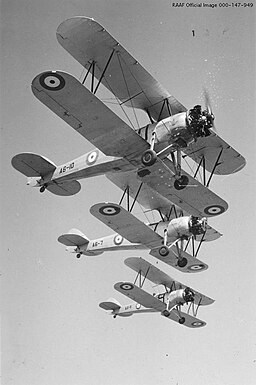
The Avro 643 Cadet was a British two-seat primary training biplane developed in the mid-1930s as a refinement of the already successful Avro Tutor series. Designed to provide an economical yet capable trainer for flying clubs, civil operators, and export customers, the Cadet represented Avro’s attempt to combine the robust performance of military training aircraft with a more compact airframe and reduced operating costs. Although intended primarily for civil training, the Cadet’s durability, predictable handling, and structural integrity made it well suited to military and auxiliary roles in several countries. Throughout its service life, the aircraft developed a reputation for being dependable, easy to maintain, and well matched to the demands of student-level flying instruction.
Design and Construction
The Avro 643 Cadet was conceived as a scaled-down derivative of the Avro Tutor, maintaining many of its structural principles while reducing overall size and weight. Its fuselage employed a welded steel-tube framework that provided strength and damage tolerance, particularly important for training aircraft subjected to frequent hard landings and operational mishandling. This structure was faired with wooden formers and stringers, then covered with doped fabric to create a streamlined external surface. The two cockpits were arranged in tandem and remained open, offering excellent visibility for both student and instructor and enabling clear verbal communication during instruction.
The wings followed a conventional biplane layout, with equal-span upper and lower wings built from wooden spars and ribs. These were fabric-covered and braced using metal interplane struts and tensioned flying wires. The wing design emphasized stability and slow-speed controllability, essential for novice pilots learning fundamental maneuvering techniques. Ailerons were typically fitted to the lower wings and provided smooth, predictable roll response without excessive sensitivity.
The tail assembly used a combination of steel tubing and wooden structures, also fabric-covered, and incorporated a broad fin and rudder for effective directional control. The fixed undercarriage featured a simple, sturdy layout with a cross-axle supported by V-struts and bungee suspension, allowing the aircraft to operate safely from grass airfields. A tailskid, often metal-shod, was standard, though some Cadets in later civilian service were modified with lightweight tailwheels. The simplicity of the undercarriage design reduced maintenance demands and enhanced suitability for less-developed airfields.
Powerplant and Performance
The Avro Cadet was powered primarily by the Armstrong Siddeley Genet Major radial engine, an air-cooled, five- or seven-cylinder powerplant typically producing around 140 horsepower depending on the specific variant. This engine was chosen for its light weight, ease of servicing, and proven reliability in training environments. The radial configuration provided ample airflow for cooling and ensured consistent performance during prolonged low-speed operation such as circuit practice or taxi training.
Despite its modest power, the Cadet offered respectable performance for a primary trainer. Maximum speed usually ranged near 105 miles per hour, with a cruising speed around 85 to 90 miles per hour. These speeds were well suited to training scenarios, offering a balance between sufficient responsiveness and manageable handling. The climb rate was adequate for reaching standard training altitudes efficiently, and service ceilings often exceeded 12,000 feet, although Cadets seldom needed to operate at such heights. Endurance typically reached between two and three hours, appropriate for instructional flights while maintaining light fuel loads that preserved favorable handling balance.
Flight Characteristics
The Avro Cadet’s most enduring quality was its exceptionally forgiving flight behavior. Designed specifically for student training, the aircraft delivered stable longitudinal and lateral handling, enabling novice pilots to master fundamental aeronautical skills. Its low wing loading produced gentle stall characteristics, with ample aerodynamic warning and straightforward recoveries. The biplane configuration also provided excellent lift at low speeds, which improved safety during takeoff, landing, and slow-flight drills.
Control harmony was carefully calibrated, giving the aircraft precise but not overly sensitive responses. The rudder provided strong authority essential for coordinated turns, especially at the slower speeds common in training exercises. Ailerons responded smoothly, while the elevator allowed gradual pitch changes ideal for practicing glide approaches and altitude management. The open cockpit layout enhanced situational awareness and increased a student’s ability to judge heading, alignment, and attitude relative to the horizon.
Although not intended for advanced aerobatics, the Cadet was capable of performing basic maneuvers such as loops, rolls, and stall-turns when flown within operational limits. This capability made it valuable for early aerobatic familiarization, preparing students for more complex aircraft they would encounter later in their training.
Operational History
The Avro Cadet entered service during a period of expanding aviation interest, particularly within civil flying clubs and nations modernizing their air forces. Although not adopted in large numbers by the Royal Air Force, the Cadet became popular abroad. Many foreign customers—including air forces in South America, the Middle East, Australasia, and parts of Europe—purchased the Cadet to serve as a basic trainer and general-purpose liaison aircraft.
In civilian roles, the Cadet was widely used by flying schools, aero clubs, and private owners. Its low operating costs and straightforward maintenance requirements made it attractive to organizations requiring a durable training platform without the complexity or expense of larger military-derived designs. Several Cadets participated in air displays, long-distance reliability flights, and instructional demonstrations highlighting their ruggedness and dependable behavior.
As aviation technology advanced and monoplane trainers became more common, the Avro Cadet gradually transitioned out of mainstream training roles. Nevertheless, many airframes continued operating well into the 1940s and early 1950s in secondary or private service. A number of surviving examples have since been restored by museums or private collectors, preserving the legacy of an aircraft that played a significant role in shaping pre-war aviation training.
Technical Specifications (Typical Avro 643 Cadet)
- Crew: Two, student and instructor
- Length: Approximately 24 ft
- Wingspan: Approximately 34 ft
- Height: Approximately 9 ft
- Empty Weight: Around 1,300 lb
- Maximum Takeoff Weight: Around 2,000 lb
- Powerplant: Armstrong Siddeley Genet Major radial engine, about 140 hp
- Maximum Speed: Approximately 105 mph
- Cruise Speed: Approximately 90 mph
- Range: Around 275 miles
- Service Ceiling: Approximately 12,000 ft
Legacy
The Avro 643 Cadet is remembered as one of the most refined and effective primary trainers of its era, embodying Avro’s philosophy of simplicity, durability, and pilot-friendly design. By providing consistent performance, forgiving handling, and economical operation, the Cadet helped train numerous pilots across the world at a time when many nations were developing aviation capability from limited foundations. Its structural reliability and practical engineering made it an ideal stepping stone between basic flight instruction and more advanced training aircraft.
