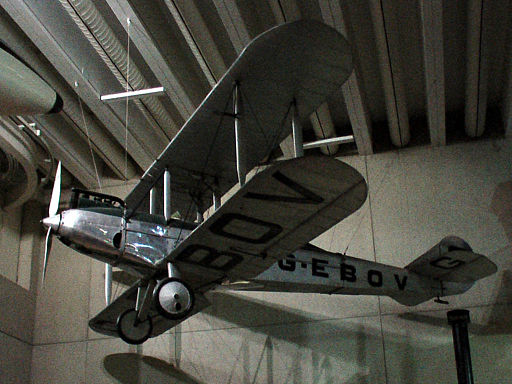
The Avro Avian was a versatile British light aircraft developed during the interwar years, notable for its balanced integration of performance, practicality, and adaptability. Designed to satisfy both military and civil aviation markets, the Avian evolved through multiple variants and became one of Avro’s most successful light biplanes. Its robust construction and dependable flight characteristics made it suitable for training, touring, competitive flying, and long-distance record attempts. The aircraft gained international recognition thanks to pioneering aviators who used it for ambitious flights, demonstrating its reliability and endurance. Across its production life, the Avro Avian helped define the expectations for economical yet capable civil aircraft in the 1920s and early 1930s.
Design and Construction
The Avro Avian employed a traditional two-bay biplane arrangement with equal-span wings, relying heavily on conventional materials such as spruce, ash, and doped fabric covering. The fuselage used a rectangular cross-section wooden frame with wire-bracing to provide structural rigidity while minimizing weight. Designers intentionally kept the structure simple to allow smaller flying clubs and private owners to perform their own maintenance with limited equipment. The forward fuselage incorporated metal fittings and reinforced joints to manage engine loads and landing stresses more effectively.
The wing assembly featured fabric-covered wooden ribs mounted on spars and supported by pairs of interplane struts and tensioned steel flying wires. The wings were detachable for ease of transport and storage, an important advantage for private owners who lacked dedicated hangar space. Control surfaces were built from lightweight wooden frames with a straightforward rib arrangement, offering responsive but stable handling. The tailplane mounted on the aft fuselage provided generous horizontal and vertical surface areas, ensuring predictable behavior during takeoff, landing, and low-speed maneuvering.
The undercarriage consisted of a simple fixed gear with a split axle supported by V-struts and shock-cord bungee suspension, a system common to light aircraft of the era. This configuration allowed the Avian to operate effectively from grass fields and unprepared airstrips. A tailskid, often metal-shod for durability, provided ground steering and prevented structural damage on rough surfaces. Overall, the aircraft’s construction combined rugged practicality with enough refinement to satisfy competitive pilots seeking aerodynamic cleanliness.
Powerplant and Performance
Different Avro Avian variants were fitted with a wide range of engines, reflecting the aircraft’s continuous evolution and international licensing. Common powerplants included the Cirrus I and Cirrus II inline engines, typically delivering between 65 and 85 horsepower. Later versions incorporated more powerful engines such as the Cirrus III, de Havilland Gipsy I, and even radial engines in some export models. The use of air-cooled inline engines gave the aircraft a slim nose profile, contributing to reduced drag and improved forward visibility.
Performance varied between models, but most Avians achieved maximum speeds between 95 and 110 miles per hour, depending on engine output and airframe configuration. Their climb rate was respectable for a light biplane of the time, aided by the aircraft’s relatively low empty weight. Service ceilings typically reached 15,000 feet or more, giving pilots ample altitude performance for cross-country touring and training missions. Fuel endurance commonly ranged between three and four hours, allowing for long-distance flight without excessive tank capacity.
Flight Characteristics
The Avro Avian gained popularity among instructors and private pilots due to its predictable handling qualities and balanced control responses. The aircraft was stable longitudinally, thanks to its generous tailplane and well-distributed mass. The biplane layout provided high lift at low speeds, making approaches and landings manageable even for less experienced aviators. Stalls were gentle and easily recoverable, a characteristic attributed to the wing design and the aircraft’s relatively low wing loading.
Control harmony was a strong point of the Avian, with ailerons offering crisp response and the rudder providing enough authority to coordinate turns efficiently. The aircraft’s light control forces made it pleasant to fly for long durations, an essential quality for touring and record-setting journeys. While not designed for aerobatics, the Avian could perform modest maneuvering safely when flown within recommended limits. Pilots appreciated the open cockpit configuration, which delivered excellent visibility and a direct connection to the environment—an experience cherished by civil aviation enthusiasts.
Operational History
Introduced in the mid-1920s, the Avro Avian quickly found a market among flying clubs, private owners, and export customers. Its affordability and efficiency made it particularly attractive to aviation pioneers looking to attempt long-distance flights. One of the aircraft’s most famous achievements involved historic solo flights across continents, cementing the Avian’s reputation as a dependable long-range platform. Its rugged construction allowed it to withstand varied climates and terrain, from tropical conditions to remote airfields with limited infrastructure.
Commercial flying schools adopted the Avian as a primary trainer, where it served alongside other contemporary biplanes. Its reliability significantly reduced grounding time and maintenance costs, enabling cost-effective pilot instruction. The Avian also appeared in small numbers in military service, particularly in Commonwealth nations that employed it as a trainer, liaison aircraft, or communication platform. Some variants were produced under license overseas, increasing the aircraft’s global presence.
Though eventually overshadowed by newer monoplane designs in the 1930s, the Avian remained in use for years due to its economical operation and durable structure. Many aircraft found second lives in private hands, used for pleasure flying, bush operations, or local transport. The Avian’s influence persisted long after production ended, as many pilots trained on it later became important figures in civil and military aviation.
Technical Specifications (Typical Avro Avian 1A)
- Crew: One or two (depending on configuration)
- Length: Approximately 23 ft
- Wingspan: Approximately 28 ft
- Height: Approximately 8 ft
- Empty Weight: Around 850 lb
- Maximum Takeoff Weight: Around 1,400 lb
- Powerplant: Typically a Cirrus II inline engine, around 80 hp
- Maximum Speed: Approximately 105 mph
- Cruise Speed: Approximately 90 mph
- Range: Around 350 miles
- Service Ceiling: Approximately 16,000 ft
Legacy
The Avro Avian stands as a significant milestone in early private aviation, representing an era where aircraft became accessible to individuals outside military or commercial organizations. Its combination of performance, simplicity, and reliability made it a popular choice for recreational flying and long-distance exploration. The Avian’s contributions to record-setting flights helped raise global awareness of the capabilities of light aircraft and demonstrated the potential for intercontinental air travel on a modest budget.
