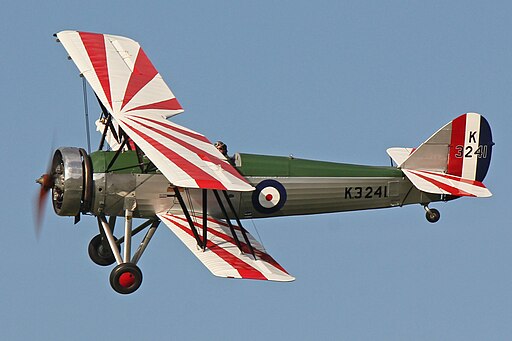
The Avro Tutor was a British biplane trainer developed during the late 1920s to meet the Royal Air Force’s need for an improved instructional aircraft capable of bridging the gap between elementary and advanced flight training. Designed by Avro as an evolution of their earlier civil and military training machines, the Tutor introduced modernized construction techniques, better handling characteristics, and a more powerful engine than many contemporaries. Its balanced combination of ruggedness, reliability, and predictable performance made it a staple in RAF flying schools throughout the 1930s. The aircraft also entered service with several foreign air forces, validating its reputation as a dependable training platform capable of accommodating both novice and experienced pilots.
Design and Structural Features
The Tutor featured a mixed-construction airframe that blended wood and metal components to achieve an optimal balance of strength, ease of maintenance, and weight efficiency. The fuselage employed a steel-tube framework, an increasingly modern solution at the time, offering the instructor and student a strong, stable cockpit structure capable of absorbing operational stresses. This metal skeleton was faired with wooden formers and longerons and then covered with doped fabric, producing a streamlined and durable exterior while keeping overall mass low.
The wings maintained the traditional biplane configuration common to training aircraft of the era. They were assembled from wooden spars and ribs, fabric-covered, and braced by struts and steel flying wires. Both upper and lower wings were of equal span and incorporated a modest stagger to enhance cockpit visibility and aerodynamic stability. Ailerons were typically fitted to the lower wings, providing responsive roll control without compromising the trainer’s inherently steady handling qualities. The tail assembly was constructed from a combination of steel tubing and wooden elements, fabric-clad to ensure a smooth aerodynamic surface while remaining easy to repair after heavy use in training operations.
Its landing gear utilized a simple fixed undercarriage with a cross-axle supported by V-struts and bungee cord suspension. This arrangement allowed the Tutor to handle the repeated hard landings typical of student pilots. A tailskid, later replaced by a tailwheel on some machines, provided sufficient directional stability during taxiing and takeoff while operating from grass airfields. The rugged gear design minimized maintenance downtime and made the aircraft suitable for a variety of airfield conditions.
Powerplant and Performance
At the heart of the Avro Tutor’s design was the Armstrong Siddeley Lynx engine, most commonly the Lynx IV or Lynx IVC, an air-cooled radial powerplant delivering approximately 215 horsepower. This engine represented a significant improvement over earlier instructional aircraft engines, providing more stable operation, smoother power delivery, and better reliability during repetitive training cycles. The radial configuration offered good cooling characteristics and contributed to the Tutor’s distinctive rounded nose profile.
The Tutor typically achieved maximum speeds in the vicinity of 120 miles per hour, depending on variant and equipment fit. Its cruising speed was slightly lower, but still adequate for cross-country navigation exercises and aerobatic training. The aircraft’s climb performance benefited from the radial engine’s torque and robust thrust output, enabling it to reach training altitudes quickly and sustain extended maneuvering. Endurance typically ranged between two and three hours, sufficient for most instructional sorties without imposing excessive fuel weight. The aircraft’s service ceiling exceeded 15,000 feet, allowing instructors to conduct advanced training where thinner air reduced aerodynamic loads.
Flight Characteristics
Pilots frequently praised the Avro Tutor for its forgiving handling traits and reliable control response across a broad speed range. The combination of a strong metal-tube fuselage and well-proportioned wings produced a predictable flight envelope, enabling student pilots to master fundamental skills such as stall recovery, sideslips, coordinated turns, and steep gliding approaches. The aircraft’s stability was enhanced by its well-balanced control surfaces, which provided enough authority for effective maneuvering without overwhelming inexperienced fliers.
The Tutor’s radial engine introduced a degree of torque and gyroscopic effect that helped students transition toward more advanced, higher-performance aircraft. Nevertheless, the trainer’s overall behavior remained docile, particularly in straight and level flight, making it safe for ab-initio training. Stalls were generally gentle, with clear aerodynamic warnings and straightforward recoveries. The aircraft’s slow-speed characteristics, combined with its strong undercarriage, made it ideal for circuits, forced-landing drills, and occasional rough-field operations.
The open cockpit provided excellent forward and downward visibility, an essential feature for both navigation practice and formation exercises. Instructor and student sat in tandem, allowing direct verbal communication and straightforward demonstration of techniques. The simple cockpit layout exposed new pilots to essential instrumentation without unnecessary complexity, supporting the RAF’s training philosophy of gradually increasing procedural difficulty.
Operational History
The Avro Tutor entered RAF service as a standard elementary trainer and quickly established itself as a mainstay of flying schools throughout the interwar period. It replaced older aircraft that no longer met evolving training demands, providing a modernized platform with improved durability and performance. Its widespread adoption ensured that thousands of RAF pilots gained their first formal flight experience in the Tutor as they progressed toward more advanced aircraft, including fast biplane fighters and early monoplanes.
Aside from its primary role in the United Kingdom, the Tutor attracted international users. Countries in Europe, the Middle East, and the Commonwealth procured license-built or factory-supplied models, using them for basic instruction, aerobatic training, and liaison duties. Its strong showing in air displays and its suitability for aerobatic teams further demonstrated the Tutor’s reliability and graceful handling in demanding maneuvers.
By the late 1930s, the rapid modernization of global air forces gradually pushed the Tutor into secondary roles. However, many examples continued to serve as civilian club aircraft or instructional airframes for ground training. A number of Tutors survived into the postwar period and were preserved in museums or restored by private enthusiasts, providing an enduring representation of interwar RAF flight training.
Technical Parameters (Typical Avro Tutor)
- Crew: Two, instructor and student
- Length: Approximately 25 ft
- Wingspan: Approximately 34 ft
- Height: Approximately 9 ft
- Empty Weight: Around 1,900 lb
- Maximum Takeoff Weight: Around 2,800 lb
- Powerplant: Armstrong Siddeley Lynx radial engine, about 215 hp
- Maximum Speed: Approximately 120 mph
- Cruise Speed: Approximately 100 mph
- Range: Around 250 miles
- Service Ceiling: Approximately 16,000 ft
Legacy
The Avro Tutor played a significant role in shaping air-training doctrine during a period of rapid global aviation development. As one of the RAF’s primary training aircraft during the interwar years, it helped create a generation of pilots who would later serve in both military and civilian capacities during a transformative phase in aviation history. Its innovative combination of steel-tube fuselage construction and reliable radial powerplant demonstrated a shift toward more durable and standardized training platforms.
_(30226029807).jpg)