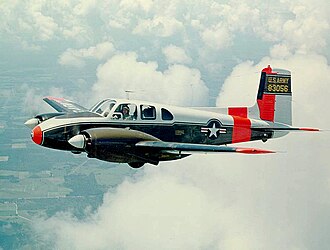
The Beechcraft L-23 Seminole represents a fascinating chapter in the evolution of postwar military aviation, particularly in the niche role of liaison and utility aircraft. Developed during a period when military doctrine was rapidly adapting to new technological and geopolitical realities, the L-23 Seminole bridged the gap between light observation aircraft and more capable multi-engine transports. Its roots lie in the civilian success of the Twin Bonanza, yet its military service reveals a deeper story of adaptability, engineering refinement, and operational necessity.
The aircraft’s development coincided with the early Cold War era, when the United States sought versatile platforms capable of fulfilling a range of missions, from personnel transport to reconnaissance and command liaison. Unlike many aircraft that were purpose-built for combat roles, the L-23 Seminole was valued for its reliability, flexibility, and relatively low operational cost. These characteristics made it indispensable in both peacetime operations and limited conflicts, where efficiency and responsiveness were paramount.
Origins and Development
The L-23 Seminole traces its lineage directly to the civilian Beechcraft Model 50 Twin Bonanza, an aircraft that first flew in 1949. Designed by Beech Aircraft Corporation, the Twin Bonanza was intended as a rugged, multi-purpose aircraft capable of carrying passengers and cargo over moderate distances with high reliability. Its distinctive twin-engine configuration, high wing loading, and sturdy landing gear made it particularly attractive for operations from less-than-ideal airfields.
Recognizing the potential of the Twin Bonanza for military use, the United States Army began acquiring modified versions in the early 1950s. These aircraft were designated L-23, following the Army’s liaison aircraft classification system. Over time, several variants were introduced, each incorporating improvements in avionics, structural design, and mission capability.
The early L-23A and L-23B models were relatively close to their civilian counterparts, but subsequent variants such as the L-23D and L-23F featured more powerful engines, extended fuselages, and enhanced payload capacity. These changes reflected the Army’s growing reliance on the aircraft for more demanding roles, including transport of personnel and sensitive equipment.
Design Philosophy and Airframe Characteristics
The design of the L-23 Seminole reflects a pragmatic approach to aviation engineering. Rather than pursuing cutting-edge performance metrics, the aircraft was optimized for durability, ease of maintenance, and operational flexibility. Its all-metal construction provided robustness, while the low-wing configuration contributed to stability and efficient aerodynamics.
One of the most notable features of the L-23 is its twin-engine layout, typically powered by Lycoming piston engines. This configuration offered several advantages, including increased reliability through redundancy and improved performance in high-density altitude conditions. For military operators, the ability to continue flight after an engine failure was a critical safety feature, particularly in remote or hostile environments.
The aircraft’s landing gear was designed for rough-field operations, with a retractable tricycle configuration that balanced aerodynamic efficiency with ground handling stability. The relatively large tires and sturdy struts allowed the L-23 to operate from unpaved runways, a common requirement in forward-deployed military scenarios.
Cockpit and Avionics
The cockpit of the L-23 Seminole was designed with functionality and clarity in mind. Early variants featured analog instrumentation typical of the era, including basic navigation and communication systems. However, as the aircraft evolved, later versions incorporated more advanced avionics, reflecting broader trends in aviation technology.
Pilots benefited from good visibility, thanks to the aircraft’s cockpit layout and window design. This was particularly important for liaison and observation missions, where situational awareness was crucial. The dual-control setup allowed for training operations as well as mission flexibility, enabling co-pilots or observers to assist in navigation and communication tasks.
In military service, avionics upgrades often included improved radios, navigation aids such as VOR and ADF systems, and, in some cases, specialized equipment for reconnaissance or command roles. These enhancements extended the aircraft’s usefulness well beyond its original design parameters.
Performance and Handling Characteristics
The L-23 Seminole was not designed as a high-speed aircraft, but its performance was more than adequate for its intended roles. Cruising speeds typically ranged between 160 and 200 knots, depending on the variant and configuration. This allowed for efficient point-to-point travel while maintaining fuel economy.
Climb performance was respectable, particularly in later variants equipped with more powerful engines. The aircraft’s service ceiling generally exceeded 20,000 feet, providing flexibility for operations in various weather conditions and terrains. Its range, often exceeding 1,000 kilometers, made it suitable for regional transport missions without the need for frequent refueling.
Handling characteristics were generally described as stable and predictable, qualities that are highly valued in utility aircraft. The L-23 was forgiving of pilot input, making it accessible to a wide range of operators, including those with limited multi-engine experience. This ease of handling contributed to its popularity within the Army and other operators.
Operational Roles and Missions
The versatility of the L-23 Seminole allowed it to fulfill a wide array of missions. Initially classified as a liaison aircraft, it was used to transport personnel, deliver messages, and facilitate communication between units. However, its capabilities quickly led to expanded roles.
One of the primary uses of the L-23 was as a light transport aircraft. It could carry several passengers or a combination of cargo and personnel, making it ideal for logistical support. In this role, it often operated between forward bases and rear-area facilities, ensuring the smooth flow of resources.
The aircraft was also used for medical evacuation, albeit on a limited scale. Its cabin could be configured to accommodate stretchers, allowing for the transport of injured personnel. While not as specialized as dedicated medevac aircraft, the L-23 provided a valuable capability in situations where other assets were unavailable.
In addition, the L-23 served as a platform for command and control. Senior officers could use the aircraft to travel quickly between units, maintaining oversight and coordination. Its relatively quiet operation and unobtrusive profile made it suitable for such missions.
Service History
The L-23 Seminole saw extensive service with the United States Army throughout the 1950s and 1960s. It was deployed in a variety of environments, from domestic bases to overseas theaters. Although it did not play a prominent role in major conflicts, its contributions were nonetheless significant.
During the early stages of the Vietnam War, some L-23 aircraft were used in support roles, although they were eventually overshadowed by more specialized aircraft and helicopters. The rise of rotary-wing aviation, in particular, reduced the demand for fixed-wing liaison aircraft like the L-23.
Despite this, the aircraft remained in service for many years, a testament to its reliability and utility. It was eventually redesignated as the U-8 under the tri-service aircraft designation system introduced in 1962. This change reflected a broader effort to standardize aircraft naming conventions across the U.S. military.
Variants and Evolution
The L-23 Seminole family includes several distinct variants, each reflecting incremental improvements and adaptations. The L-23A and L-23B were the earliest versions, closely resembling the civilian Twin Bonanza. These were followed by the L-23C and L-23D, which introduced more powerful engines and structural enhancements.
The L-23F represented a significant evolution, featuring a longer fuselage and increased payload capacity. This variant was particularly well-suited for transport missions, offering greater flexibility in terms of cargo and passenger configurations.
Each variant incorporated lessons learned from operational experience, resulting in a progressively more capable aircraft. These improvements ensured that the L-23 remained relevant even as aviation technology advanced.
Comparison with Contemporary Aircraft
When compared to other aircraft of its era, the L-23 Seminole occupies a unique niche. Unlike the Cessna L-19 Bird Dog, which was optimized for short takeoff and landing and forward observation, the L-23 offered greater range, speed, and payload capacity. However, it lacked the STOL performance that made the Bird Dog so effective in frontline roles.
Similarly, when compared to larger transport aircraft, the L-23 was more economical and easier to operate, but it could not match their capacity or range. This positioned it as an intermediate solution, ideal for missions that required more capability than light observation aircraft but did not justify the use of larger transports.
Legacy and Impact
The legacy of the L-23 Seminole lies in its demonstration of the value of adaptable, multi-role aircraft. While it may not have achieved the fame of more iconic military aircraft, its contributions were nonetheless महत्वपूर्ण in shaping operational practices.
The aircraft also highlights the importance of leveraging civilian designs for military applications. By adapting the Twin Bonanza for military use, the Army was able to acquire a capable aircraft quickly and cost-effectively. This approach has been replicated in numerous programs since then.
Today, surviving examples of the L-23 and its civilian counterparts can be found in museums and private collections, serving as reminders of an era when versatility and reliability were paramount.
Conclusion
The Beechcraft L-23 Seminole stands as a testament to practical engineering and operational adaptability. Its development from a civilian platform into a capable military aircraft illustrates the flexibility of aviation design and the importance of meeting real-world needs.
Although it has long since been retired from military service, the L-23’s influence can still be seen in modern utility aircraft. Its emphasis on reliability, versatility, and ease of operation continues to inform the design of contemporary platforms.
Technical Specifications Table
| Parameter | Value |
|---|---|
| Manufacturer | Beech Aircraft Corporation |
| Role | Liaison / Utility Aircraft |
| Crew | 1–2 pilots |
| Capacity | 4–6 passengers |
| Length | ~10.9 m |
| Wingspan | ~13.5 m |
| Height | ~3.8 m |
| Empty Weight | ~2,400 kg |
| Maximum Takeoff Weight | ~3,400 kg |
| Powerplant | 2 × Lycoming piston engines |
| Engine Power | ~295–340 hp each |
| Maximum Speed | ~320 km/h |
| Cruise Speed | ~280–300 km/h |
| Range | ~1,200–1,500 km |
| Service Ceiling | ~6,000–7,000 m |
| Rate of Climb | ~6–8 m/s |
| Landing Gear | Retractable tricycle |
