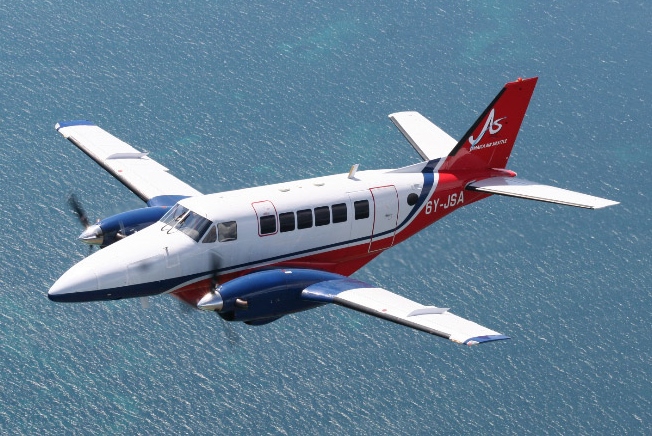
The Beechcraft Model 99 was developed during the mid-1960s as a response to the growing demand for short-haul regional air transportation in North America. At that time, commuter airlines were transitioning from piston-powered transports to more reliable turbine aircraft that offered better performance, lower vibration levels, and improved operational economics. Recognizing this opportunity, Beechcraft engineered the Model 99 as a stretched, utility-focused derivative of its successful King Air series, but optimized specifically for passenger and cargo operations rather than executive transport.
The aircraft first flew in 1966 and entered service shortly thereafter. Unlike corporate turboprops that emphasized luxury and pressurization, the Model 99 was intentionally designed as an unpressurized commuter aircraft capable of carrying up to 15 passengers. Its straightforward systems, strong short-field performance, and turbine reliability quickly made it a preferred platform for regional airlines operating from smaller airports with limited infrastructure.
Airframe Design and Structural Characteristics
The Beechcraft Model 99 features a low-wing monoplane configuration with retractable tricycle landing gear and a conventional tail. While it shares some lineage with the King Air family, its fuselage was significantly redesigned and stretched to accommodate airline-style seating and higher payload capacity. The airframe is constructed primarily from aluminum alloys using semi-monocoque methods, ensuring structural strength and resistance to fatigue under frequent flight cycles typical of commuter operations.
The aircraft measures approximately 44 feet 4 inches (13.5 meters) in length, with a wingspan of 45 feet 11 inches (14.0 meters) and a height of about 14 feet 6 inches (4.4 meters). The wing area is roughly 280 square feet (26 square meters). The relatively high aspect ratio wing supports efficient cruise performance while maintaining strong lift characteristics at lower speeds, which is critical for operations from short regional runways.
The maximum takeoff weight of early variants was approximately 10,400 pounds (4,717 kilograms), while later versions such as the 99A and 99B increased this to around 11,900 pounds (5,398 kilograms). The empty weight typically ranged from 6,500 to 7,000 pounds (2,948–3,175 kilograms), allowing a useful load of more than 4,000 pounds in some configurations. The unpressurized cabin simplified construction and maintenance while remaining adequate for short-haul routes typically flown below 15,000 feet.
Powerplant and Propulsion Systems
The Beechcraft Model 99 is powered by two Pratt & Whitney Canada PT6A turboprop engines, one of the most reliable turbine engine families in aviation history. Early models were equipped with PT6A-20 engines producing approximately 550 shaft horsepower each, while later variants used PT6A-27 engines delivering up to 680 shaft horsepower per engine. These engines drive three- or four-blade constant-speed, full-feathering propellers, depending on the specific version and modification package.
The PT6A engine’s reverse-flow design contributes to compact installation and operational durability. Its modular construction allows efficient maintenance and overhaul procedures, which is particularly important for high-cycle commuter aircraft. The twin-engine configuration provides redundancy and enhances safety during operations in remote or weather-challenged environments.
Fuel capacity typically totals around 336 U.S. gallons (1,272 liters), depending on configuration, enabling substantial range for regional routes. The fuel system is integrated into the wing structure, with careful balance considerations to ensure stability throughout all phases of flight.
Performance and Operational Capabilities
The Beechcraft Model 99 delivers solid performance for a commuter-class turboprop. Maximum cruise speed is approximately 230–250 knots (426–463 km/h), depending on engine variant and operating altitude. Typical cruise speeds are slightly lower to optimize fuel consumption and engine longevity. The aircraft’s service ceiling is approximately 21,000 feet (6,400 meters), though it is most commonly operated between 10,000 and 18,000 feet on short regional sectors.
The rate of climb under standard conditions is about 2,000 feet per minute (10.2 m/s), reflecting strong power-to-weight characteristics. Takeoff distance over a 50-foot obstacle is approximately 2,200 feet (671 meters), while landing distance is comparable, making the aircraft well suited for smaller airports with shorter runways. Its rugged landing gear and robust structure allow frequent operations on semi-prepared or less-developed airfields.
Range varies with payload and cruise settings but typically falls between 800 and 1,200 nautical miles (1,480–2,220 kilometers). This range is more than adequate for the short-haul commuter missions for which the aircraft was designed.
Cabin Layout and Systems
The cabin of the Beechcraft Model 99 is configured for airline-style seating, typically accommodating 15 passengers with a single pilot or two-crew arrangement depending on regulatory requirements. The interior layout emphasizes practicality rather than luxury, with straightforward seating rows and overhead storage solutions. A cargo door option enables rapid loading and unloading, allowing the aircraft to serve in mixed passenger-cargo or dedicated freight roles.
Because the aircraft is unpressurized, passengers may experience higher cabin altitudes during cruise; however, the short stage lengths for which it was designed mitigate this limitation. Environmental control systems provide heating and ventilation suitable for regional operations. Flight instrumentation in early models consisted of traditional analog gauges, but many aircraft have since been retrofitted with modern glass cockpit avionics, GPS navigation, and digital autopilot systems to meet contemporary airspace requirements.
The retractable landing gear system is hydraulically actuated, and the aircraft incorporates de-icing systems for wings and propellers, enhancing its ability to operate in adverse weather conditions.
Operational History and Legacy
The Beechcraft Model 99 became a mainstay of commuter airlines throughout the United States and other regions during the 1970s and 1980s. Its combination of turbine reliability, manageable operating costs, and short-field capability made it ideal for feeding passengers from smaller communities into larger airline hubs. It also found roles in cargo transport, skydiving operations, military utility service, and special mission applications.
Although production eventually ceased as newer regional aircraft entered the market, the Model 99 demonstrated remarkable longevity. Many examples continued flying for decades after introduction, a testament to the strength of its design and the durability of its PT6A engines.
Technically, the Beechcraft Model 99 represents a transitional aircraft that bridged the gap between small executive turboprops and larger regional airliners. Its emphasis on simplicity, structural integrity, and turbine efficiency allowed it to carve out a significant niche in commuter aviation history. Even today, surviving aircraft reflect the enduring value of a design that prioritized operational practicality and mechanical robustness over unnecessary complexity.
