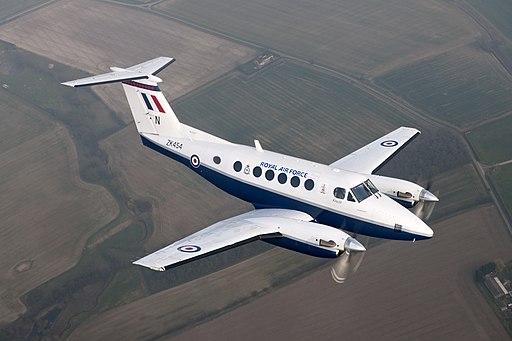
The Beechcraft Super King Air represents a major evolutionary step within the broader King Air lineage, transforming a successful executive turboprop into a higher-performance, pressurized aircraft capable of competing with light jets in certain mission profiles. Developed by Beechcraft during the late 1960s and early 1970s, the Super King Air designation was first applied to the Model 200 series, which introduced significant aerodynamic, structural, and systems enhancements over earlier King Air 90 and 100 variants.
The most visible change was the adoption of a T-tail configuration, which improved longitudinal stability and allowed cleaner airflow over the horizontal stabilizer. The aircraft also featured a lengthened fuselage, increased maximum takeoff weight, and more powerful engines. These refinements shifted the aircraft from a compact executive transport toward a more capable corporate, utility, and government platform. Over time, the Super King Air family expanded to include the 200, 300, and 350 series, each incorporating incremental performance improvements and avionics modernization while maintaining core design principles.
Airframe Architecture and Structural Engineering
The Super King Air features a low-wing monoplane configuration with retractable tricycle landing gear and a distinctive T-tail. The airframe is constructed primarily from aluminum alloys using semi-monocoque structural techniques, ensuring a balance between strength, fatigue resistance, and weight efficiency. Pressurization allows sustained cruise at altitudes up to 35,000 feet (10,668 meters), significantly expanding operational flexibility compared to unpressurized turboprops.
In the widely operated Super King Air 200 variant, overall length measures approximately 43 feet 10 inches (13.36 meters), with a wingspan of 54 feet 6 inches (16.61 meters) and a height of 14 feet 10 inches (4.52 meters). The later 350 variant stretches the fuselage to 46 feet 8 inches (14.22 meters) and extends the wingspan to 57 feet 11 inches (17.65 meters), improving stability and payload capacity. Maximum takeoff weight ranges from about 12,500 pounds (5,670 kilograms) in early 200 models to approximately 15,000 pounds (6,804 kilograms) in the 350 series.
The cabin cross-section is nearly rectangular, maximizing usable interior volume. Executive configurations typically accommodate six to nine passengers, while high-density layouts may seat up to 11 occupants. Large oval windows and sound insulation enhance passenger comfort, while structural reinforcement supports high utilization rates in charter and government operations.
Powerplant and Propulsion Systems
The Super King Air family is powered by two Pratt & Whitney Canada PT6A turboprop engines, widely regarded as among the most reliable turbine engines in aviation. The Model 200 commonly uses PT6A-41 or PT6A-42 engines, each producing approximately 850 shaft horsepower. The 300 series increases output to around 1,050 shaft horsepower per engine with PT6A-60A variants, and similar powerplants equip the 350 models.
These engines drive four-blade or, in modernized versions, five-blade composite propellers with full feathering and reverse thrust capability. The reverse thrust feature enhances short-field landing performance and reduces landing roll distance. Fuel capacity varies by variant but typically exceeds 500 U.S. gallons (1,893 liters), supporting extended-range operations.
The twin-engine configuration provides redundancy and strong climb performance even under single-engine conditions, provided weight and environmental factors are within limits. Automatic propeller feathering systems and engine monitoring instrumentation contribute to operational safety and reduced pilot workload.
Performance Characteristics and Flight Envelope
The Super King Air delivers impressive performance for a turboprop aircraft. In the 350 variant, maximum cruise speed reaches approximately 312 knots (578 km/h), while typical cruise speeds range from 280 to 300 knots (519–556 km/h) depending on altitude and power settings. The service ceiling is approximately 35,000 feet (10,668 meters), allowing operations above most weather systems and commercial traffic flows.
Initial climb rates can exceed 2,500 feet per minute (12.7 m/s) at sea level under standard atmospheric conditions. Range varies with payload and configuration but can surpass 1,800 nautical miles (3,334 kilometers) at long-range cruise settings. Takeoff distance over a 50-foot obstacle is typically around 3,000 to 3,300 feet (914–1,006 meters), and landing distance is approximately 2,700 feet (823 meters), enabling operation from regional airports and shorter runways that are inaccessible to many jets.
Pressurization systems maintain a cabin altitude of approximately 6,000 feet when cruising at 35,000 feet, enhancing passenger comfort during extended flights. De-icing boots on the wings and tail, heated propellers, and engine inlet anti-ice systems enable certified flight into known icing conditions.
Avionics, Systems Integration, and Modernization
Early Super King Air aircraft were equipped with advanced analog instrumentation for their time, but modern variants feature fully integrated glass cockpit avionics suites such as the Collins Pro Line Fusion system. These flight decks incorporate large multifunction displays, synthetic vision technology, digital autopilot systems, satellite-based navigation, and advanced weather radar integration. Touchscreen controls streamline cockpit workflow while maintaining redundancy and reliability.
Flight control systems remain mechanically actuated, providing direct tactile feedback and simplifying maintenance compared to fly-by-wire architectures. Electrical systems include dual generators and multiple bus configurations to ensure redundancy. Environmental control systems regulate cabin temperature and pressurization, while optional auxiliary power units enhance ground operations.
Many earlier aircraft have undergone extensive retrofits, including upgraded avionics, winglets to improve aerodynamic efficiency, and enhanced interior configurations. These modernization efforts have extended the operational lifespan of the fleet and improved fuel efficiency and climb performance.
Operational Versatility and Global Impact
The Super King Air serves in a wide range of roles beyond corporate transport. It is widely used for air ambulance services, aerial survey, maritime patrol, intelligence gathering, and military liaison missions. Several armed forces operate modified versions equipped with surveillance radar, electro-optical sensors, and specialized communications systems. The aircraft’s stability, endurance, and ability to operate from relatively short runways make it particularly valuable for special mission profiles.
Charter operators favor the Super King Air for its balance of speed and operating cost efficiency. Compared to light jets, it consumes less fuel on short routes and can access airports with shorter runways, increasing mission flexibility. Government agencies rely on it for reliability and adaptable cabin configurations.
Enduring Technical Legacy
The Beechcraft Super King Air has maintained continuous production for decades, making it one of the longest-running turboprop aircraft families in aviation history. Its design reflects a philosophy of incremental refinement rather than radical redesign, preserving proven aerodynamics while integrating modern propulsion and avionics technologies.
Technically, the Super King Air represents a mature turboprop platform capable of delivering jet-like cruise speeds with lower operating costs and superior runway flexibility. Its structural durability, turbine reliability, and adaptability to diverse mission profiles ensure its continued relevance in both civil and governmental aviation sectors. The aircraft’s sustained global presence demonstrates how thoughtful engineering and continuous improvement can secure a lasting position in an evolving aerospace landscape.
