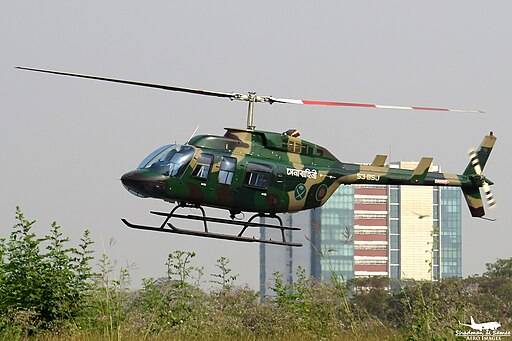
Bell 206
Bell 206: The Iconic Light Helicopter That Defined a Generation
The Bell 206 is one of the most recognized and widely used light utility helicopters in aviation history. Developed by Bell Helicopter, this single-engine rotorcraft has served in both civil and military sectors since its introduction in the late 1960s. Known for its sleek design, reliability, and cost-effectiveness, the Bell 206 became a cornerstone for countless missions around the world—from news reporting and corporate transport to law enforcement, air ambulance services, and military training.
With over 7,300 units built across multiple variants and more than five decades of service, the Bell 206 has achieved legendary status in the rotorcraft community. This article dives into the helicopter’s development, design features, and technical specifications, as well as the reasons for its enduring global popularity.
Origins and Development
The origins of the Bell 206 date back to the early 1960s when Bell Helicopter entered a U.S. Army competition for a new light observation helicopter (LOH). Though Bell’s original design, the YOH-4, lost out to the Hughes OH-6 Cayuse, Bell went on to redevelop the aircraft for the commercial market. The result was the Bell 206A JetRanger, introduced in 1967.
The civilian model was immediately successful due to its clean lines, quiet ride, and excellent flight characteristics. So much so, in fact, that the U.S. Army reconsidered and later adopted a militarized version of the JetRanger as the OH-58 Kiowa.
Over the years, the Bell 206 family expanded into several variants, including the longer 206L LongRanger, multi-engine versions, and the upgraded Bell 206B JetRanger III. The airframe’s legacy continues today in the form of the Bell 505 Jet Ranger X, a clean-sheet design that builds on the heritage of the original 206.
Design Overview
The Bell 206 features a two-blade main rotor and tail rotor system, driven by a single turboshaft engine. Its construction is based on aluminum alloys and composite components, resulting in a lightweight yet durable airframe. The helicopter’s design emphasizes simplicity and maintainability, making it particularly attractive for private owners, operators, and public service agencies.
The JetRanger’s iconic teardrop fuselage not only enhances aerodynamics but also provides excellent visibility from the cockpit, which is especially valuable in observation and reconnaissance roles.
Structural Design Highlights
- Rotor Configuration: Semi-rigid, two-blade teetering rotor system
- Landing Gear: Skid-type landing gear for simple ground operations
- Fuselage: Riveted aluminum alloy with streamlined contours
- Cabin Access: Dual pilot doors and wide passenger doors for easy entry
Dimensions
- Overall Length (rotors turning): 11.84 m (38 ft 10 in)
- Fuselage Length: 9.84 m (32 ft 3 in)
- Main Rotor Diameter: 10.16 m (33 ft 4 in)
- Height: 2.83 m (9 ft 3 in)
- Cabin Width: 1.24 m (4 ft 1 in)
- Cabin Height: 1.28 m (4 ft 2 in)
- Cabin Volume: Approx. 2.0 m³ (70.6 ft³)
Powerplant and Transmission
The Bell 206 is powered by a single turboshaft engine, with several variants utilizing different powerplants over time. These engines are paired with a simple and efficient transmission system that has proven exceptionally reliable in field conditions.
Engine Configurations
- Bell 206A: Allison 250-C18 engine producing 317 shp (236 kW)
- Bell 206B JetRanger II: Allison 250-C20 engine producing 400 shp (298 kW)
- Bell 206B JetRanger III: Allison 250-C20B engine with improved performance and hot/high capability
Transmission System
- Main Transmission Rating: Approximately 317–420 shp
- Tail Rotor Drive: Via a driveshaft running through the tail boom
- FADEC: Not present in original models, though some upgrades exist
Performance Specifications
- Cruise Speed: 220 km/h (137 mph, 119 knots)
- Maximum Speed (Vne): 240 km/h (149 mph, 130 knots)
- Range: 690 km (429 miles, 373 nautical miles)
- Endurance: Approx. 4.0 hours
- Service Ceiling: 4,115 m (13,500 ft)
- Hover Ceiling IGE: 2,870 m (9,400 ft)
- Hover Ceiling OGE: 1,830 m (6,000 ft)
- Rate of Climb: 5.2 m/s (1,020 ft/min)
Weight and Payload
- Empty Weight: 1,040 kg (2,293 lb)
- Maximum Takeoff Weight: 1,451 kg (3,200 lb)
- Useful Load: Approx. 410 kg (900 lb)
- Fuel Capacity: 416 liters (110 US gal)
- Passenger Capacity: Up to 4 passengers plus pilot
Cockpit and Avionics
The Bell 206 was originally equipped with analog instruments, but many aircraft in use today have been upgraded with modern avionics suites. It can be flown single-pilot under VFR, and with the right equipment, under IFR conditions as well.
Typical Avionics Package (Upgraded)
- Digital Attitude Indicator
- GPS/WAAS Navigation Systems
- VHF/UHF Radios
- Transponder with ADS-B Out
- Autopilot (2-axis optional)
- NVG-compatible cockpit
- Synthetic Vision System (in retrofit packages)
Mission Roles and Applications
The Bell 206’s versatility is a major reason for its widespread use across civilian, government, and military sectors. Its reliability, low operating costs, and good flight characteristics make it suitable for a wide range of missions.
Common Applications
- Law Enforcement: Aerial surveillance, patrol, and suspect pursuit
- News Reporting: Aerial filming and traffic updates
- Air Ambulance: EMS configurations for patient transport
- VIP Transport: Corporate and executive shuttles
- Tourism: Scenic flights and adventure tourism
- Flight Training: Primary helicopter trainer for civilian and military use
- Pipeline and Power Line Patrol: Utility sector inspections
- Search and Rescue: Light-duty SAR with basic equipment
Notable Variants
- Bell 206A JetRanger: Original civilian model
- Bell 206B JetRanger II and III: Improved performance and engine reliability
- Bell 206L LongRanger: Stretched fuselage, seating for up to 7
- OH-58A/C/D Kiowa: Military reconnaissance and utility variants
- Agusta-Bell 206: Licensed production in Italy
- Bell 407: A modernized follow-on design with four-blade rotor and upgraded systems
Global Operators
The Bell 206 has seen use in more than 80 countries and by countless private and public organizations. Some key operators include:
- U.S. Border Patrol
- Royal Canadian Mounted Police (RCMP)
- Mexican Navy
- NASA
- Los Angeles Police Department
- Numerous news outlets and tourism companies worldwide
Technical Specifications – Bell 206B JetRanger III
| Parameter | Specification |
|---|---|
| Crew | 1 (pilot) |
| Capacity | Up to 4 passengers |
| Engine | Allison 250-C20B turboshaft |
| Engine Power | 420 shp (derated to 317 shp for gearbox) |
| Main Rotor Diameter | 10.16 m (33 ft 4 in) |
| Rotor System | 2-blade semi-rigid |
| Length (rotors turning) | 11.84 m (38 ft 10 in) |
| Height | 2.83 m (9 ft 3 in) |
| Empty Weight | 1,040 kg (2,293 lb) |
| Max Takeoff Weight | 1,451 kg (3,200 lb) |
| Max Speed | 240 km/h (149 mph) |
| Cruise Speed | 220 km/h (137 mph) |
| Range | 690 km (429 miles) |
| Endurance | 4 hours (approx.) |
| Hover Ceiling OGE | 1,830 m (6,000 ft) |
| Service Ceiling | 4,115 m (13,500 ft) |
Conclusion
The Bell 206 stands as one of the most influential helicopters ever built. Its enduring appeal lies in its blend of simplicity, efficiency, and effectiveness. Whether flying over cities, deserts, forests, or oceans, the JetRanger has proven its worth time and again.
Its legendary status isn’t just about numbers—it’s about the millions of missions flown, the lives saved in medevac roles, the criminals tracked by police helicopters, and the countless pilot careers that began in its cockpit. Even in an era of advanced rotorcraft, the Bell 206 remains a trusted workhorse and a symbol of dependable flight.
.jpg)