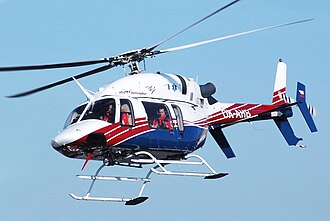
Bell 427 – The Elegant Twin-Engine Helicopter That Bridged Two Generations of Rotary Aviation
The Bell 427 occupies a fascinating and often underestimated place in helicopter history. In an aviation world dominated by legendary aircraft with massive production numbers and decades of military fame, the Bell 427 was something different. It was not designed to become a battlefield icon like the UH-1 Huey, nor was it intended to define an entire era of corporate aviation in the way the Bell 206 JetRanger once did. Instead, the Bell 427 emerged during a transitional period in rotorcraft development, when manufacturers were beginning to blend modern digital design methods, composite materials, advanced avionics, and improved passenger comfort into helicopters that still retained the practical utility and straightforward operation of earlier generations.
At first glance, the Bell 427 may appear to be simply a twin-engine evolution of the successful Bell 407. In reality, the aircraft represented a far more ambitious effort. Bell Helicopter wanted to create a modern light twin-engine helicopter that could serve emergency medical services, law enforcement agencies, executive transport operators, offshore support missions, and utility customers alike. The result was a sleek aircraft with a spacious cabin, refined flying characteristics, and enough flexibility to adapt to a wide range of operational demands.
The helicopter first flew in the late 1990s, entered service in 2000, and remained in production until 2010. Although its production run was relatively short and its total manufacturing numbers remained modest, the Bell 427 played a crucial role in Bell’s evolution toward the later Bell 429 GlobalRanger. In many ways, the 427 served as the technological and conceptual bridge between Bell’s traditional light helicopters and the more sophisticated, globally competitive rotorcraft of the twenty-first century.
Despite being overshadowed commercially by rivals such as the Airbus EC135 and later by Bell’s own Bell 429, the Bell 427 developed a loyal following among pilots and operators. Many crews appreciated its responsive handling, comfortable cabin, and relatively low operating costs for a twin-engine platform. Emergency medical operators valued the aircraft’s accessibility and smooth ride characteristics, while corporate users appreciated its elegant appearance and quieter cabin compared with older helicopter designs.
The story of the Bell 427 is therefore not one of failure or obscurity. It is a story about innovation, experimentation, and the difficult realities of helicopter development in a fiercely competitive market. It also reflects broader trends within the aerospace industry, including globalization, digital engineering, and the changing expectations of helicopter operators around the world.
This article explores the Bell 427 in depth, covering its origins, development, technical innovations, operational roles, pilot impressions, cabin design, market challenges, and long-term legacy. By examining the aircraft from multiple perspectives, it becomes clear that the Bell 427 deserves far more recognition than it usually receives.
The Aviation Environment That Created the Bell 427
The Helicopter Market in the 1990s
To understand the Bell 427 properly, it is necessary to examine the aviation environment in which it was conceived. The 1990s represented a major turning point for helicopter manufacturers. By this period, the basic helicopter market had matured significantly. Aircraft such as the Bell 206, Bell 212, Eurocopter AS350, and Sikorsky S-76 had already established strong reputations. Operators around the world increasingly demanded more capable aircraft with enhanced safety systems, twin-engine redundancy, improved passenger comfort, and reduced pilot workload.
Twin-engine helicopters became especially important for emergency medical services and offshore operations because many regulators and operators viewed them as safer for flights over urban areas, mountains, or water. During this era, the expectation for instrument flight capability also increased dramatically. Customers wanted helicopters that could operate in poor weather conditions while maintaining modern navigation and autopilot systems.
At the same time, technological progress in computer-aided design and composite materials gave manufacturers new opportunities. Helicopter companies could create more aerodynamic airframes, reduce vibration levels, improve rotor efficiency, and optimize cabin layouts more effectively than before. The Bell 427 would become one of the earliest Bell helicopters designed entirely with computer-based methods, symbolizing the company’s move into a new engineering era.
Bell Helicopter’s Need for a Modern Light Twin
Bell Helicopter already possessed enormous experience in single-engine utility helicopters, but the company wanted a stronger presence in the light twin-engine market. Earlier attempts to create a successful twin based on the JetRanger family had produced mixed results. Bell experimented with designs such as the Bell 206LT TwinRanger, but these aircraft did not fully satisfy the evolving market.
Initially, Bell explored the idea of a straightforward twin-engine derivative of the Bell 407 called the Bell 407T. However, engineers eventually concluded that simply attaching another engine to the existing platform would not provide enough improvement in payload, cabin space, or overall capability. The company therefore decided to pursue a more ambitious design.
This decision would ultimately lead to the Bell 427 project. Rather than creating a minimal modification of an existing aircraft, Bell aimed to produce a helicopter that could compete effectively with European rivals while preserving Bell’s well-known operational simplicity.
Development of the Bell 427
International Collaboration
One of the most interesting aspects of the Bell 427 program was its international character. Bell Helicopter partnered with Samsung Aerospace Industries of South Korea, which later became part of Korea Aerospace Industries. This collaboration reflected the increasingly global nature of aerospace manufacturing during the late twentieth century.
The partnership allowed Bell to share development costs while taking advantage of Korean manufacturing capabilities. Major portions of the fuselage and tailboom were produced in South Korea, while final assembly took place in Canada. This multinational production strategy represented an early example of the globally integrated aerospace supply chains that would become standard in later decades.
The Bell 427 therefore stood not only as a helicopter project but also as a symbol of international industrial cooperation. The aircraft’s origins connected North American engineering expertise with Asian manufacturing capacity, creating a truly international rotorcraft.
First Flight and Certification
The Bell 427 made its first flight in December 1997. This milestone marked the beginning of an intensive testing and certification program intended to prove the aircraft’s safety, reliability, and operational effectiveness.
Certification arrived in stages. Canadian certification came first, followed shortly afterward by certification in the United States. Instrument flight rules certification also became available, enhancing the aircraft’s appeal for emergency medical and corporate operators.
For Bell Helicopter, the successful certification of the 427 represented more than the launch of a new aircraft. It demonstrated that the company could still innovate in a rapidly evolving marketplace increasingly influenced by advanced European competitors.
Digital Design and Engineering
The Bell 427 is frequently noted as Bell’s first helicopter designed entirely using computer-aided engineering techniques. This fact may sound ordinary today, but at the time it represented a major leap forward.
Traditional helicopter development often relied heavily on physical mockups, manual drafting methods, and slower iteration cycles. Computer-aided design allowed Bell engineers to optimize aerodynamic surfaces, structural components, and cabin layouts with far greater precision and efficiency.
This digital approach also improved manufacturing consistency and reduced development risks. The Bell 427 thus represented an important technological milestone within Bell Helicopter’s internal engineering culture.
Exterior Design and Aerodynamics
A Modern Appearance
The Bell 427 possessed a noticeably modern appearance compared with many older Bell helicopters. Its smooth fuselage lines, sleek nose profile, and larger cabin gave it a more refined and contemporary visual identity.
The helicopter’s proportions reflected its mission priorities. Unlike purely utility-oriented aircraft with cramped interiors, the Bell 427 emphasized passenger comfort and accessibility. The elongated cabin area immediately distinguished it from the Bell 407.
Even today, the aircraft still appears modern. Its clean aerodynamic form avoids the bulky or awkward appearance that affects some helicopters from the same era.
Rotor System
One of the Bell 427’s most important technical features was its four-blade composite main rotor system. This rotor design was derived from technology used in the Bell 407 and offered significant advantages over older two-blade rotor systems.
Four-blade rotor systems generally reduce vibration levels while improving ride comfort and aerodynamic efficiency. The Bell 427 therefore delivered smoother flight characteristics than many earlier Bell helicopters.
Composite rotor blades also improved durability and corrosion resistance. These materials reduced maintenance requirements while enhancing long-term operational reliability.
The helicopter used a two-blade tail rotor, which provided effective directional control while helping maintain mechanical simplicity.
Cabin Accessibility
The Bell 427 featured large cabin doors and a relatively unobstructed interior design. Bell engineers removed structural elements that had limited cabin flexibility in earlier helicopters.
This approach proved especially valuable for emergency medical missions. Medical crews could access patients more easily, while operators could configure the cabin for stretchers, medical equipment, or executive seating arrangements.
The spacious cabin became one of the aircraft’s strongest selling points.
Engines and Performance
Pratt & Whitney Canada PW207D Engines
Power for the Bell 427 came from two Pratt & Whitney Canada PW207D turboshaft engines. These engines delivered excellent reliability and strong performance for a helicopter of this size class.
The use of twin engines dramatically improved operational safety compared with single-engine helicopters. In the event of one engine failure, the remaining engine could continue providing enough power for controlled flight and safe landing procedures under many operational conditions.
The engines incorporated Full Authority Digital Engine Control technology, commonly known as FADEC. This system automated many engine management tasks and reduced pilot workload. FADEC systems improve engine efficiency while helping prevent operational mistakes.
For pilots transitioning from older helicopters with more manual engine management procedures, the Bell 427 represented a significant modernization.
Speed and Range
The Bell 427 achieved a maximum speed of approximately 259 kilometers per hour, with a practical cruising speed slightly lower than that figure. While not exceptionally fast by helicopter standards, the aircraft delivered respectable performance suitable for medical transport, corporate travel, and law enforcement operations.
Its range of roughly 700 to 730 kilometers allowed operators to perform regional transport missions effectively without excessive refueling requirements.
This balance between speed, range, and operating economy made the Bell 427 attractive for organizations requiring dependable medium-distance transport capability.
Hot and High Operations
Like many light twin helicopters, the Bell 427 faced certain limitations in extremely hot and high operating conditions. High temperatures and high altitudes reduce rotorcraft performance because thinner air decreases lift generation and engine efficiency.
Some operators in mountainous regions therefore preferred more powerful helicopters for demanding environments. Nevertheless, within normal operational parameters, the Bell 427 delivered solid overall performance.
Pilots often praised the helicopter for its responsive handling and predictable flight characteristics, even when operating near its performance envelope.
Cockpit and Avionics
Pilot-Friendly Design
The Bell 427 cockpit reflected Bell Helicopter’s traditional emphasis on pilot-friendly layouts. Controls were arranged logically, visibility was generally excellent, and the aircraft’s handling characteristics inspired confidence among experienced rotorcraft crews.
Bell attempted to create a helicopter that balanced modern systems with manageable operational complexity. The result was an aircraft that felt technologically advanced without becoming intimidating for pilots transitioning from earlier Bell models.
IFR Capability
Instrument Flight Rules capability represented a major selling point for the Bell 427. IFR-certified helicopters can operate more safely in poor weather conditions by relying on instruments and navigation systems rather than purely visual references.
This capability proved especially important for emergency medical services operators, who often conduct missions in difficult weather and at night.
Corporate operators also appreciated IFR certification because it improved schedule reliability and expanded operational flexibility.
Glass Cockpit Evolution
As avionics technology evolved during the 2000s, some Bell 427 aircraft received upgraded glass cockpit systems. Digital displays replaced older analog gauges, improving situational awareness and reducing pilot workload.
These modernization efforts helped keep the Bell 427 relevant even as newer helicopters entered the market.
Passenger Comfort and Cabin Experience
A Spacious Cabin
One of the Bell 427’s defining features was its spacious cabin. Bell designed the interior to accommodate multiple seating arrangements, including executive transport layouts, passenger shuttle configurations, and medical evacuation setups.
Passengers often described the cabin as comfortable and surprisingly roomy for a helicopter in the light twin category. The absence of intrusive structural beams enhanced the sense of space.
The helicopter could typically accommodate one or two pilots plus up to seven passengers depending on the mission configuration.
Corporate Transport Role
The Bell 427 found a niche among corporate operators seeking a helicopter with twin-engine safety and executive-level comfort.
For business travelers, the helicopter offered smooth flight characteristics, modern styling, and enough cabin flexibility to support productive travel. Compared with larger executive helicopters, the Bell 427 also maintained lower operating costs.
Its elegant appearance contributed to its appeal in the corporate market.
Noise and Vibration Reduction
Helicopter comfort depends heavily on vibration and noise levels. Bell engineers worked to reduce both through rotor design improvements and better cabin insulation.
The Bell 427 therefore delivered a noticeably smoother ride than many older light helicopters. Reduced vibration not only improved passenger comfort but also decreased pilot fatigue during long missions.
Emergency Medical Services Operations
A Helicopter Designed for EMS
Emergency medical services represented one of the Bell 427’s primary target markets. Bell designed the helicopter with EMS operations in mind from the beginning.
The aircraft’s cabin dimensions allowed for efficient stretcher placement and easier access to patients compared with smaller helicopters. Medical crews appreciated the ability to work more comfortably around patients during transport.
Twin-engine safety also appealed strongly to EMS providers operating over populated areas.
Competition with the EC135
Despite its strengths, the Bell 427 faced intense competition from the Airbus EC135, which became extremely successful in the air ambulance market.
The EC135 offered a fenestron tail rotor, advanced avionics, and a highly optimized medical cabin configuration. Many EMS operators ultimately selected the European helicopter instead of the Bell 427.
Nevertheless, several organizations continued operating the Bell 427 successfully in medical roles. In countries such as the Czech Republic, the helicopter became a familiar sight in rescue operations.
Operational Reliability
Reliability is critical for emergency medical aviation because mission delays can directly affect patient outcomes.
Operators generally regarded the Bell 427 as dependable and mechanically robust. The Pratt & Whitney engines developed a reputation for reliability, while the helicopter’s systems remained relatively straightforward compared with some more complex rivals.
This dependability helped the aircraft maintain a positive reputation among operators even when market competition intensified.
Law Enforcement and Public Safety Roles
Police Aviation
Law enforcement agencies also found the Bell 427 attractive for surveillance, patrol, and rapid response missions.
The helicopter’s spacious cabin allowed installation of specialized equipment such as cameras, searchlights, communication systems, and tactical gear. Twin-engine safety further increased its appeal for urban operations.
Police pilots appreciated the helicopter’s stable flight characteristics during low-speed observation missions.
Search and Rescue Missions
The Bell 427 also proved useful in search and rescue operations. Its range, cabin flexibility, and hover performance allowed crews to conduct a variety of rescue tasks.
Although not a heavy-lift rescue helicopter, the aircraft performed effectively in regional rescue environments where agility and accessibility mattered more than sheer payload capacity.
Pilot Impressions and Flying Characteristics
Handling and Responsiveness
Pilots frequently described the Bell 427 as enjoyable to fly. The helicopter responded smoothly to control inputs while maintaining predictable stability.
The four-blade rotor system contributed significantly to this positive reputation. Compared with older two-blade helicopters, the Bell 427 offered more refined handling and reduced vibration.
Many pilots transitioning from the Bell 407 found the aircraft relatively intuitive.
Single-Engine Performance
Twin-engine helicopters are often evaluated partly on their ability to continue safe operation after losing one engine.
The Bell 427 delivered respectable single-engine capability for its class, although some operators considered its margins limited in very demanding environmental conditions.
Even so, the aircraft represented a substantial safety improvement over comparable single-engine helicopters for many mission profiles.
Training and Transition
Bell’s effort to preserve familiar control philosophies made the Bell 427 easier for experienced Bell pilots to adopt.
This reduced training complexity and helped operators integrate the helicopter into mixed fleets containing Bell 206 or Bell 407 aircraft.
The Bell 427i and Evolution Toward the Bell 429
Plans for Improvement
Bell recognized that the helicopter market continued evolving rapidly during the early 2000s. To strengthen the Bell 427 platform, the company proposed an upgraded version known as the Bell 427i.
The upgraded model would have included improved avionics, increased cabin size, more powerful engines, and better IFR capability.
Bell collaborated again with Korean partners and additional international companies to pursue the project.
Cancellation of the 427i
Ultimately, Bell decided not to proceed with full production of the 427i. Instead, the company redirected its resources toward the development of an entirely new helicopter: the Bell 429 GlobalRanger.
This decision reflected changing market demands and Bell’s desire to compete more aggressively with European manufacturers.
The Bell 429 incorporated lessons learned from the Bell 427 while introducing more advanced systems, larger dimensions, and improved performance.
The Bell 427 as a Technological Bridge
Although overshadowed by the Bell 429, the Bell 427 played a crucial role in Bell Helicopter’s technological development.
The aircraft served as a testbed for modern rotor systems, digital engineering methods, international manufacturing partnerships, and advanced avionics integration.
Without the Bell 427 program, the later success of the Bell 429 might not have been possible.
Production Numbers and Market Reality
Limited Production
Compared with Bell’s most famous helicopters, the Bell 427 was produced in relatively small numbers. Fewer than one hundred examples were built before production ended around 2010.
This modest production total reflected the difficult realities of the helicopter market rather than any single catastrophic flaw in the aircraft itself.
The Bell 427 entered service during a highly competitive period dominated by strong European products and changing customer expectations.
Why the Aircraft Struggled Commercially
Several factors contributed to the Bell 427’s limited commercial success.
First, the helicopter market increasingly favored aircraft with advanced glass cockpits and highly specialized mission configurations. Competitors such as the EC135 established strong reputations in the EMS sector.
Second, operators often preferred helicopters with larger cabins or greater payload capacity. The Bell 427 occupied an intermediate position that sometimes made it less compelling for customers seeking either maximum economy or maximum capability.
Third, Bell itself eventually focused on the newer Bell 429, which effectively replaced the Bell 427 in the company’s product lineup.
A Better Aircraft Than Its Sales Suggested
Despite limited production numbers, many aviation professionals believe the Bell 427 was a better helicopter than its commercial results implied.
Pilots often praised its flying qualities, while operators appreciated its reliability and maintainability. In some ways, the aircraft became a victim of timing and market competition rather than poor engineering.
This phenomenon is not uncommon in aviation history. Many technically excellent aircraft fail to achieve major commercial success because of broader economic or competitive factors.
Bell 427 in the Czech Republic
Air Rescue Operations
The Bell 427 developed a particularly interesting operational history in the Czech Republic, where it served in emergency medical roles.
Several aircraft operated in helicopter emergency medical services configurations, providing rapid transport for patients and medical personnel.
The helicopter became associated with rescue bases and emergency response operations in multiple regions.
Public Recognition
Because of its EMS role, the Bell 427 became familiar to many Czech citizens. Air ambulance helicopters are often highly visible in public life because they operate during emergencies, accidents, and rescue situations.
The Bell 427 therefore achieved a level of recognition beyond what its global production numbers might suggest.
Operational Lessons
The Czech experience demonstrated both the strengths and challenges of the aircraft in real-world medical operations.
Operators valued its cabin flexibility and smooth ride characteristics, but competition from other helicopter models eventually influenced fleet modernization decisions.
Nevertheless, the Bell 427 left a lasting impression within Czech helicopter rescue aviation.
Maintenance and Operational Economics
Operating Costs
Twin-engine helicopters inevitably cost more to operate than single-engine aircraft because they contain more complex systems, additional engines, and higher maintenance requirements.
However, the Bell 427 aimed to remain economically competitive within the light twin category.
Bell attempted to simplify maintenance procedures where possible, while the Pratt & Whitney engines offered dependable support networks.
Maintenance Accessibility
Operators often praised the Bell 427 for relatively accessible maintenance architecture.
Ease of maintenance is extremely important in helicopter operations because downtime directly affects profitability and mission readiness.
Aircraft that require excessive maintenance hours can quickly become economically unattractive.
Longevity and Continued Service
Even after production ended, many Bell 427 helicopters remained in active service around the world.
The aircraft’s continued operation demonstrates that the helicopter still fulfills useful roles despite newer designs entering the market.
In aviation, longevity often speaks louder than production numbers alone.
Comparing the Bell 427 with Its Rivals
Bell 427 vs Airbus EC135
The Airbus EC135 became one of the Bell 427’s most important competitors.
The EC135 offered advanced avionics, a fenestron tail rotor, and highly optimized EMS capability. European operators especially embraced the aircraft.
However, some pilots preferred the Bell 427’s handling characteristics and simpler systems.
The comparison ultimately reflected different design philosophies. Airbus emphasized technological sophistication and mission specialization, while Bell pursued operational familiarity and balanced versatility.
Bell 427 vs Bell 429
The Bell 429 represented the Bell 427’s direct successor.
The newer helicopter offered increased cabin space, more advanced avionics, greater payload capacity, and stronger overall market positioning.
Nevertheless, the Bell 427 remained lighter and retained certain flying qualities that some pilots continued to admire.
The relationship between the two helicopters illustrates the evolutionary nature of aircraft development.
Bell 427 vs Older Bell Twins
Compared with older Bell twin-engine helicopters such as the TwinRanger, the Bell 427 represented a dramatic leap forward in technology, comfort, and performance.
It introduced modern rotor systems, digital engine controls, and more sophisticated cabin design.
In many respects, the aircraft marked Bell Helicopter’s transition into the modern era.
The Legacy of the Bell 427
A Transitional Aircraft
The Bell 427’s historical significance lies partly in its role as a transitional aircraft.
It bridged the gap between Bell’s traditional utility helicopters and the more advanced rotorcraft that followed.
The helicopter demonstrated Bell’s willingness to experiment with digital engineering, international partnerships, and new market strategies.
Lessons Learned
Every aircraft program teaches valuable lessons, even if production numbers remain modest.
The Bell 427 helped Bell Helicopter refine technologies and concepts later used in the Bell 429.
The program also revealed the growing importance of avionics integration, cabin flexibility, and globalized manufacturing.
Reputation Among Enthusiasts
Among helicopter enthusiasts and professional pilots, the Bell 427 retains a surprisingly positive reputation.
Many regard it as an elegant and underrated aircraft whose qualities were overshadowed by market circumstances.
Its relatively rare status today also contributes to its appeal. Seeing a Bell 427 in operation has become less common than encountering more widely produced helicopters.
Why the Bell 427 Still Matters Today
The Continuing Importance of Light Twins
Light twin-engine helicopters continue playing vital roles in emergency medical transport, law enforcement, corporate aviation, and public safety.
The Bell 427 helped shape expectations for what such helicopters should provide.
Modern aircraft now emphasize exactly the qualities Bell pursued during the 427’s development: safety, comfort, avionics integration, and mission flexibility.
Influence on Future Bell Designs
The Bell 427’s influence can still be seen in later Bell helicopters.
Its cabin philosophy, rotor technology, and design priorities contributed directly to subsequent aircraft generations.
The Bell 429 especially owes much of its conceptual foundation to the Bell 427 program.
Appreciation Over Time
Aircraft reputations often evolve over decades. Some helicopters initially considered commercial disappointments later gain recognition for their technical sophistication or historical importance.
The Bell 427 appears increasingly likely to follow this pattern.
As aviation historians and rotorcraft enthusiasts look back at the late twentieth century, the Bell 427 stands out as an aircraft that represented important industry transitions.
Conclusion
The Bell 427 may never achieve the universal recognition enjoyed by iconic helicopters such as the Bell UH-1 Huey or the Bell 206 JetRanger, yet its importance within rotorcraft history should not be underestimated. The aircraft represented Bell Helicopter’s attempt to redefine its position in the light twin-engine market during a period of intense technological and competitive change.
From its internationally collaborative development process to its digitally engineered design philosophy, the Bell 427 embodied the modernization of helicopter manufacturing at the turn of the century. Its spacious cabin, smooth rotor system, twin-engine safety, and operational versatility demonstrated Bell’s commitment to evolving beyond traditional utility helicopter concepts.
Although commercial competition limited its production numbers, the Bell 427 succeeded in proving that Bell could create a modern helicopter capable of meeting the growing expectations of emergency medical providers, corporate operators, and public safety agencies. The aircraft also served as a crucial stepping stone toward the later Bell 429, which inherited and expanded many of the ideas first explored in the 427 program.
Perhaps the Bell 427’s greatest legacy lies in its balance. It balanced traditional Bell flying qualities with modern avionics. It balanced operational practicality with passenger comfort. It balanced proven engineering concepts with experimental innovation. In doing so, it captured a unique moment in aviation history when helicopter manufacturers around the world were transitioning into a new technological era.
Today, the Bell 427 remains respected by many pilots and operators who appreciate its elegant handling, dependable engines, and refined cabin environment. It may not have dominated the market, but it earned something arguably more enduring: admiration from the professionals who flew and maintained it.
In the end, the Bell 427 was not simply a helicopter. It was a bridge between generations of rotary-wing aviation.
Technical Parameters of the Bell 427
| Parameter | Bell 427 Specification |
|---|---|
| Manufacturer | Bell Helicopter / Samsung Aerospace Industries |
| Helicopter Type | Light twin-engine utility helicopter |
| First Flight | December 11, 1997 |
| Introduction Into Service | 2000 |
| Production Period | 1997–2010 |
| Crew | 1–2 pilots |
| Passenger Capacity | Up to 7 passengers |
| Length | Approx. 11.42 m |
| Overall Length with Rotors | Approx. 12.99 m |
| Height | Approx. 3.2 m |
| Main Rotor Diameter | 11.28 m |
| Tail Rotor Type | Two-blade tail rotor |
| Main Rotor Type | Four-blade composite rotor |
| Empty Weight | Approx. 1,760 kg |
| Maximum Takeoff Weight | Approx. 2,970 kg |
| Engines | 2 × Pratt & Whitney Canada PW207D |
| Engine Power | Approx. 710 shp each |
| Maximum Speed | Approx. 259 km/h |
| Cruising Speed | Approx. 220–222 km/h |
| Range | Approx. 700–730 km |
| Service Ceiling | Approx. 3,048 m |
| Climb Rate | Approx. 10.2 m/s |
| Avionics | IFR-capable, optional glass cockpit |
| Typical Roles | EMS, corporate transport, police, utility, rescue |
| Successor | Bell 429 GlobalRanger |
