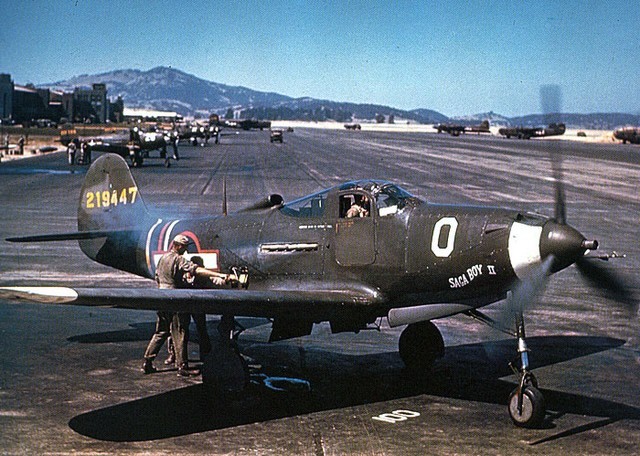
The Bell P-39 Airacobra stands as one of the most unconventional and controversial fighter aircraft of the Second World War. Designed by Bell Aircraft, the P-39 broke with nearly every established design convention of its era. While many fighters followed a predictable layout—engine in the nose, pilot behind, guns mounted in the wings—the Airacobra introduced radical changes that made it both innovative and polarizing among pilots and historians alike.
What makes the P-39 particularly fascinating is not just its unusual engineering, but the stark contrast in how it was perceived by different air forces. In Western Allied service, especially with the United States and the United Kingdom, it was often criticized for poor high-altitude performance. Yet on the Eastern Front, in the hands of Soviet pilots, it became a highly effective and respected fighter, contributing significantly to aerial victories against German forces.
This duality—technological boldness paired with situational effectiveness—makes the Airacobra an aircraft worth studying in depth. It represents both the risks and rewards of innovation in wartime aviation.
Historical Background and Development Origins
The origins of the P-39 can be traced back to the late 1930s, when the United States Army Air Corps sought a new generation of fighter aircraft capable of outperforming existing designs. The requirement emphasized speed, firepower, and advanced aerodynamics, pushing manufacturers to explore unconventional solutions.
Bell Aircraft responded with a design that was radically different from its competitors. Instead of placing the engine in the nose, Bell engineers moved it behind the pilot, near the center of gravity. This configuration allowed for a streamlined nose housing a powerful cannon, while also improving balance and maneuverability.
The prototype, designated XP-39, first flew in 1938. Early testing showed promise, particularly in terms of speed and handling. However, a critical decision during development would shape the aircraft’s future: the removal of its turbo-supercharger.
Originally designed for high-altitude performance, the XP-39 featured a turbo-supercharged engine that allowed it to maintain power at altitude. However, due to cost, complexity, and perceived operational priorities, the turbo-supercharger was removed in production models. This decision significantly reduced the aircraft’s effectiveness at higher altitudes, limiting its role primarily to low- and medium-altitude combat.
Despite this limitation, the P-39 entered production and saw widespread use, particularly through the Lend-Lease program, which supplied aircraft to Allied nations.
Revolutionary Design Philosophy
The most striking feature of the P-39 Airacobra is its unconventional layout. By placing the engine behind the pilot, Bell engineers created a configuration that offered several advantages but also introduced unique challenges.
The engine, a Allison V-1710 engine, was mounted in the fuselage behind the cockpit and connected to the propeller via a long driveshaft running beneath the pilot’s seat. This arrangement allowed for a streamlined nose, which housed a 37 mm cannon firing through the propeller hub—a feature rarely seen in Western fighters of the time.
The mid-engine configuration also improved weight distribution, enhancing maneuverability and reducing the moment of inertia. This made the aircraft particularly responsive in turns and well-suited for dogfighting at lower altitudes.
Another unusual feature was the use of automobile-style side doors instead of a traditional sliding canopy. This design choice made entry and exit easier, especially on the ground, but raised concerns about emergency egress in combat situations.
The tricycle landing gear was another innovation. Unlike the tail-dragger configuration common in most aircraft of the era, the P-39’s nose wheel improved ground handling and visibility during taxiing, takeoff, and landing. This feature would later become standard in many post-war aircraft.
Aerodynamics and Flight Characteristics
Aerodynamically, the P-39 was a clean and efficient design. Its low-wing monoplane configuration minimized drag and provided a solid platform for high-speed flight. The absence of wing-mounted armament further reduced drag, as all major weapons were concentrated in the nose.
At low and medium altitudes, the aircraft performed admirably. It was fast, agile, and capable of tight turns, making it a formidable opponent in dogfights. The centralized mass contributed to excellent roll rates and quick directional changes.
However, the lack of a turbo-supercharger severely limited its high-altitude performance. As altitude increased, engine power dropped significantly, reducing speed and climb rate. This made the P-39 less effective in high-altitude interception roles, where other fighters such as the P-51 Mustang and P-47 Thunderbolt excelled.
Another characteristic of the Airacobra was its tendency toward instability in certain flight conditions. The rear-mounted engine could cause a shift in the center of gravity, particularly as fuel was consumed. This sometimes led to dangerous spin behavior, requiring careful handling by experienced pilots.
Armament and Firepower
One of the defining features of the P-39 Airacobra was its heavy and concentrated armament. At the heart of its offensive capability was a 37 mm cannon mounted in the nose, firing through the propeller hub. This weapon was capable of delivering devastating blows to enemy aircraft, often destroying them with just a few hits.
In addition to the cannon, the aircraft was equipped with machine guns mounted in the nose and wings, depending on the variant. This combination of weapons provided a powerful mix of high-explosive and rapid-fire capabilities, making the P-39 particularly effective against both aircraft and ground targets.
The centralized placement of the armament improved accuracy, as all weapons were aligned with the pilot’s line of sight. This eliminated the need for convergence adjustments required in wing-mounted gun systems.
The P-39’s firepower made it especially useful in ground-attack roles, where its cannon could be used to destroy armored vehicles and fortified positions. This versatility contributed to its success in certain theaters of operation.
Operational Use in the United States and United Kingdom
In U.S. service, the P-39 was initially deployed as a frontline fighter but quickly revealed its limitations. Its poor high-altitude performance made it unsuitable for escorting bombers or engaging enemy aircraft operating at higher altitudes.
As a result, the aircraft was gradually relegated to secondary roles, including ground attack and training. Some units continued to use it effectively at lower altitudes, but it was largely overshadowed by more capable fighters.
The United Kingdom also received P-39s early in the war but found them unsatisfactory for European combat conditions. The Royal Air Force required fighters capable of high-altitude interception, and the Airacobra’s limitations made it unsuitable for this role. Consequently, many British P-39s were reassigned or transferred to other Allied forces.
Success on the Eastern Front
While the P-39 struggled in Western Allied service, it found a new life with the Soviet Union. Through the Lend-Lease program, thousands of Airacobras were delivered to Soviet forces, where they became one of the most successful fighters in Soviet service.
The nature of air combat on the Eastern Front played to the P-39’s strengths. Engagements often occurred at lower altitudes, where the aircraft’s performance was optimal. Soviet pilots appreciated its speed, maneuverability, and heavy armament, using it effectively in both air-to-air combat and ground attack missions.
Several Soviet aces achieved significant success flying the P-39, including some of the highest-scoring Allied pilots of the war. The aircraft’s ability to deliver powerful cannon strikes made it particularly effective against German aircraft, including bombers and fighters.
The Soviet experience with the P-39 highlights the importance of matching aircraft capabilities to operational environments. While it was considered inadequate in one context, it excelled in another.
Variants and Production Evolution
The P-39 underwent numerous modifications during its production run, resulting in several variants with different configurations and capabilities. Early models focused on refining the basic design, while later versions incorporated improvements in armament, armor, and avionics.
Variants such as the P-39D and P-39N introduced changes to weight distribution and fuel capacity, addressing some of the aircraft’s handling issues. The P-39Q, one of the most widely produced versions, featured simplified armament and improved reliability.
Production of the P-39 exceeded 9,500 units, making it one of the most widely built American fighters of the war. Its widespread use across multiple theaters and air forces underscores its versatility and adaptability.
Engineering Challenges and Lessons Learned
The P-39 Airacobra presented engineers with a range of challenges, many of which stemmed from its unconventional design. The mid-engine configuration required careful management of weight distribution and structural integrity, particularly with the long driveshaft connecting the engine to the propeller.
Cooling the rear-mounted engine also posed difficulties, requiring innovative solutions to ensure adequate airflow and temperature control. Additionally, the absence of a turbo-supercharger highlighted the trade-offs between complexity and performance.
Despite these challenges, the P-39 provided valuable lessons for future aircraft design. Its innovations, such as tricycle landing gear and centralized armament, influenced subsequent generations of aircraft.
Legacy and Historical Significance
The legacy of the P-39 Airacobra is one of innovation, adaptation, and controversy. It was an aircraft that dared to challenge conventional design principles, resulting in both successes and shortcomings.
While it may not have achieved universal acclaim, its impact on aviation history is undeniable. It demonstrated the potential of unconventional layouts and highlighted the importance of aligning design choices with operational requirements.
Perhaps most importantly, the P-39’s success in Soviet service underscores the idea that an aircraft’s effectiveness cannot be judged in isolation. Context matters, and the Airacobra proved that even a flawed design can excel under the right conditions.
Technical Parameters Table
| Parameter | Value |
|---|---|
| Manufacturer | Bell Aircraft |
| Role | Fighter / Ground-attack aircraft |
| Crew | 1 |
| Length | 9.19 m |
| Wingspan | 10.36 m |
| Height | 3.61 m |
| Empty Weight | ~2,550 kg |
| Maximum Takeoff Weight | ~3,800 kg |
| Engine | Allison V-1710 V12 |
| Power Output | ~1,200 hp |
| Maximum Speed | ~620 km/h |
| Cruise Speed | ~550 km/h |
| Range | ~840 km |
| Service Ceiling | ~10,700 m |
| Rate of Climb | ~16 m/s |
| Armament | 37 mm cannon, machine guns |
| Landing Gear | Tricycle (retractable) |
| Special Features | Mid-engine layout, driveshaft propulsion, nose cannon |