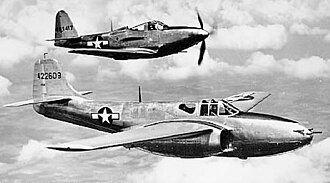
Bell P-59 Airacomet — America’s First Jet Fighter That Wasn’t Quite a Fighter
When people think about the dawn of jet-powered aviation, names like the Messerschmitt Me 262 or the Gloster Meteor often dominate the conversation. Yet, across the Atlantic, the United States was quietly conducting its own revolutionary experiments in propulsion—efforts that culminated in the creation of the Bell P-59 Airacomet.
The P-59 Airacomet holds a unique place in aviation history: it was the first American jet aircraft to fly. However, despite its pioneering status, it never saw combat and is often overshadowed by more successful successors. Its story is not one of battlefield glory, but of technological transition, experimentation, and the steep learning curve associated with an entirely new era of flight.
This article explores the Bell P-59 Airacomet in depth—its origins, development challenges, design features, operational history, and technical specifications—offering a comprehensive view of one of the most important yet underappreciated aircraft in aviation history.
The Context: The Race to Jet Propulsion
By the late 1930s, aviation had reached a plateau in piston-engine performance. Engineers were pushing propeller-driven aircraft to their limits, encountering barriers such as compressibility effects and diminishing returns in speed and altitude.
Meanwhile, revolutionary work was being done in jet propulsion. In the United Kingdom, Frank Whittle had developed one of the first practical turbojet engines. In Germany, Hans von Ohain was independently pursuing similar concepts.
The United States initially lagged behind in jet engine development. Recognizing this gap, the U.S. government collaborated with the British to license Whittle’s engine technology. This cooperation would prove crucial in accelerating America’s entry into the jet age.
The Birth of the Airacomet
The development of the P-59 began in 1941 under extreme secrecy. The U.S. Army Air Forces (USAAF) approached Bell Aircraft—a company known for unconventional designs, including the Bell P-39 Airacobra.
Bell was chosen partly because it was not heavily involved in large-scale production at the time, allowing it to focus on experimental work without disrupting other programs.
Project XP-59A
The project was initially designated XP-59A. Interestingly, the designation was intentionally misleading—it reused a previously canceled propeller aircraft designation to obscure the true nature of the program.
The first prototype flew on October 1, 1942, at Muroc Army Air Field (now Edwards Air Force Base). The flight marked a historic milestone: the United States had officially entered the jet age.
Design Philosophy and Configuration
The Bell P-59 Airacomet featured a relatively straightforward design, reflecting the experimental nature of early jet aircraft.
Airframe Layout
- Configuration: Straight-wing, mid-mounted design
- Engines: Twin turbojets mounted in the wing roots
- Landing Gear: Tricycle arrangement (still relatively novel at the time)
The twin-engine configuration was chosen for redundancy, as early jet engines were notoriously unreliable.
Powerplant
The P-59 was powered by two General Electric J31 turbojet engines, derived from Whittle’s design.
These engines produced approximately 1,650 pounds of thrust each, which was modest even by early jet standards. Compared to piston engines, they offered smoother operation but significantly lower thrust-to-weight ratios.
Engineering Challenges
The Airacomet was a technological leap, but it came with numerous challenges.
1. Engine Reliability
Early turbojets were plagued by:
- Frequent mechanical failures
- Short operational lifespans
- Poor throttle response
Pilots had to adapt to slow acceleration and lag between throttle input and engine response—characteristics unfamiliar to those accustomed to piston engines.
2. Aerodynamic Limitations
Unlike later jet aircraft, the P-59 used straight wings rather than swept wings. This limited its high-speed performance due to compressibility effects.
3. Performance Shortcomings
Despite being a jet, the P-59 was not significantly faster than contemporary piston fighters like the North American P-51 Mustang.
This was a critical drawback, as speed was one of the primary advantages expected from jet propulsion.
Flight Characteristics
Pilots described the P-59 as:
- Stable but underpowered
- Easy to fly but uninspiring
- Slow to accelerate
Its handling characteristics were generally forgiving, making it useful as a training platform for jet operations.
However, its lack of performance meant it was unsuitable for combat roles.
Operational History
Testing and Evaluation
The P-59 was primarily used for testing and evaluation. It provided invaluable data on:
- Jet engine behavior
- High-speed aerodynamics
- Pilot training requirements
Training Role
Although it never saw combat, the P-59 played a crucial role in preparing American pilots for the jet age. It served as a stepping stone to more advanced aircraft like the Lockheed P-80 Shooting Star.
Limited Production
A total of 66 P-59 aircraft were built, including prototypes and production models.
These were designated:
- XP-59A (prototypes)
- YP-59A (pre-production)
- P-59A (production)
Comparison with Contemporary Aircraft
When compared to its contemporaries, the P-59 fell short in several areas:
| Aircraft | Top Speed | Role | Outcome |
|---|---|---|---|
| P-59 Airacomet | ~660 km/h | Experimental | Training only |
| Me 262 | ~870 km/h | Fighter | Combat success |
| Gloster Meteor | ~670 km/h | Fighter | Combat deployment |
The P-59’s relatively low speed and climb rate made it obsolete even before it entered service.
Technological Contributions
Despite its shortcomings, the P-59 was immensely valuable.
1. Jet Engine Development
The Airacomet helped refine early turbojet technology in the United States.
2. Pilot Training
It introduced American pilots to:
- Jet handling characteristics
- New cockpit instrumentation
- Different flight dynamics
3. Design Evolution
Lessons learned from the P-59 directly influenced the development of more advanced aircraft, particularly the P-80.
Why the P-59 Failed as a Fighter
The P-59’s failure as a combat aircraft can be attributed to several factors:
Underpowered Engines
The J31 engines simply did not provide enough thrust.
Rapid Technological Progress
Jet technology was advancing rapidly, and the P-59 was quickly outpaced by newer designs.
Conservative Design Choices
The use of straight wings and a conventional layout limited its performance potential.
The Transition to the P-80
The shortcomings of the P-59 led to the rapid development of the Lockheed P-80 Shooting Star, which featured:
- More powerful engines
- Improved aerodynamics
- Superior performance
The P-80 would go on to become America’s first operational jet fighter.
Legacy of the Airacomet
While it never achieved combat success, the P-59’s legacy is profound.
A Technological Pioneer
It marked the beginning of America’s jet aviation program.
A Learning Platform
It provided critical experience that shaped future aircraft design.
A Historical Milestone
The P-59 represents the transitional phase between piston and jet propulsion.
Surviving Aircraft
Several P-59 Airacomets are preserved in museums today, serving as reminders of this important chapter in aviation history.
These aircraft offer insight into the early days of jet propulsion and the challenges faced by engineers and pilots alike.
Conclusion
The Bell P-59 Airacomet may not have been a successful fighter, but it was never truly meant to be. Its real mission was to bridge the gap between two eras of aviation—to take the United States from the age of propellers into the age of jets.
In that role, it succeeded brilliantly.
The Airacomet taught engineers how to design jet aircraft, trained pilots to fly them, and laid the groundwork for the powerful, high-speed jets that would dominate the skies in the decades to come.
Its story is a reminder that progress is often built on imperfect beginnings—and that even the most unremarkable machines can have extraordinary impact.
Technical Specifications — Bell P-59 Airacomet
| Parameter | Value |
|---|---|
| Manufacturer | Bell Aircraft |
| Role | Experimental / Training Jet Fighter |
| First Flight | October 1, 1942 |
| Crew | 1 |
| Length | 11.61 m |
| Wingspan | 13.87 m |
| Height | 3.65 m |
| Wing Area | 35.8 m² |
| Empty Weight | 3,190 kg |
| Maximum Takeoff Weight | 6,256 kg |
| Powerplant | 2 × General Electric J31 turbojets |
| Thrust (each) | ~1,650 lbf (7.3 kN) |
| Maximum Speed | ~660 km/h |
| Range | ~386 km |
| Service Ceiling | 13,700 m |
| Rate of Climb | ~14 m/s |
| Armament | 1 × 37 mm cannon, 3 × .50 caliber machine guns |
| Production Number | 66 aircraft |
